


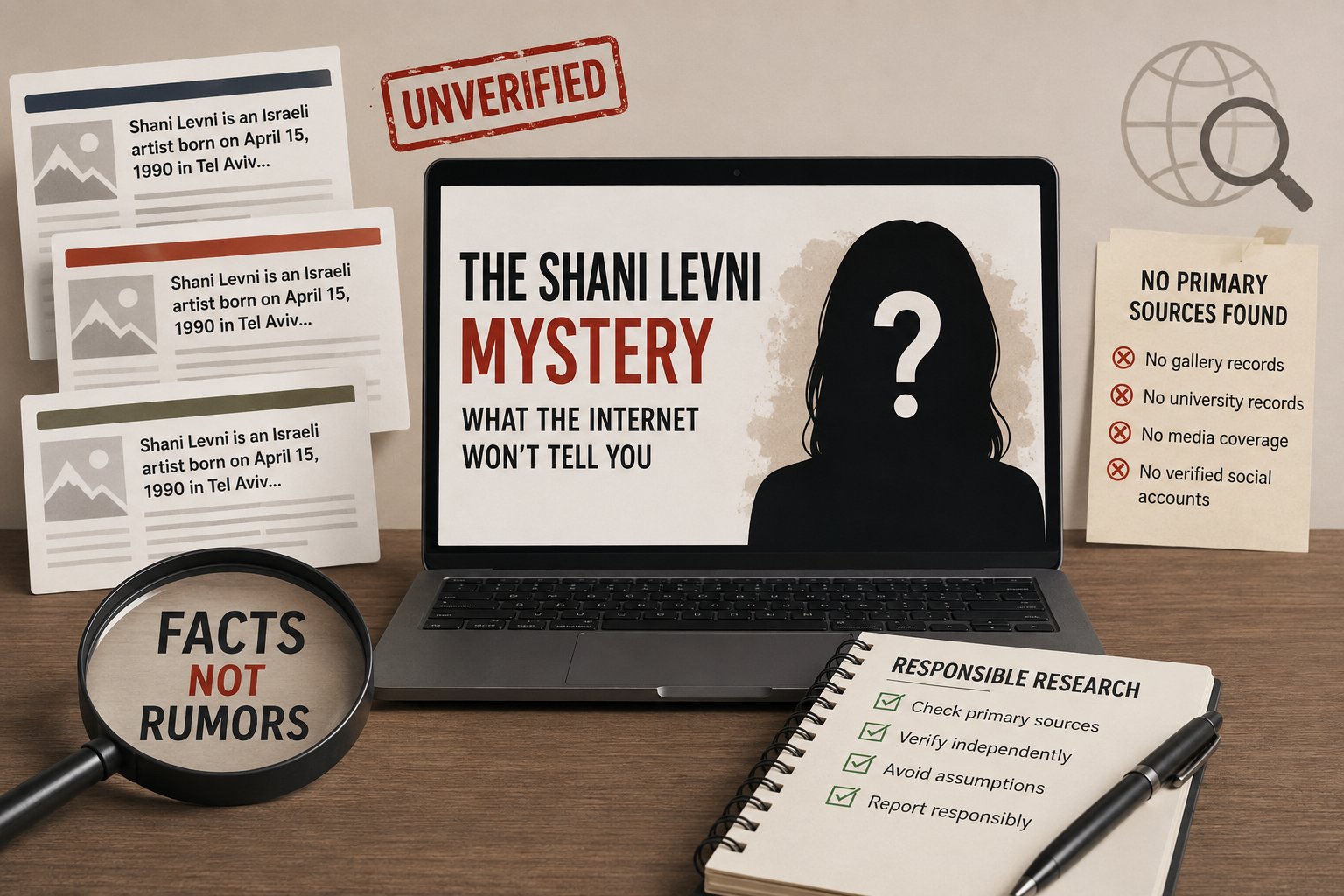
If you have searched for “Shani Levni” recently, you have probably noticed something strange. Dozens of articles describe her the same way: an Israeli multidisciplinary artist born in Tel Aviv on April 15, 1990, trained at the Bezalel Academy of Arts and Design, later earning a master’s degree in Berlin, exhibiting at respected venues, and running a nonprofit that supports refugee youth through creative work. The story reads well. It has warmth, detail, and the kind of specificity that usually signals a real, well-documented biography.
There is just one problem. None of it traces back to a primary source.
This article does not repeat that biography as fact. Instead, it looks at what is actually known about the name Shani Levni, why so many nearly identical write-ups exist, and what that pattern says about how information spreads online today. If you came here looking for a straightforward artist profile, you will leave with something more useful: a clear picture of what can and cannot be confirmed, and why that distinction matters.
The Pattern Behind the Name
Search results for this keyword share an unusual trait. Article after article uses the same birth date, the same two schools, the same list of exhibition venues, and the same charitable initiative name. Normally, when a person has that level of documented biographical detail, you can find at least one anchor point outside of blog content — a museum press release, a university alumni record, a gallery listing, a news interview, a verified social media account. For Shani Levni, that anchor point does not surface. What surfaces instead is a chain of articles that appear to paraphrase one another, each adding slightly different wording around the same core claims.
This is a recognizable pattern in modern web publishing. A biography-shaped piece of content gets produced, often to fill out a website’s topical coverage or to capture search traffic around a name that is trending for reasons unrelated to the claimed profession. Other sites then produce their own “unique” version by rewording the same facts, without independently checking whether those facts are true. Search engines see many pages repeating the same information and can mistake repetition for confirmation — a dynamic Google’s own Search Central guidance on helpful content explicitly warns publishers against contributing to. Readers do the same thing. The result is a biography that feels solid because it is everywhere, even though “everywhere” and “verified” are not the same thing.
We cover this exact dynamic — search demand outpacing verified information — in more detail in our guide on researching trending names responsibly, which is worth a read if you write about people online.
What Actually Ties the Name to Public Interest
Where the trail becomes more grounded is in why the name is being searched at all. Some of the more careful write-ups on this subject note that interest in Shani Levni is connected to a loose, celebrity-adjacent association with Israeli actor Michael Aloni, rather than to a documented independent art career. That single thread — a name search driven by proximity to a public figure — is a far more common and far more explainable phenomenon than a fully formed, internationally exhibited art career with no primary coverage anywhere. It is the kind of situation search platforms see constantly: a private individual’s name becomes searchable because of an association, and content producers rush to fill the resulting demand with whatever biography-style content will rank, whether or not it is accurate.
This matters for a simple reason. If Shani Levin is a real private person, publishing an invented professional history under her name — complete with a specific birthday, named institutions, and a named nonprofit — is not a neutral act. It can misrepresent a real individual, and it can make it harder for anyone trying to find accurate information about her to separate fact from filler. Privacy researchers at the Electronic Frontier Foundation have written extensively about how private individuals get pulled into public search results simply through association with a public figure, which is a useful frame for understanding cases like this one.
If this raises broader questions for you about how names attached to celebrities end up with fabricated backstories, see our related post on celebrity-adjacent search trends for more examples.
Why “Consistent” Content Isn’t the Same as “Confirmed” Content
It is worth spending a moment on why repetition creates false confidence. When five, ten, or twenty websites describe the same birth date and the same art school, most readers reasonably assume that level of agreement could not exist unless it were true. But content about trending names is often produced quickly, and once one early piece establishes a set of “facts,” later writers commonly treat that earlier piece as their source material rather than doing independent verification. Each new article is technically “unique” in its sentence structure while being biographically identical to the one before it. That is precisely what appears to have happened here — a distinctive, emotionally engaging backstory got established early, and it has been recycled with cosmetic changes ever since.
This is also why professional fact-checking standards, and outlets like Reuters and AP Fact Check, always look for a primary source — a direct statement, an official record, an original interview — rather than counting how many secondary sites agree with each other. The volume of repetition is not evidence. It is simply a sign that something has been copied successfully.
What Responsible Coverage Looks Like Here
The honest and useful version of an article about this keyword does three things. First, it tells readers plainly that the widely circulated biography has not been independently verified through galleries, universities, media archives, or the nonprofit sector it claims to involve. Second, it explains the more grounded reason the name is being searched, so readers are not left more confused than when they arrived. Third, it avoids adding yet another confidently worded, fact-shaped article to the pile — because that is exactly how this kind of unverified content problem grows in the first place.
If you are researching this name for a specific reason — due diligence, journalism, curiosity about a public figure’s associates, or simple fact-checking — the right next step is to look for primary documentation directly: exhibition catalogs from named institutions, official alumni or faculty records from the schools mentioned, or a verified social account. The International Fact-Checking Network publishes a useful checklist for exactly this kind of verification process. Absent primary confirmation, the responsible conclusion is that the current public record is thin, repetitive, and largely unconfirmed.
For readers interested in how this kind of online biography pattern forms more broadly, our related piece on how misinformation spreads through repeated content walks through similar cases in more depth, and is a useful companion to this article. You may also want to read our breakdown of how to fact-check an online biography in five steps, which applies directly to cases like this one.
Final Thought
Not every trending name has a documented story behind it, and treating repetition as proof is one of the easiest mistakes to make when researching someone online. The most useful thing this article can offer is not a polished but unverifiable biography — it is clarity about what is actually known, what is not, and why that gap exists in the first place. If verified information about Shani Levni becomes available through primary sources, it deserves an update built on that record, not on the version that simply got repeated the most.
Frequently Asked Questions
Is Shani Levni a real person? The name is real in the sense that it appears consistently across multiple sources tied to a specific context — a loose association with actor Michael Aloni. Whether the detailed art-career biography attached to the name is accurate is a separate question, and that part remains unverified.
Where does the widely repeated biography come from? It appears to have originated in one or a small number of early articles and been reworded by later sites, rather than being independently sourced from institutions or media that would normally document a public artistic career.
Is there any official confirmation of her exhibitions or education? No primary confirmation — such as an official gallery record, university listing, or verified interview — has surfaced alongside the repeated claims. That absence is the main reason for treating the biography with caution.
Why do so many websites describe her the same way if it isn’t confirmed? Search-driven content production often works by rewording existing articles rather than independently researching a subject. When one version of a story ranks well, others tend to imitate its structure and facts, which creates an illusion of consensus.
What should I do if I need accurate information about this name? Look for primary sources directly connected to the claims — the named academic institutions, exhibition venues, or the nonprofit mentioned — rather than relying on secondary blog coverage, which tends to recycle the same unverified details.
