

If you’ve spent any time around a marketing team, you’ve probably heard “digital marketing” and “social media marketing” used as if they mean the same thing. A client asks for “more digital marketing” and somehow the conversation ends up being entirely about Instagram reels. It’s an easy mix-up, but the two aren’t interchangeable, and understanding where one ends and the other begins can save a business from putting its entire budget into one channel while ignoring five others that might convert better.
This article breaks down what each term actually means, how they overlap, where they diverge, and how a business — whether it’s a two-person startup or an established brand — should think about allocating time and money between the two.
What Digital Marketing Really Covers
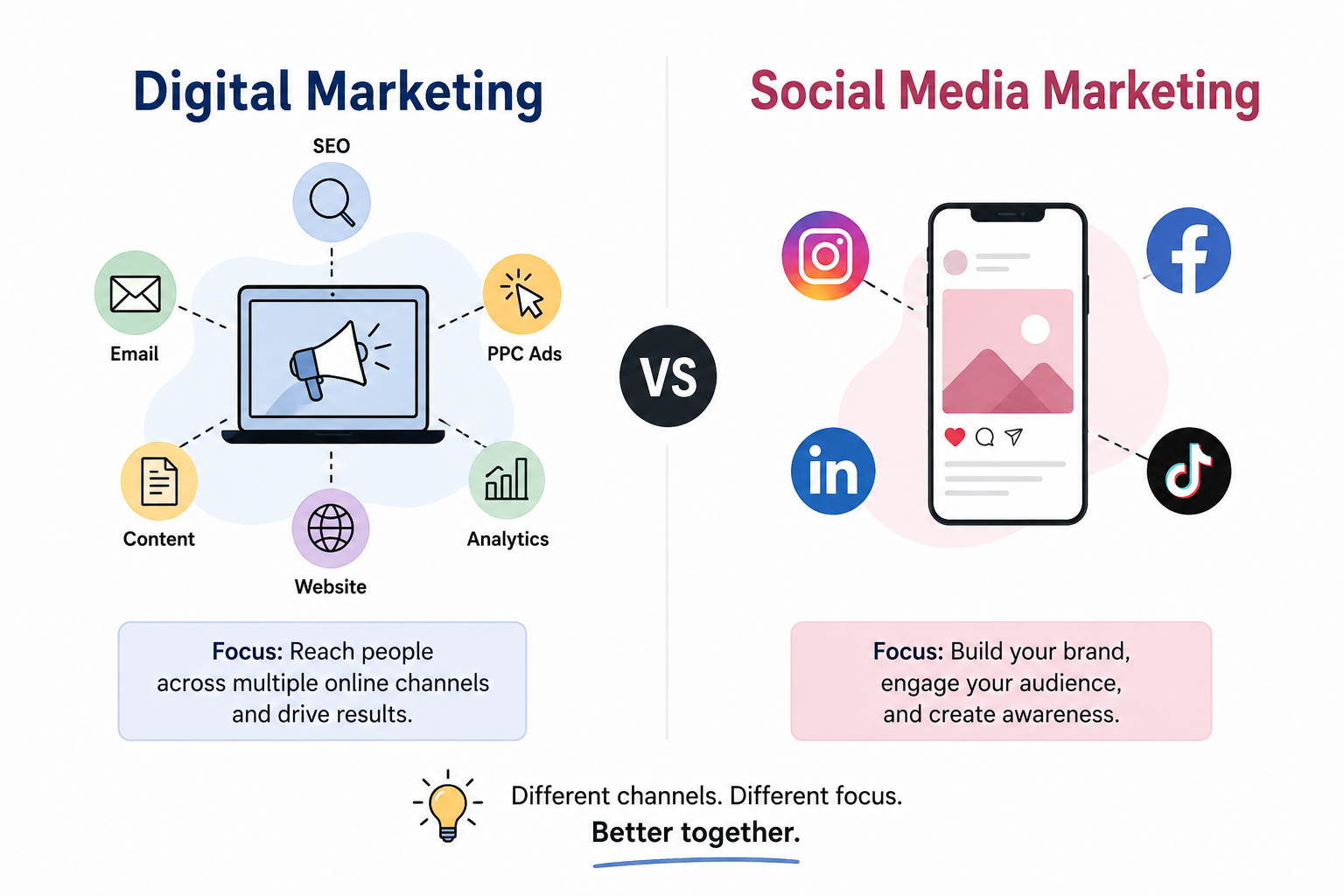
Digital marketing is the umbrella term. It refers to any marketing effort that uses the internet or a digital device to reach an audience. That’s a wide net. It includes:
Search engine optimization, where a business works to rank higher on Google for terms people are already searching for. Pay-per-click advertising, where ads run on search engines or display networks and the advertiser pays only when someone clicks. Email marketing, which remains one of the highest-ROI channels because it reaches people who’ve already opted in. Content marketing, meaning blog posts, guides, videos, and downloadable resources built to educate and eventually convert an audience. Affiliate and influencer partnerships, mobile app marketing, and even the retargeting ads that follow you around the web after you’ve looked at a pair of shoes online.
Social media marketing is one piece of this larger picture, not a separate discipline sitting outside it. That distinction matters because when a business says “we do digital marketing,” it should mean a coordinated strategy across search, email, content, and paid channels — not a single Facebook page updated twice a month.
What Social Media Marketing Actually Means
Social media marketing is narrower and more specific. It’s the practice of building a brand’s presence and driving engagement on platforms like Instagram, Facebook, LinkedIn, TikTok, and X. It includes organic posting, community management, influencer collaborations, and paid social ads that run natively inside those platforms.
What makes social media marketing distinct is the environment it operates in. People aren’t on Instagram looking for a specific product the way they’re on Google searching “best running shoes for flat feet.” They’re scrolling, browsing, and discovering. That changes the entire approach — content has to interrupt attention and feel native to the platform, rather than answer a direct query the way an SEO-optimized blog post does.
The Real Differences Between the Two
Intent vs. Discovery
This is probably the sharpest line between the two. Search-driven digital marketing (SEO and PPC) targets people who already have a need and are actively looking for a solution. Someone typing “affordable web designer near me” into Google has intent baked into the search itself. Social media marketing works the opposite way — it creates demand rather than capturing it. A well-made video might introduce someone to a product they didn’t know they needed, but it’s rarely answering an active search.
Channel Breadth
Digital marketing spans search engines, websites, email inboxes, mobile apps, and even offline-adjacent tools like digital signage or QR codes on print materials. Social media marketing lives entirely within the walls of individual platforms, and each of those platforms has its own algorithm, content format, and audience behavior that a brand has to learn separately.
Communication Style
A lot of traditional digital marketing, like an email newsletter or a landing page, is one-directional. The brand sends the message, and the user either converts or doesn’t. Social media flips that dynamic into something closer to a conversation — comments, shares, direct messages, and duets all mean the audience is talking back in real time, and a brand’s response (or lack of one) becomes part of the public record.
Measurement and Funnel Position
Digital marketing as a whole is usually judged across the entire funnel, from first click to final sale, using tools like Google Analytics or CRM attribution reports. Social media marketing goals tend to sit higher up that funnel — brand awareness, engagement rate, follower growth, share of voice — though performance-driven social ads can absolutely be tied to direct conversions too.
Cost Structure
SEO takes time and consistent content investment before it pays off, PPC costs scale with competition for keywords, and email marketing is comparatively cheap once a list is built. Social media has its own economics: organic reach has shrunk dramatically over the past several years, which means most brands now treat paid social as a near-requirement rather than a bonus.
Where They Overlap and Reinforce Each Other
None of this means the two should be treated as rivals competing for budget. In practice, the strongest marketing strategies treat social media as one channel feeding a bigger digital ecosystem. A blog post written for SEO can be repurposed into a five-part carousel for Instagram. A product launch email can be teased with a countdown on Stories. Social proof — reviews, user-generated content, testimonials shared on social — often strengthens the trust signals a website needs to convert visitors coming in from a Google search.
Retargeting is another obvious intersection point. Someone browses a website (a digital marketing touchpoint), doesn’t buy, and later sees a Facebook ad reminding them of the product they left in their cart (a social media marketing touchpoint). Neither channel did the job alone; they worked in sequence.
Which One Should a Business Prioritize?
There’s no universal answer, but a few patterns tend to hold up. Businesses selling to a clear, high-intent audience — think B2B software, legal services, or anything people actively search for — usually get more return from SEO and PPC first, then layer in social media for brand-building. Consumer brands, especially in fashion, food, beauty, or lifestyle categories, often see the opposite pattern, where social media drives discovery and digital marketing (email, retargeting, a well-optimized site) closes the sale.
The honest answer for most growing businesses is that they need both, just not necessarily at the same intensity from day one. Trying to run a full-scale campaign across SEO, email, paid search, and five social platforms simultaneously without the budget or team to support it usually produces mediocre results everywhere instead of strong results somewhere. It’s worth reading through a broader breakdown of digital marketing channels and how they compare before deciding where to start.
Final Thought
Digital marketing and social media marketing aren’t competing strategies — one is simply a larger container that the other fits inside. The businesses that get the most out of their marketing budget are the ones that stop asking “which one should we do” and start asking “how do these work together.” Search captures people who already know what they want; social media introduces the brand to people who don’t know it yet. Used together, with a clear sense of what each channel is actually good at, they cover both ends of the customer journey instead of just one.
