


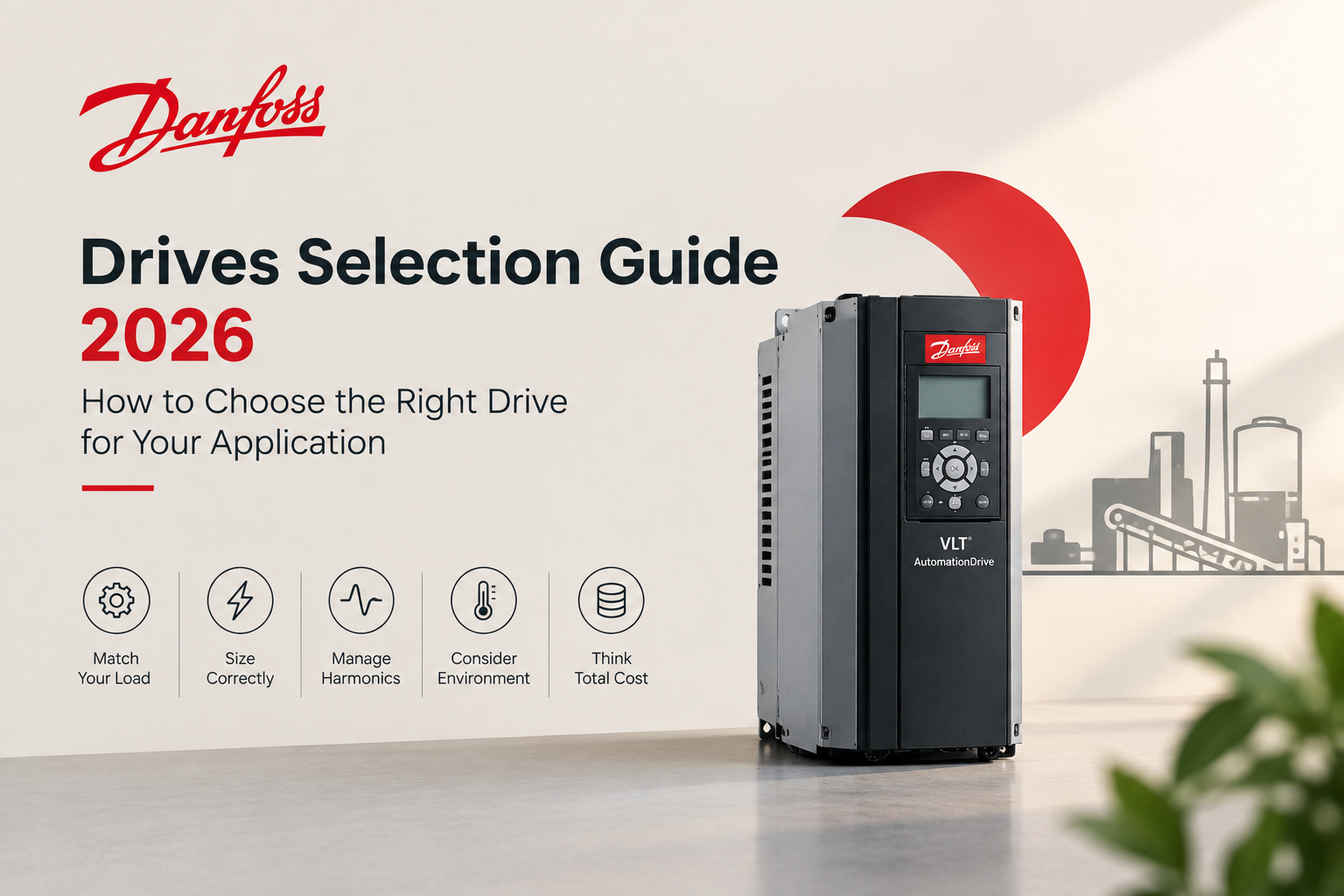
Picking a variable frequency drive looks simple until the wrong one is running in a hot panel room, tripping every afternoon, or feeding harmonics back into the plant supply. Most drive problems trace back to decisions made at the selection stage. This Danfoss Drives Selection Guide 2026 walks through how experienced engineers narrow down the options, so you match the drive to the job instead of buying by kilowatt rating alone.
Start With the Load, Not the Catalogue
Before you open a product brochure, write down what the motor actually drives. A centrifugal pump, a conveyor, a crusher and a hoist all need very different things from a drive, even at the same power.
Variable torque loads, such as fans and centrifugal pumps, need torque that rises with speed. They are gentle on a drive and offer the biggest energy savings, because a small drop in speed cuts power consumption sharply. Constant torque loads, such as conveyors, mixers and extruders, need full torque even at low speed, which stresses both motor cooling and drive current. High-starting-torque or dynamic loads, such as cranes, presses and winders, demand fast response, precise control and often braking.
Also note the duty cycle, the minimum and maximum speeds, whether the motor must run in both directions, and how often it starts and stops. Two minutes on this list saves hours of troubleshooting later.
Understanding the Danfoss Drive Families
Danfoss organises its low-voltage drives around application types. Product names and ranges do change over time, so confirm the current lineup on the official Danfoss Drives website before finalising an order. The broad logic, however, has stayed consistent.
VLT HVAC Drive (FC 102) is built for buildings: fans, pumps, compressors and cooling towers. It carries features such as sleep mode, pipe-fill and cascade control, and it is designed to keep energy use low in variable-torque duty.
VLT AQUA Drive (FC 202) targets water and wastewater. Dry-run detection, deragging for clogged pumps, flow compensation and robust protection against harsh conditions make it a common choice for pumping stations and treatment plants.
VLT AutomationDrive (FC 301/302) is the machine and process workhorse. It suits conveyors, packaging lines, mixers and material handling, and it supports advanced motor control and flexible fieldbus options.
VLT Midi Drive (FC 280) and VLT Micro Drive (FC 51) serve smaller machines and simpler applications where panel space and cost matter more than expansion options.
VACON drives, which joined Danfoss through acquisition, cover more demanding segments, including marine, oil and gas, and heavy industry, as well as compact machine builds. Newer platforms such as the iC7 series are aimed at specialised sectors like marine and hybrid systems, and are worth checking if your project involves those fields.
The practical takeaway is to choose the family by application, then pick the power size within it. An HVAC drive on a high-torque crusher, or an automation drive bought for a simple fan, either underperforms or wastes money.
Sizing: Power, Current and Overload
Motor kilowatts are a starting point, not the answer. The drive must be sized on output current, because current is what heats the drive’s power electronics.
Read the motor nameplate for rated current, voltage and frequency. Then compare that to the drive’s continuous output current at your operating conditions. Multi-pole motors, older motors and special-design motors often draw more current than a standard four-pole motor of the same kilowatt rating, which is why sizing by kW alone catches people out.
Next, consider overload. Many drives offer a normal overload rating for variable torque loads and a higher, shorter overload rating for constant torque loads. A conveyor that must start under full load needs the heavy-duty rating, and that may mean stepping up one frame size. Confirm how many seconds of overload the drive can sustain, and whether your process can actually stay within that limit.
Finally, apply derating. High ambient temperature, altitude above roughly 1,000 metres, and high switching frequency all reduce usable output current. Drives in hot climates and enclosed panels are the classic victims here. If your installation is in a region where summer panel temperatures climb well past 40°C, size with that number, not the comfortable figure on the datasheet.
Harmonics, EMC and Cabling
A drive changes how your installation behaves electrically, and that matters more as the number of drives on a site grows.
Standard drives draw current in pulses, creating harmonic distortion on the supply. A few small drives on a strong supply cause no trouble. Dozens of drives on a weak transformer can push voltage distortion past the limits described in IEEE 519 and cause overheating, nuisance trips and interference with other equipment. Danfoss offers built-in DC chokes on many models, plus options such as low-harmonic drives, active filters and advanced harmonic filter solutions. Its MyDrive software tools can help estimate harmonic levels before you commit to hardware.
EMC is the other half of the story. Choose the correct RFI filter class for your environment, since residential, commercial and industrial settings carry different limits. Use screened motor cables, terminate the screens properly at both ends, and keep motor cables away from signal wiring. Long motor cables also need attention, since they can call for output filters to protect motor insulation from voltage spikes.
Enclosure, Environment and Cooling
Drives fail early when their environment is ignored. IP20 chassis drives are economical but need a clean, cooled panel. IP54 or IP55 units tolerate dust and splashing and can be wall-mounted near the machine. IP66 and decentralised drives go on the motor or machine itself, saving cabling but demanding careful thermal planning.
Dust, moisture, corrosive gases and vibration each shorten drive life. In wastewater plants, coastal sites and chemical facilities, conformal-coated circuit boards are worth the modest premium. Also leave the manufacturer’s clearance around each unit, because a crowded panel with a neglected fan filter is one of the most common causes of overheating.
Communication and Commissioning
A driver rarely works alone. Check which protocol your control system speaks, whether that is Modbus, PROFIBUS, PROFINET, EtherNet/IP or another, and confirm that the drive supports it either built-in or through an option card. Retrofitting a communication card later often costs more than ordering it upfront.
Think about commissioning too. Quick-setup menus, a readable keypad, PC tools and parameter cloning between identical drives can save days on a multi-drive project. Ask whether your maintenance team already knows the Danfoss interface, because familiarity reduces training costs and downtime.
Look at Lifecycle Cost, Not Only Price
The purchase price of a drive is usually a small share of what it costs over ten or fifteen years. Energy savings, especially on fans and pumps, tend to dwarf the initial spend. Add spare parts availability, local service support, firmware updates, and the cost of downtime when a drive fails. The IEC 61800-9 standard, available through the IEC, defines efficiency classes for drive systems and gives you a neutral way to compare options.
If you want a practical starting point for related topics, our guides on choosing between a VFD and a soft starter and VFD installation best practices cover the neighbouring decisions in more detail.
Final Thought
There is no single best drive, only the right one for a specific load, environment and control system. Start with the application, size on current rather than power, plan for harmonics and heat, and think in terms of total cost over the drive’s life. Follow that order and the Danfoss lineup becomes easy to navigate. Since specifications and product ranges evolve, always verify the details against current Danfoss documentation before you finalise a purchase for 2026.
