


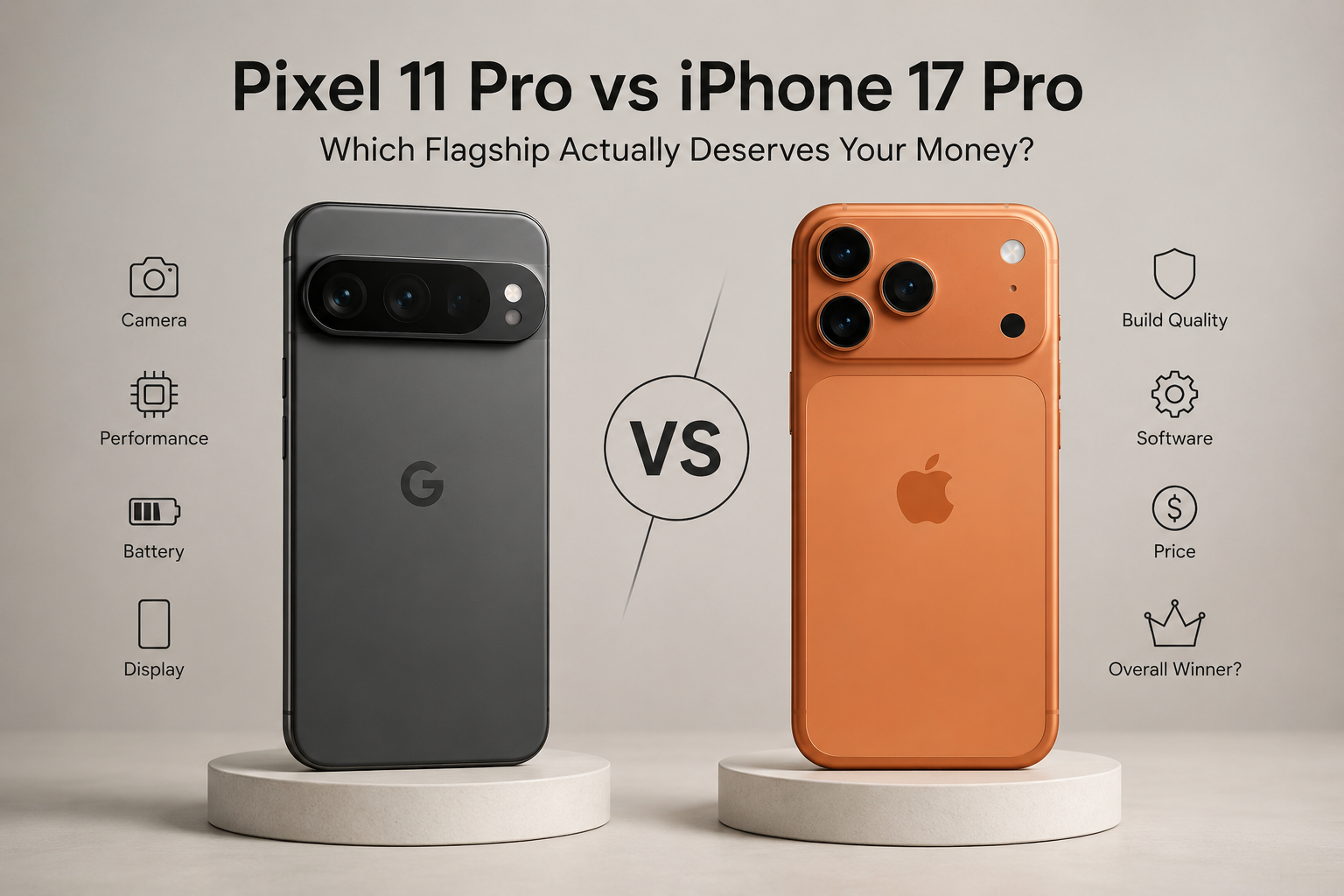
Every year the same argument starts the moment Google and Apple finish their launch events: which flagship is worth the upgrade, the Pixel or the iPhone? The Pixel 11 Pro vs iPhone 17 Pro debate is this year’s version of that argument, and with the Pixel 11 Pro now official and the iPhone 17 Pro having spent a full year in the market, this comparison finally has real, tested data behind it instead of rumors. Both phones sit in the same price bracket, both are aimed at people who want the best their respective ecosystem has to offer, and both make very different bets on what a “pro” phone should feel like.
This article breaks down the two phones across the areas that actually matter day to day — design, display, performance, cameras, battery, software, and price — before landing on a final recommendation. If you’re curious how this year’s other big flagship battle is shaping up, we’ve also covered iPhone 18 Pro Max vs. Samsung Galaxy S26 Ultra in detail.
Design and Build Quality
The Pixel 11 Pro vs iPhone 17 Pro design battle is one of the most noticeable differences between the two phones this year. Apple reworked the iPhone Pro line more than it has in years. The iPhone 17 Pro moves to a heat-forged aluminum unibody with a laser-welded vapor chamber built in for cooling, and the back is now protected by Ceramic Shield 2, which Apple claims is far more scratch-resistant than before. The camera “plateau” on the back is larger, mainly to make room for that cooling system and a bigger battery, and the phone comes in newer finishes like deep blue and cosmic orange alongside silver.
Google, on the other hand, played it safer with the Pixel 11 Pro. The design is a refinement rather than a rethink — the familiar camera bar returns, but now with a uniform matte-black glass finish across every color instead of the two-tone metal look from the Pixel 10 Pro. The bezels are slightly slimmer, and Google added a small but genuinely useful touch: an RGB LED strip built into the camera bar, reportedly marketed as “Pixel Glow” or “HiLight,” which lights up for notifications or while talking to Gemini hands-free.
If you like a phone that looks a little different from last year’s model, the iPhone’s redesign will feel more significant. If you prefer Google’s understated, symmetrical camera bar with a fun ambient lighting touch, the Pixel wins this round on personality.
Display Comparison
When it comes to screens, the Pixel 11 Pro vs iPhone 17 Pro matchup is closer than most people expect. Both phones sit at a similar size — the iPhone 17 Pro has a 6.3-inch Super Retina XDR OLED panel, while the Pixel 11 Pro also uses a 6.3-inch OLED display, so this isn’t a case of one company chasing bigger screens. Apple’s panel benefits from an always-on display, Dynamic Island, True Tone, and a very high contrast ratio, all backed by years of color-calibration refinement. Google’s panel is reported to be noticeably brighter than its predecessor, which should help in direct sunlight, a spot where older Pixels have historically lagged behind iPhones.
For pure everyday readability and outdoor visibility, the improvements Google made this generation close the gap significantly, but Apple’s display tuning and app-level HDR support still have a slight edge for content consumption and gaming.
Performance and Chipset
This is where the Pixel 11 Pro vs iPhone 17 Pro comparison takes its sharpest turn, since the two phones take completely different paths. The iPhone 17 Pro runs on Apple’s A19 Pro chip, built with a vapor chamber cooling system specifically so the phone can sustain peak performance for longer during gaming or video editing without throttling. Reviewers noted smoother frame rates and more evenly distributed heat compared to the iPhone 16 Pro.
The Pixel 11 Pro moves to Google’s new Tensor G6, which — depending on the source — is either a 2nm or refined 3nm process chip, paired this time with a new modem (reportedly from MediaTek) aimed at finally fixing the connectivity complaints that have followed Tensor phones for years. Google isn’t chasing benchmark supremacy with Tensor chips; the G6 is built around accelerating on-device AI tasks, which is where the Pixel’s software experience leans hardest.
In short: if raw sustained performance, gaming, and benchmark numbers matter most to you, the A19 Pro currently has the advantage. If you care more about how quickly the phone can run local AI features and how much RAM it gives you for multitasking, the Pixel 11 Pro’s 16GB of RAM is worth noting, especially since Apple has kept the iPhone 17 Pro at 12GB.
You can check the official Tensor G6 specifications on GSMArena and Apple’s A19 Pro chip details for the full technical rundown.
Camera Comparison
In the Pixel 11 Pro vs iPhone 17 Pro camera race, the differences are less about who has “more megapixels” and more about style. The iPhone 17 Pro carries a 48MP triple-lens Fusion system — main, ultra-wide, and telephoto — with up to 8x optical-quality zoom, the longest zoom range ever on an iPhone Pro. Apple’s color science tends toward natural, slightly warmer tones, and the new 18MP Center Stage front camera is specifically built for better group selfies.
The Pixel 11 Pro keeps a familiar-looking 50MP wide, 48MP ultrawide, and 48MP telephoto combination, but leans on Google’s computational photography stack — the same processing pipeline that has made Pixels favorites among people who want a great photo straight out of the camera app with zero editing. Night Sight, Magic Editor, and other AI-driven tools remain a genuine differentiator here, especially for people who shoot a lot indoors or at night.
If you’re the type who edits your photos afterward, the iPhone’s flexible RAW-friendly capture and zoom range are appealing. If you want to point, shoot, and post immediately, the Pixel’s software-first approach to photography still has an edge.
Battery Life and Charging
Battery life is often the deciding factor in the Pixel 11 Pro vs iPhone 17 Pro decision for people who travel or work long hours away from a charger. Battery capacity numbers can be misleading across ecosystems because iOS and Android manage power very differently, but the trend lines are worth noting. Apple significantly increased battery capacity in the iPhone 17 Pro, and reviewers have called it the best battery life of any iPhone to date, helped directly by that new vapor chamber cooling design.
Google’s Pixel 11 Pro actually saw a slight dip in battery size compared to the Pixel 10 Pro, landing at roughly 4,850mAh, though the more efficient Tensor G6 could offset some of that loss in real-world screen-on time. Wired charging stays at 30W on the standard Pro model, with the larger Pixel 11 Pro XL reportedly getting a 45W bump instead.
For anyone who regularly ends the day worried about battery percentage, the iPhone 17 Pro currently has the stronger reputation.
Software and AI Features
This is really the heart of the decision. The iPhone 17 Pro runs iOS with Apple Intelligence layered throughout — smarter Siri interactions, on-device summarization, and deep integration with Apple’s own apps and ecosystem, including Macs, iPads, and AirPods.
The Pixel 11 Pro runs Android with Gemini built in at a system level, and Google is pushing deeper AI integration than ever before, including that ambient light indicator reacting specifically to Gemini interactions. Android also offers more flexibility for customization, sideloading, and default app choices, which matters to a certain kind of power user.
Neither system is objectively “better” — this decision usually comes down to which ecosystem you’re already invested in. Switching from years of iMessage groups and AirDrop habits to Android is a bigger friction point for most people than any spec sheet comparison. If you’re curious how the underlying AI assistants stack up beyond just phones, our breakdown of ChatGPT vs Claude covers the broader AI landscape both companies are racing to compete in.
Price and Value
Price is usually the tiebreaker in any Pixel 11 Pro vs iPhone 17 Pro decision. The iPhone 17 Pro launched at $1,099 for the base 256GB model, a $100 increase over its predecessor, partly justified by Apple doubling the starting storage. The Pixel 11 Pro’s pricing has also crept upward this generation, with Google reportedly citing global memory costs, though it starts with more generous storage tiers and a class-leading 16GB of RAM as standard.
When you line up the price against what each phone offers, the iPhone 17 Pro justifies its cost through sustained performance and battery life, while the Pixel 11 Pro justifies its price through RAM, AI features, and camera software — a case of two different value propositions rather than one phone simply being “worth more.”
Which One Should You Buy?
At the end of the day, the Pixel 11 Pro vs iPhone 17 Pro choice comes down to ecosystem and shooting style more than raw specs. If you’re deep into Apple’s ecosystem — Mac, iPad, Apple Watch — the iPhone 17 Pro is the obvious pick, and the improved thermals and battery life make it a genuinely stronger upgrade than the last couple of generations. If you’re an Android user who values computational photography, more RAM for multitasking, and Google’s AI tools baked directly into the OS, the Pixel 11 Pro is the better long-term bet, especially if the modem issues that plagued past Tensor chips are truly fixed this time.
Neither phone is a bad choice. The gap between flagship Android and iOS phones has narrowed to the point where ecosystem lock-in and personal shooting style matter more than raw spec sheets.
Final Thoughts
Comparing the Pixel 11 Pro vs iPhone 17 Pro isn’t really about crowning a single winner — it’s about matching a phone to how you actually use one. Apple’s phone is built for people who want raw, sustained performance and best-in-class battery life without thinking too hard about settings. Google’s phone is built for people who want their photos to look finished the moment they’re taken and who want AI woven into the operating system rather than bolted on top of it. Whichever direction you lean, both phones represent the strongest versions of Pixel and iPhone we’ve seen in years, and neither is likely to disappoint anyone who picks it for the right reasons.
For a deeper look at how these phones stack up against other 2026 flagships, check out our comparison of iPhone 18 Pro Max vs. Samsung Galaxy S26 Ultra, and if you’re gearing up for either phone, our guide to the best phone accessories for a great mobile gaming experience is worth checking too. You can also read the full technical breakdowns directly from MacRumors’ iPhone 17 Pro coverage and Google’s Pixel 11 Pro announcement details.
