


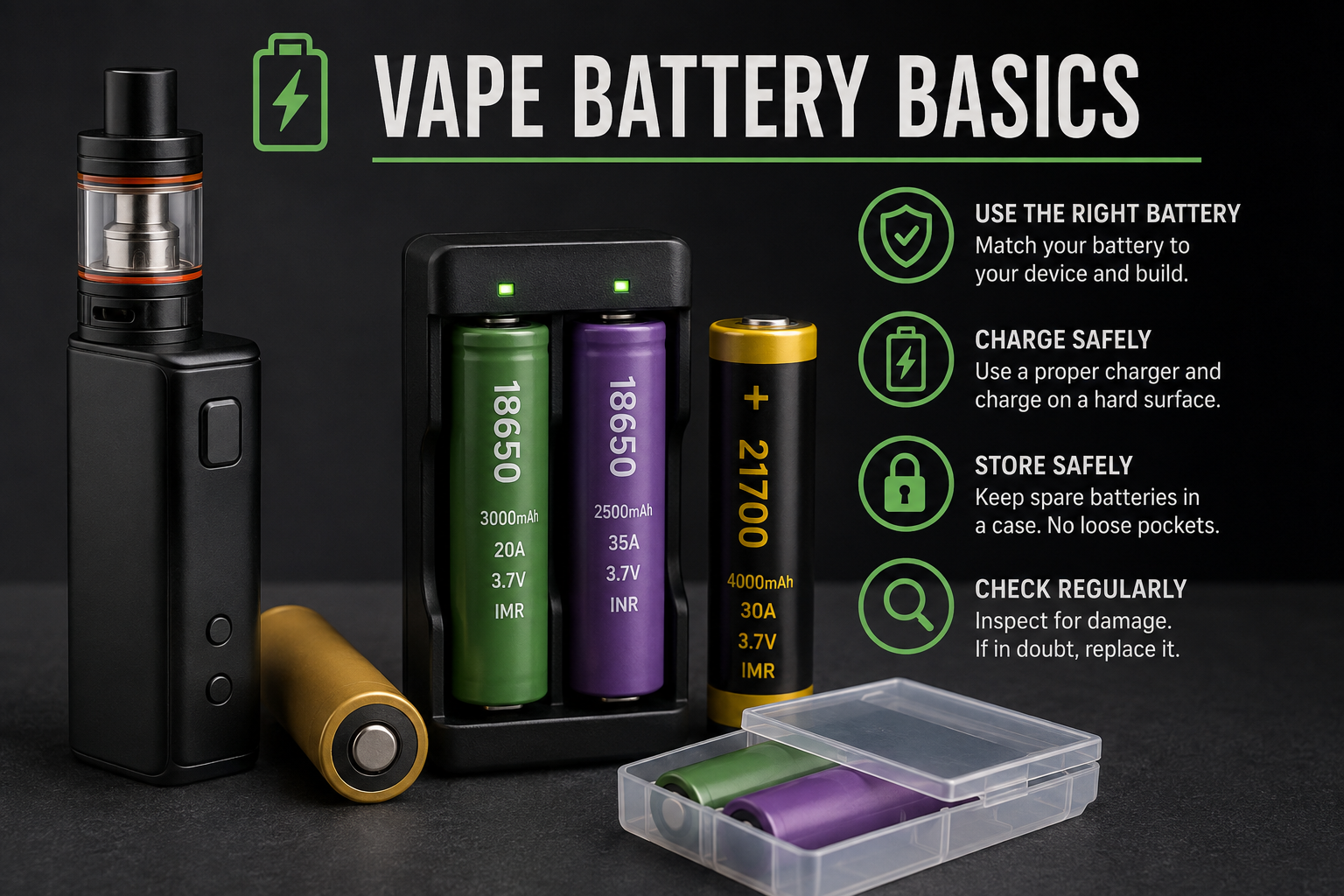
If you’ve ever had your device die halfway through the day, or worse, heard a horror story about a battery venting inside someone’s pocket, you already know that the battery is the single most important — and most misunderstood — part of any vaping setup. A coil is easy to swap, a tank is easy to refill, but the battery is where power, performance, and safety all meet. Get it wrong, and you’re not just risking a shorter vape session; you’re risking real physical harm.
This guide walks through what actually matters when it comes to Vape Battery Guide: the different types you’ll come across, how capacity and discharge ratings work, the safety habits that separate a careful vaper from an accident waiting to happen, and how to keep a battery performing well for as long as possible. Along the way, we’ll also point you toward a few of our other guides and some outside resources worth bookmarking.
Why the Battery Deserves More Attention Than It Gets
Most people who pick up a vape device focus on flavor, cloud production, or nicotine strength. The battery quietly sits in the background doing the actual work — converting stored chemical energy into the heat that vaporizes your e-liquid. When it’s healthy, you barely think about it. When it isn’t, everything from flavor quality to device lifespan starts to suffer.
Understanding your battery isn’t just a technical exercise for coil-builders and mod enthusiasts. Even if you’re using a simple pod system with a sealed internal battery, knowing the basics helps you charge it correctly, store it safely, and recognize the warning signs before something goes wrong. Where you buy your battery matters too — our breakdown of what separates a reliable vape shop from the rest is worth reading before you pick up a spare cell or a new device, since counterfeit batteries and unverified sellers are a real source of the safety incidents you’ll read about below.
The Main Types of Vape Batteries
Not all vape batteries are built the same, and the differences matter more than most people realize.
Internal (built-in) batteries are what you’ll find in most pod systems and disposable devices. They’re sealed inside the unit, charged via USB-C or micro-USB, and aren’t meant to be removed or replaced by the user. They’re convenient and generally safer for beginners because the manufacturer has already matched the battery to the device’s power draw.
Removable lithium-ion batteries, most commonly in the 18650, 20700, or 21700 format, are used in box mods and mechanical mods. These are the batteries that give vapers control — you can swap in a fresh one when the first runs low, choose higher-capacity cells for longer sessions, or pick high-drain cells for sub-ohm builds. This flexibility is also where most safety mistakes happen, because the responsibility for choosing a suitable, well-rated battery shifts from the manufacturer to the user.
Within removable lithium-ion batteries, you’ll also see chemistry labels like IMR, INR, and hybrid variants. Broadly speaking, IMR and INR cells are considered more stable for the higher discharge demands of vaping compared to older ICR chemistry, which was designed more for general electronics than for the rapid, repeated power draw a vape device asks for.
Reading a Battery: mAh, Amps, and Why Both Matter
Two numbers matter most when you’re comparing batteries: milliampere-hours (mAh) and the continuous discharge rating (measured in amps).
mAh (capacity) tells you how much energy the battery can store — think of it as the size of the fuel tank. A higher mAh rating generally means longer use between charges, though real-world battery life also depends on your coil resistance, wattage setting, and how often you’re vaping throughout the day.
Continuous discharge rating (CDR) tells you how much current the battery can safely deliver without overheating. This is the number that actually determines whether a battery is safe for your device, especially if you’re running a mechanical mod or vaping at higher wattages. A battery with a high mAh rating but a low discharge rating can still be dangerous if you push more current through it than it’s rated for.
This is where a bit of basic electrical math becomes genuinely useful. Ohm’s Law — voltage divided by resistance equals current — lets you calculate the maximum current your coil will pull from the battery. A freshly charged lithium-ion cell reads close to 4.2 volts. If you divide that by your coil’s resistance in ohms, you get the amp draw, and that number should always sit comfortably below your battery’s continuous discharge rating, not right up against it. Most experienced builders leave a buffer of several amps rather than running a battery at its absolute limit, and it’s a habit worth building early if you’re new to rebuildable setups.
Charging Habits That Actually Protect Your Battery
A surprising number of battery incidents trace back to charging mistakes rather than manufacturing defects. A few habits make a real difference:
Always use the charger that came with your device, or one explicitly rated for it. Phone chargers, laptop chargers, and generic USB adapters don’t always deliver the voltage and current profile a vape battery expects, and mismatched charging is a common cause of overheating.
Charge on a hard, heat-resistant surface rather than on a bed, couch, or carpet, and avoid leaving a battery charging unattended overnight. Unplug once it’s full — leaving a lithium-ion battery on the charger for hours after it reaches 100% adds unnecessary stress, even with built-in protection circuits.
Temperature extremes are another quiet killer. Leaving a device or spare battery in a hot car, in direct sunlight, or somewhere below freezing accelerates degradation and, in worst cases, can trigger a failure. Store batteries at room temperature whenever possible.
Storing and Carrying Spare Batteries Safely
If you carry removable batteries, how you store them matters almost as much as how you charge them. Loose batteries tossed into a pocket or bag alongside coins, keys, or other metal objects are a genuine short-circuit risk — the metal can bridge the battery’s positive and negative terminals and cause a rapid, dangerous discharge. A simple plastic battery case solves this problem for a few dollars and should be considered non-negotiable if you carry spares regularly.
It’s also worth building a habit of inspecting batteries periodically. Look for a wrapper that’s torn, peeling, or discolored, any dents or swelling, or a battery that feels unusually warm even when not in use. Any of these signs means it’s time to retire the battery, not keep squeezing use out of it. Many local vape shops and battery retailers accept old lithium-ion cells for proper recycling — never throw a used vape battery in regular household trash.
Getting the Most Life Out of Your Battery
Beyond safety, there are simple habits that extend how long a battery performs well:
Avoid letting a removable battery drain to zero repeatedly; lithium-ion cells generally last longer when you charge them before they’re fully depleted rather than running them flat every time. Rotating between two or more batteries, rather than repeatedly deep-cycling a single one, also spreads out wear. Keep the battery contacts on both the cell and the device clean — a bit of residue or oxidation on the contacts can cause resistance issues that make the device work harder than it needs to, generating extra heat in the process.
If you’re running a rebuildable setup, matching your coil builds to your battery’s actual capabilities (rather than the highest wattage your mod allows) will also keep both your battery and your coils lasting longer. This is also where buying from a shop with proper storage and stock-rotation practices pays off — a battery that’s been sitting on a hot shelf for months rarely performs like a fresh one.
For broader, regulator-backed safety information, the U.S. Food and Drug Administration publishes consumer guidance on preventing e-cigarette battery incidents, and it’s worth a look if you want a second, independent source beyond any single retailer’s advice — see the FDA’s tips for e-cigarette battery safety. If you want a deeper technical dive into lithium-ion chemistry and discharge behavior generally, Battery University’s overview of lithium-ion battery types is a genuinely useful reference, even though it isn’t vaping-specific.
Final Thoughts
A vape battery isn’t just a power source you plug in and forget about — it’s a piece of chemistry that rewards a bit of understanding and punishes carelessness. The good news is that the habits that keep you safe are the same ones that make your battery last longer and perform better: use the right charger, respect the discharge ratings, store spares properly, and retire a battery the moment it shows warning signs. None of this requires technical expertise, just a bit of consistency.
If you’re building out the rest of your setup, take a look at our guide on choosing a trustworthy vape shop and, more broadly, our smart buyer’s guide to picking reliable gadgets to round out what you’ve learned here. And whenever you’re unsure about a specific battery or device, checking the manufacturer’s documentation — or an independent source like the FDA’s safety guidance linked above — is always worth the extra five minutes.
