


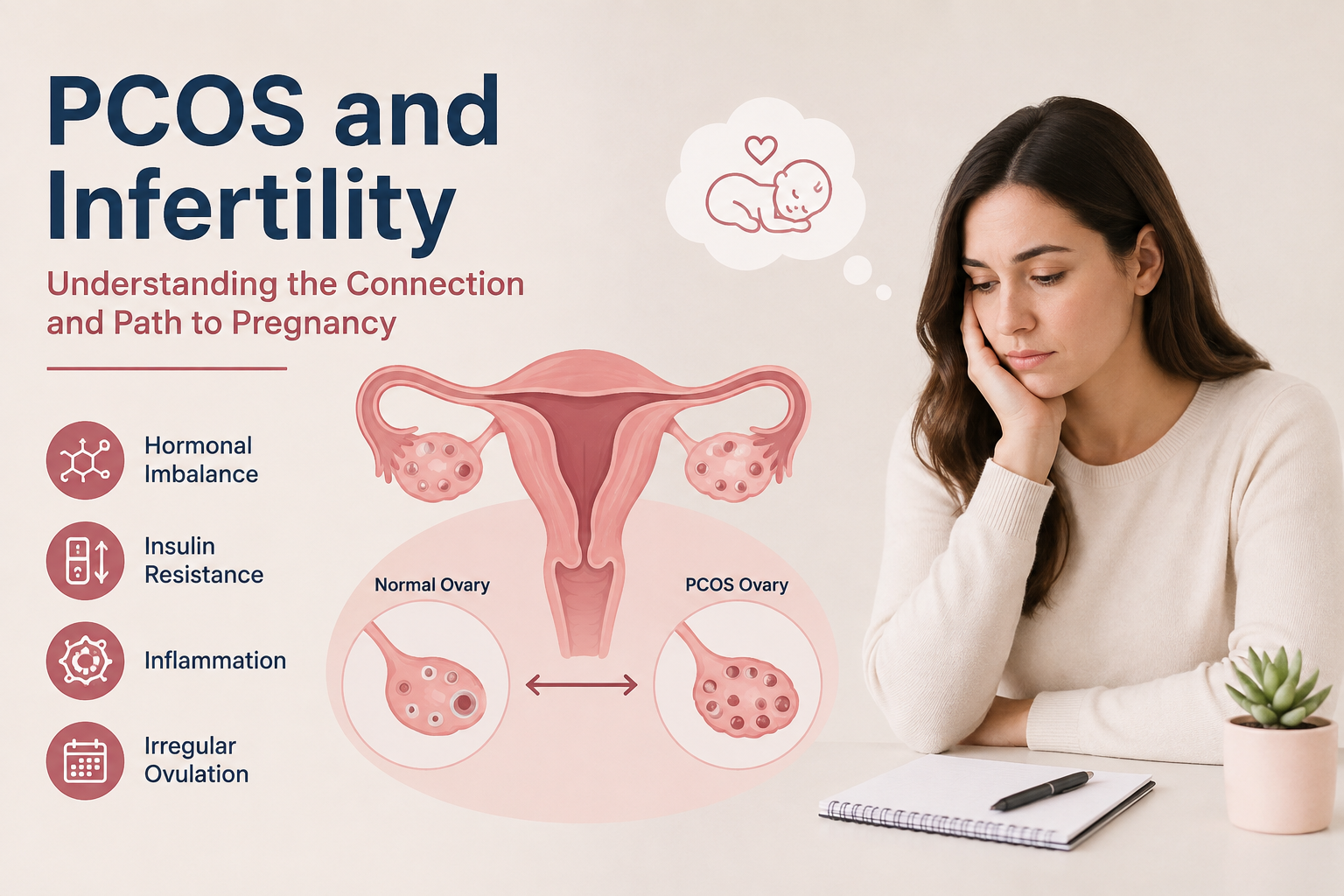
When a woman hears the words “you have PCOS” during a fertility workup, the first question that usually follows is simple and urgent: will I still be able to have a baby? Polycystic Ovary Syndrome (PCOS) is one of the most common hormonal disorders in women of reproductive age, and it is also one of the leading causes of infertility worldwide. But a PCOS diagnosis is not the end of the road to parenthood — it is the beginning of a more informed one.
This article breaks down how PCOS and infertility are connected, what actually happens inside the body, and which treatment paths tend to work, based on current medical understanding.
What Is PCOS and Why Does It Affect Fertility?
PCOS is a hormonal and metabolic condition, not simply a “cyst problem.” Despite the name, the small fluid-filled sacs seen on the ovaries during an ultrasound are immature follicles that never fully matured and released an egg — they are a symptom of the disorder, not its cause.
At the root of PCOS is a hormonal imbalance: the ovaries produce slightly higher levels of androgens (often called “male hormones,” though every woman has some naturally). This excess disrupts the delicate signalling between the brain and the ovaries that normally causes one dominant follicle to mature and release an egg each month. Instead of one clean ovulation, the cycle stalls — periods become irregular, unpredictable, or stop altogether.
According to the World Health Organization, PCOS is a leading cause of irregular periods and one of the most common causes of infertility globally, and it can begin as early as adolescence, though it is frequently only diagnosed once a woman starts trying to conceive and struggles to do so. The Mayo Clinic similarly describes PCOS as a hormone-driven condition in which follicles form along the ovary but repeatedly fail to release a mature egg.
How PCOS Actually Causes Infertility
It helps to understand that PCOS does not usually cause infertility because the eggs are damaged or the reproductive organs are unhealthy — it causes infertility primarily because ovulation does not happen on a regular, predictable schedule. A peer-reviewed clinical study published on PubMed Central reports that PCOS is the single most common cause of anovulatory infertility, accounting for roughly 70 to 75% of cases where infertility is linked to a lack of ovulation. In simpler terms, out of every four women whose infertility is caused by an ovulation problem, roughly three of them have PCOS behind it.
There are a few interconnected mechanisms at play:
Hormonal imbalance and anovulation. Elevated androgens and disrupted levels of luteinizing hormone (LH) prevent the ovarian follicles from maturing properly, so eggs are rarely released.
Insulin resistance. A large share of women with PCOS also have insulin resistance, where the body’s cells don’t respond efficiently to insulin. This causes the pancreas to produce more insulin, which in turn pushes the ovaries to produce even more androgens — worsening the cycle of irregular ovulation. This is why weight, blood sugar, and fertility are so closely tied together in PCOS.
Chronic inflammation. Some studies point to elevated inflammatory markers and oxidative stress in women with PCOS, which may interfere with the normal development and quality of the egg itself, not just the timing of its release.
Endometrial effects. Irregular cycles mean the uterine lining doesn’t shed and rebuild on a normal rhythm, which can affect implantation even in cycles when ovulation does occur.
Also Read :
Recognising the Signs Before You’re Trying to Conceive
Many women don’t realise PCOS is affecting their fertility until they start actively trying for a baby. However, there are usually earlier signs worth paying attention to: cycles that are consistently longer than 35 days or unpredictable in length, excessive facial or body hair growth, persistent acne along the jawline, thinning scalp hair, stubborn weight gain especially around the abdomen, and dark, velvety patches of skin (a sign of insulin resistance) around the neck or underarms.
None of these symptoms alone confirms PCOS, but together they are a strong signal to get evaluated sooner rather than later — early diagnosis genuinely changes the treatment timeline. The Cleveland Clinic notes that excess hair growth affects up to 70% of people with this condition, and that a large share also struggle with weight management as a direct result of the underlying hormonal imbalance.
How Doctors Diagnose PCOS-Related Infertility
Diagnosis typically follows the Rotterdam criteria, where a woman needs at least two of the following three: irregular or absent ovulation, clinical or lab-confirmed signs of excess androgens, and polycystic ovaries visible on ultrasound. Alongside this, doctors usually run blood tests to check hormone levels (LH, FSH, testosterone, AMH), fasting insulin and glucose to assess insulin resistance, and thyroid function, since thyroid disorders can mimic or worsen PCOS symptoms.
For couples actively trying to conceive, fertility specialists generally recommend a full evaluation — including checking that the fallopian tubes are open and that sperm parameters are normal — once six months to a year has passed without success, since PCOS is rarely the only factor at play in a couple’s fertility journey.
Also Read : Clear Blue hCG Test: Everything You Need to Know Before You Test
Treatment Options: From Lifestyle to IVF
The encouraging part of this conversation is that PCOS-related infertility is highly treatable, and most women with PCOS who want to conceive eventually do, often without needing the most advanced interventions.
Lifestyle change as the true first step. Diet and physical activity are not just supportive advice — they are frontline treatment. Even a modest reduction in body weight, in the range of five to ten percent, can restore ovulation in many women by improving insulin sensitivity. Johns Hopkins Medicine notes that even a 5% reduction in weight could lead to more regular periods, and this single change is often what tips an irregular cycle back toward ovulating naturally.
Insulin-sensitising medication. For women with confirmed insulin resistance, metformin is commonly prescribed. Published research on thiazolidinediones and metformin has shown that insulin-sensitising treatment can increase ovulation rates and the number of successful pregnancies in PCOS patients, largely by reducing the excess insulin that drives androgen production.
Ovulation induction (first-line medication). Letrozole and clomiphene citrate are the two most commonly used oral medications to trigger ovulation. Letrozole has increasingly become the preferred first-line option in current fertility guidelines because it tends to produce a single dominant follicle with a lower risk of multiple pregnancy compared to clomiphene. A sequential letrozole and low-dose FSH protocol, tested in a randomized controlled trial, was shown to improve pregnancy outcomes in women with PCOS whose infertility hadn’t responded to standard treatment alone.
Gonadotropins and IUI. If oral medication alone doesn’t lead to ovulation or pregnancy, clinical practice guidelines point to injectable gonadotropins (FSH or hMG) as the next step, sometimes paired with intrauterine insemination (IUI), where washed sperm is placed directly into the uterus around the time of ovulation.
Ovarian drilling. A minor laparoscopic procedure that reduces androgen-producing tissue in the ovary is sometimes used for women who don’t respond to medication, though it’s less common today given the effectiveness of newer drug protocols.
IVF. When other treatments haven’t worked, or when there are additional fertility factors involved, in-vitro fertilization remains a highly effective option. Because women with PCOS often have a higher number of follicles, they can sometimes respond very well to IVF stimulation, though careful monitoring is needed to avoid ovarian hyperstimulation syndrome (OHSS).
If you’re mapping out where to start, the Mayo Clinic’s PCOS care guide is a useful resource to read before your first fertility consultation, so you walk in with informed questions.
Myths That Deserve to Be Retired
A few misconceptions cause unnecessary anxiety. PCOS does not mean a woman is infertile — it means ovulation is irregular, which is very different and very treatable. Being thin does not rule out PCOS; a significant number of women with normal or low body weight have “lean PCOS” driven mainly by insulin resistance rather than visible weight gain. And PCOS is not something a woman causes through poor habits — genetics and family history play a strong role, alongside environmental and metabolic factors that are still being researched.
Why Early Action Matters
The biggest factor within a woman’s control is time. PCOS doesn’t typically worsen fertility with age faster than it would for anyone else, but combining PCOS with age-related fertility decline (especially after 35) narrows the treatment window. Getting evaluated as soon as irregular cycles or difficulty conceiving appear — rather than waiting a year “just to be sure” — gives doctors more room to start with the least invasive treatments first, rather than jumping straight to advanced procedures.
Final Thought
A PCOS diagnosis can feel overwhelming, especially when pregnancy is the goal, but it’s important to separate the condition from the outcome. PCOS disrupts the rhythm of ovulation — it does not switch off fertility altogether. With the right combination of lifestyle adjustments, medical treatment, and — where needed — assisted reproductive technology, the large majority of women with PCOS go on to have healthy pregnancies. The most important step isn’t finding a single perfect solution; it’s starting the conversation with a fertility specialist early, so that treatment can be tailored to your specific hormonal picture rather than a one-size-fits-all approach.
Sources: World Health Organization – Polycystic Ovary Syndrome, Johns Hopkins Medicine – PCOS and Infertility, NCBI – Treatment of Infertility in Women with PCOS, NCBI – Letrozole/FSH Therapy in PCOS
