
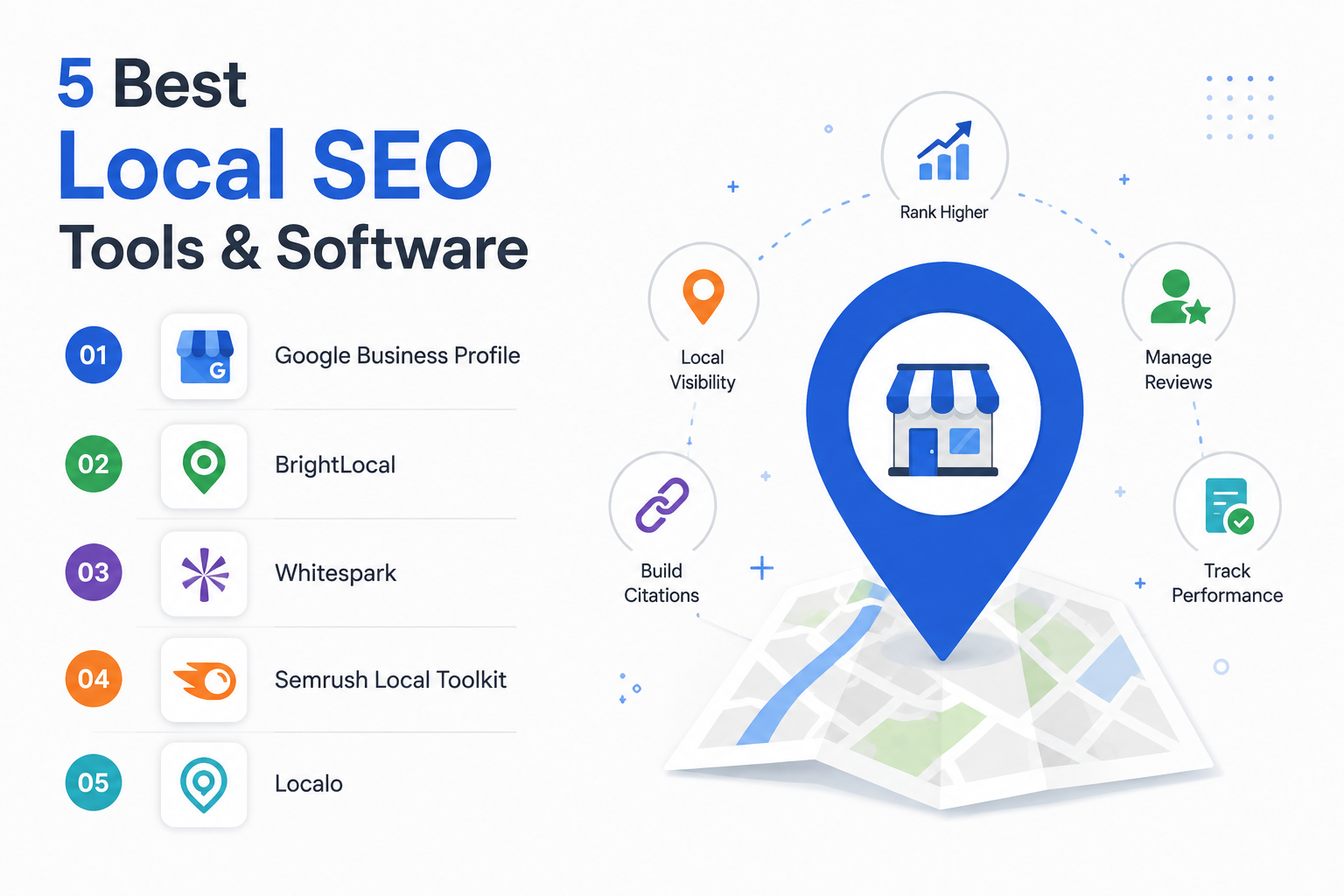
A plumber in Faisalabad and a bakery in Chicago have almost nothing in common — except one thing: both of them live or die by whether they show up when someone nearby searches “near me.” That’s the entire game of local SEO tools, and in 2026 it’s being played on a bigger board than before. Google Maps, AI Overviews, voice assistants — customers now find businesses through half a dozen different doors, not just a search bar.
Picking the right software isn’t about owning the longest toolkit. It’s about knowing exactly which job you’re hiring a tool to do — tracking your map pack position, cleaning up your business listings, or keeping your review score from quietly slipping. Below are five tools worth your money in 2026, why each one earns its place, and who should actually skip it.
What Changed in Local SEO Heading Into 2026
A few years ago, “ranking well locally” mostly meant three things: a decent Google Business Profile, a stack of consistent citations, and a healthy flow of reviews. That’s still true — but it’s no longer the whole picture.
Search behavior has fractured. A growing share of “near me” queries now get answered inside AI-generated summaries before a user ever scrolls to a traditional result. Businesses that only track a keyword’s position on page one are, in practice, only watching part of their visibility. The tools that matter most this year are the ones that adapted — adding review automation, AI-answer tracking, and grid-level ranking data instead of a single average rank.
That context matters because it changes which tool is “best” depending on what stage your business is at. A single-location shop and a 40-client agency are not shopping for the same thing.
1. Google Business Profile
Nothing on this list works without this one. Google Business Profile is the actual source of truth for your map pack position, your Maps listing, and the info panel that shows up when someone searches your brand name directly.
Filling it out properly — correct categories, real business hours, service areas, fresh photos, and regular posts — has a direct, measurable effect on whether you show up in local results. It also hands you free performance data: how customers found you, whether they called, requested directions, or clicked through to your website.
What it won’t do is tell you where you stand against the shop three blocks away, and it has zero built-in citation or review-automation features. Think of it as the ground floor, not the whole building.
Cost: Free. Every other tool on this list assumes you’ve already done this step properly.
2. BrightLocal
BrightLocal has earned its reputation the boring way — by doing local SEO and nothing else, for years, without trying to also be a general-purpose SEO suite. Rank tracking, citation building, and review management all live under one dashboard, which makes it the go-to pick for agencies juggling multiple client accounts.
Its rank tracker maps visibility across a geographic grid rather than a single blended number, so you can actually see which parts of a city you’re winning and which you’re not. Review monitoring pulls from multiple platforms into one inbox, and reporting is polished enough to hand a client without extra editing.
The trade-off is that it’s local-only by design. If you also handle national keyword strategy, you’ll still need a separate tool for that side of the work. Pricing starts around $39/month for basic tracking, moving up to roughly $59/month for the full plan with review management included, and citation submissions are billed separately.
Best fit: agencies and multi-location businesses that need one dashboard for tracking, listings, and reviews together.
3. Whitespark
Where BrightLocal bundles everything, Whitespark takes the opposite approach — it sells local SEO in pieces, so you’re not paying for features you’ll never touch. Its name is built on one specific tool: the Local Citation Finder, which shows exactly where competitors in your market are listed so you can chase the same directories instead of guessing.
Beyond citations, its rank tracker is known for pinpoint accuracy at the neighborhood level, which matters a lot for businesses competing in dense urban areas where a few blocks can be the difference between page one and page three.
The downside of buying modules separately is that costs can climb if you need more than one piece — there’s no single flat subscription covering everything. Rank tracking runs somewhere between $14 and $200 a month depending on volume, and citation building is priced per submission, generally a few dollars each.
Best fit: businesses with one clear local SEO gap — usually citations — rather than a need for a full platform.
4. Semrush Local Toolkit
If Semrush is already part of your marketing stack for keyword research or competitor audits, its Local Toolkit is worth adding before you go shopping for a separate platform. It’s sold as an add-on rather than a standalone product, priced per business location, and built specifically around Google Business Profile management.
It automates GBP posting, uses AI to draft review responses you can approve or edit, and includes map-rank-tracking credits so you can see exactly where your listing lands across different searcher locations. Because it lives inside the same account as your core Semrush data, local performance and organic performance sit side by side instead of living in two disconnected dashboards.
It’s a weak choice if local SEO is your only need, since you’re effectively paying for a base Semrush subscription to unlock it. Pricing for the Local Toolkit starts around $30/month per location on the base tier.
Best fit: teams already paying for Semrush who want local data without juggling a second login.
5. Localo
Localo has climbed the rankings among agency tools quickly, largely because it was built around agency pain points from day one — white-label reporting, bulk actions across dozens of client accounts, and shared team workspaces instead of one login per client.
Its standout feature is an AI layer that already understands each client’s rankings and competitive landscape, which means a new hire can start giving useful recommendations without weeks of manual onboarding. Branded, auto-generated reports also cut down significantly on the hours agencies usually spend building client updates by hand.
Its citation and directory network is younger than Whitespark’s or BrightLocal’s, so agencies doing heavy citation cleanup may still lean on a second tool for that piece. It’s also more of a tool than a single-location business typically needs.
Best fit: agencies scaling across many clients that want automation baked into onboarding and reporting.
Building a Stack That Actually Makes Sense
The mistake most businesses make isn’t picking the wrong tool — it’s picking too many. A realistic approach looks like this:
- Get your Google Business Profile fully optimized first. This step is free and non-negotiable.
- If you want everything — tracking, citations, reviews — in one place, go with BrightLocal.
- If citations specifically are dragging you down, Whitespark will fix that faster than a generalist platform.
- If you’re already inside Semrush, add the Local Toolkit instead of paying for a second subscription elsewhere.
- If you’re running local SEO for many clients at once, Localo will save the most hours on reporting and onboarding.
Two well-chosen tools, actually used every week, will outperform five subscriptions gathering dust in a dashboard nobody opens.
Final Thoughts
The businesses winning local search in 2026 aren’t running every tool on this list — they’re running the one or two that match their actual gap and using them consistently. Start free with Google Business Profile, layer in a paid platform once your workload justifies it, and resist the urge to collect software you won’t open again next month.
For further reading, Google’s Business Profile Help Center covers setup and guideline details directly from the source, and Moz’s Local SEO guide is a useful reference on the ranking factors behind map pack visibility.
