


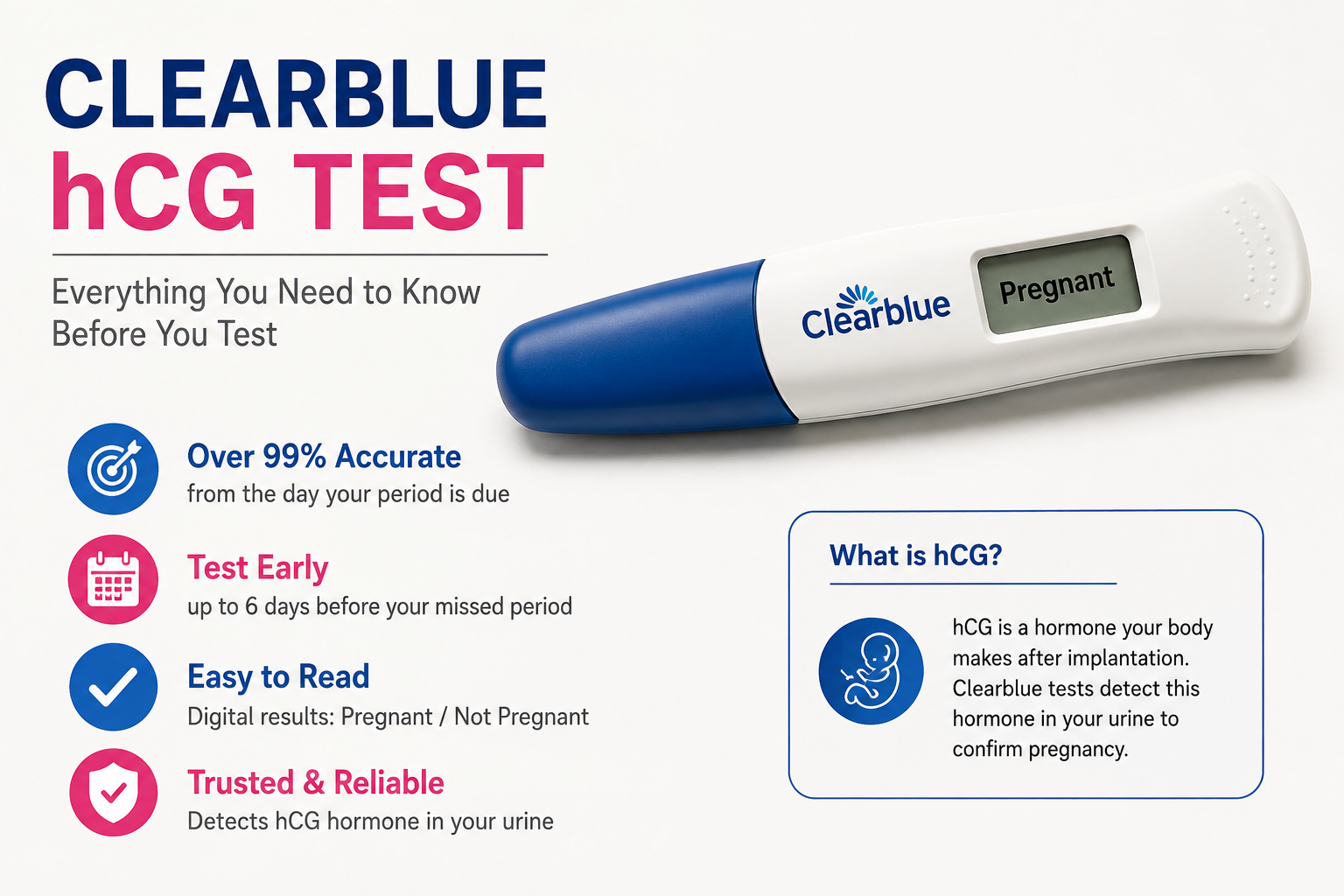
Finding out whether you’re pregnant is one of those moments that can feel both exciting and nerve-wracking at the same time. Most women reach for a home pregnancy test long before they ever set foot in a doctor’s clinic, and the Clear blue hCG test happens to be one of the most trusted names on that shelf. But how does it actually work, how early can you use it, and how do you make sure you’re reading the result correctly? Let’s break it all down in plain language.
What Is hCG and Why Does It Matter?
Before understanding the test itself, it helps to know what it’s actually looking for. hCG stands for human Chorionic Gonadotropin — a hormone your body starts producing once a fertilized egg implants itself in the wall of your uterus. This usually happens about 7 to 9 days after ovulation. Once implantation occurs, hCG levels begin to rise quickly, roughly doubling every 24 to 48 hours during the first few weeks.
This hormone is the entire basis of a home pregnancy test. A clear blue hCG test doesn’t detect “pregnancy” directly — it detects the presence of this hormone in your urine. That’s why timing matters so much. Test too early, and there may simply not be enough hCG in your system yet for the strip to pick it up, even if you are, in fact, pregnant.
How Does a Clearblue hCG Test Actually Work?
Every Clearblue pregnancy test, whether it’s a basic strip, a digital version, or an early-detection kit, uses the same core science. The test strip is coated with antibodies that react specifically to hCG. When you urinate on the stick (or dip it into a urine sample), the urine travels along the strip. If hCG is present, it binds to these antibodies and triggers a visible reaction — usually a line, a plus sign, or, in digital versions, the words “Pregnant” or “Not Pregnant” displayed directly on a small screen.
The digital tests remove the guesswork of interpreting faint lines, which is one reason so many people prefer them, even though the underlying chemistry is identical to the classic line-based strips.
Types of Clearblue Tests You Can Choose From
Not all Clearblue tests are built the same, and knowing the differences can help you pick the right one for your situation.
Digital Pregnancy Test — This is the most popular option because it gives a plain-text result instead of lines you have to interpret. It’s ideal for anyone who wants a clear, unambiguous answer.
Rapid Detection Test — A simpler, line-based strip that gives results in about a minute or two. It’s usually the most affordable option and works well once you’ve already missed your period.
Early Detection Test — Designed for people who don’t want to wait. It’s sensitive enough to pick up hCG several days before a missed period, though the accuracy at this stage is naturally lower than testing later.
Digital Test with Weeks Estimator — This version goes a step further and estimates how many weeks pregnant you are, based on hCG concentration, in addition to confirming the pregnancy itself.
How Accurate Is the Clearblue hCG Test?
Accuracy is the question most people care about most, so it’s worth being precise here instead of repeating vague marketing lines. Based on Clearblue’s published clinical data, all of their pregnancy tests are rated over 99% accurate when used from the day your period is due. That’s an extremely high accuracy level, on par with what you’d typically get from a urine-based test done in a clinic.
Things get a bit more nuanced when you test early, before your period is actually due. Clearblue’s early digital test picks up pregnancy in roughly 78% of cases when used six days before a missed period, improving to about 93% at five days before, 99% at four days before, and climbing to over 99% once you’re within three days of the missed period. In short, the earlier you test, the greater the chance of a false negative — not because anything is wrong with the test itself, but simply because hCG levels may not have risen high enough yet for it to detect.
This distinction matters. A negative result taken too early doesn’t necessarily mean you’re not pregnant — it may just mean it’s still too soon for the hormone to show up.
When Should You Actually Take the Test?
Timing makes a real difference to how much you can trust your result. If you want the most reliable answer with the least anxiety, testing on or after the day your period is due gives you the highest accuracy. If you’re too impatient to wait (which, let’s be honest, is most of us), an early-detection Clearblue test can be used up to six days before your expected period, but be prepared for the possibility that you may need to retest a few days later if the result comes back negative and your period still doesn’t show up.
Testing first thing in the morning, using your first urine of the day, is generally recommended when testing early, since hCG is more concentrated after several hours without urinating. Once you’re testing after a missed period, hCG levels are typically high enough that you can test at any time of day.
How to Read Your Result Correctly
With digital Clearblue tests, this part is simple — the screen will display “Pregnant” or “Not Pregnant” in plain words, removing any ambiguity. With line-based tests, things require a little more attention:
A single line usually appears in the control window regardless of pregnancy status; this confirms the test is working correctly. A second line in the test window, even if it’s faint, generally indicates a positive result, because any detectable trace of hCG counts. A faint line should not be dismissed as invalid — it typically still means hCG is present in your system.
If no line appears at all in the control window, the test is considered invalid, regardless of what shows in the test area, and should be repeated with a new test.
Common Mistakes That Can Affect Your Result
A lot of confusion around pregnancy tests comes down to a handful of avoidable errors. Drinking excessive fluids before testing can dilute your urine and lower the concentration of hCG enough to cause a false negative, so it’s best to avoid overhydrating right before you test. Reading the result outside the recommended time window — either too early or well after the suggested reading time — can also produce misleading lines, since evaporation lines can sometimes appear later and be mistaken for a positive result. Testing too many days before your expected period, when hCG simply hasn’t built up yet, is probably the single most common reason for a false negative. And certain fertility medications containing hCG can, in rare cases, interfere with results, so it’s worth mentioning any medications to your doctor if your result seems inconsistent with your symptoms.
What to Do After a Positive Result
If your test comes back positive, the next step is to book an appointment with your doctor or gynecologist to confirm the pregnancy through a clinical exam or blood test, and to begin prenatal care. Early prenatal visits are important for tracking hCG levels, confirming the pregnancy is developing normally, and starting essential supplements like folic acid. If you’re unsure where to start, our guide on early pregnancy care and first trimester essentials walks through what to expect in the weeks ahead.
What to Do After a Negative Result
A negative result isn’t always the final word, especially if it was taken before your missed period. If your period doesn’t arrive within a few days of testing, it’s worth testing again with a fresh sample, ideally using first-morning urine. If you continue to get negative results but still haven’t had your period, or if you’re experiencing pregnancy symptoms, it’s a good idea to consult a doctor, since there can be other reasons for a delayed cycle, including stress, hormonal imbalances, or changes in weight.
Clearblue vs. Other Home Pregnancy Tests
Most home pregnancy tests, regardless of brand, rely on the same core hCG-detection technology, so the difference usually comes down to sensitivity, ease of reading, and price. Clearblue has built its reputation largely on its digital displays, which remove the ambiguity of interpreting lines, and on its early-detection formulas, which are sensitive enough to catch lower hCG concentrations. Cheaper strip tests from other brands can be just as accurate once you’re testing on or after your missed period, so if budget is a concern, they remain a reliable option for that stage.
Final Thought
At the end of the day, a Clearblue hCG test is one of the most convenient, private, and reliable ways to get an early answer about pregnancy from the comfort of your own home. It’s not magic — it’s simply detecting a hormone your body naturally produces — but understanding how it works, when to test, and how to read the result correctly can save you a lot of unnecessary stress. If your result doesn’t match what your body is telling you, or if you’re getting conflicting results over several days, don’t hesitate to follow up with a healthcare professional. A home test is a great first step, but it was never meant to replace proper medical guidance.
For official product information and clinical accuracy data, you can visit Clearblue’s official website. For general guidance on pregnancy symptoms and prenatal care, the Mayo Clinic’s pregnancy resource is also a reliable reference.
