


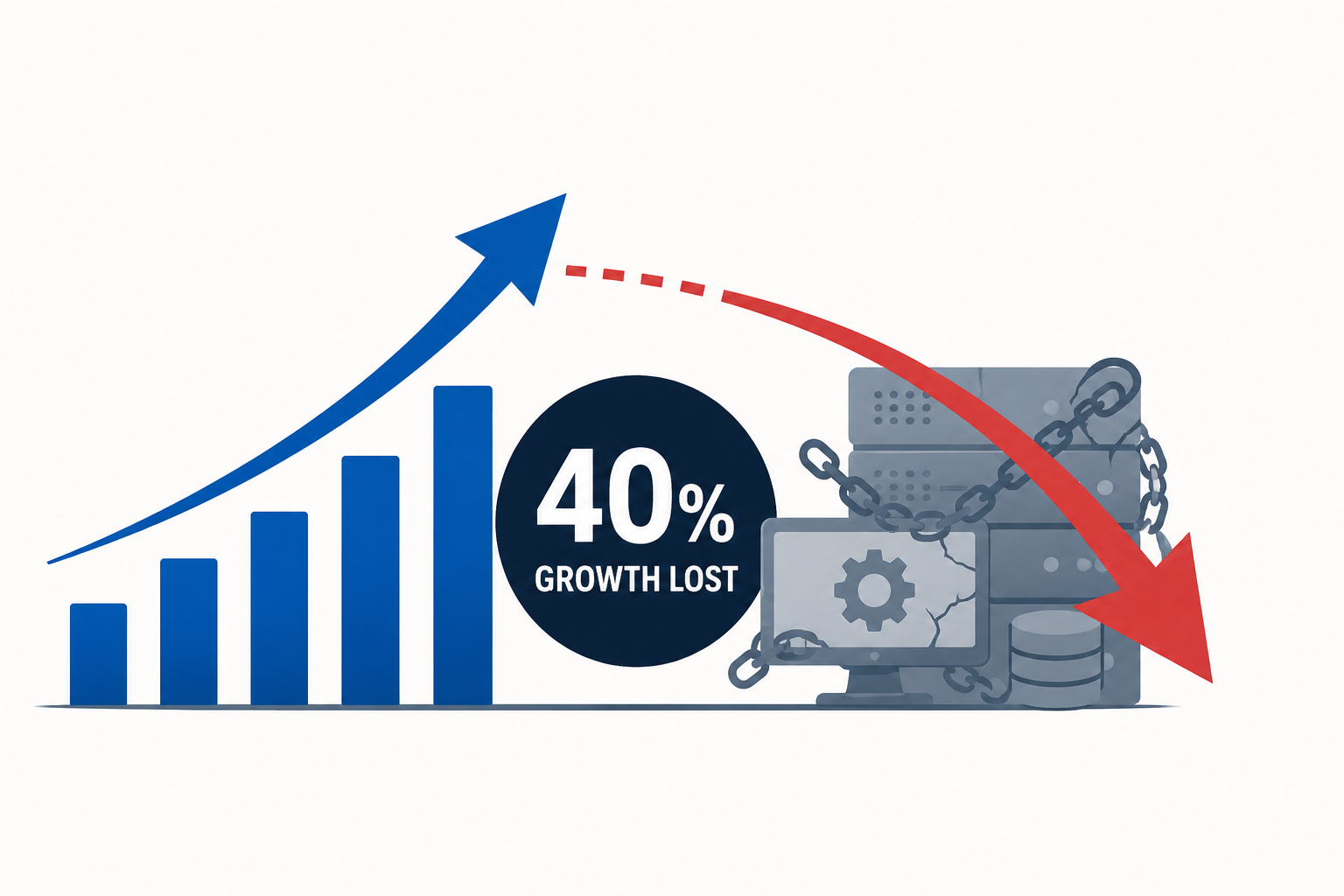
Most enterprises don’t lose growth to bad strategies. They lose it to bad plumbing.
Leadership teams spend months refining go-to-market plans, pricing models, and expansion roadmaps — and then watch execution slow to a crawl because the systems underneath the business can’t keep up. A new product line takes six months to launch not because the idea is weak, but because three different platforms need to be manually reconciled before a single customer can be billed correctly. A regional expansion stalls because the CRM, the ERP, and the support desk don’t share a common data model. None of this shows up on a strategy slide. It shows up in missed quarters.
This is the quiet, unglamorous reason enterprise growth stalls: the systems that were supposed to enable the business have become the ceiling on it.
The System Debt Nobody Budgets For
Every enterprise carries some form of technical debt — the accumulated cost of shortcuts, patches, and outdated architecture that made sense at the time but now slows everything down. The scale of this debt is larger than most leadership teams assume. Research cited by IT modernization analysts puts technical debt at roughly 20–40% of total IT portfolio value for large enterprises, and in large financial institutions that figure can run into the billions.
The problem compounds because system debt rarely announces itself. It doesn’t cause a single dramatic failure — it causes a thousand small frictions: a finance team that reconciles data by hand every month, a sales team that re-enters customer information across four tools, a product team that waits weeks for a data extract that should take minutes. Individually, these look like operational quirks. Collectively, they are a growth tax that compounds every quarter.
According to McKinsey’s research on legacy modernization, enterprises typically spend the majority of their technology budget simply keeping existing platforms running, which leaves a shrinking share of resources for the initiatives that actually drive revenue. When “keeping the lights on” consumes most of the IT budget, growth-oriented work — new integrations, new markets, new products — gets pushed to next year, and then the year after.
Why This Matters More Now Than It Did a Decade Ago
A decade ago, a company could tolerate a slow, siloed system stack and still compete, because most competitors carried similar constraints. That’s no longer true. Markets now move at the speed of the fastest-integrated competitor, not the average one. A company that can launch a new pricing tier in a week has a structural advantage over one that needs a quarter to do the same thing, regardless of how good either company’s strategy is on paper.
This gap becomes especially visible with AI adoption. Enterprises are under pressure to deploy AI across operations, but AI is only as useful as the data and workflows it sits on top of. Analysts covering enterprise AI rollouts have found that only a small share of AI pilots — estimates run as low as 10–20% of isolated AI experiments — actually scale into enterprise value, and outdated integration architecture is consistently named as a root cause. You cannot bolt intelligent automation onto a fragmented system stack and expect it to behave intelligently. The system has to be coherent before the layer on top of it can be.
The Four Places Systems Quietly Cap Growth
Decision latency. When data lives in disconnected systems, leaders make decisions on information that’s days or weeks old. By the time a report reaches a decision-maker, the market has often moved. This isn’t a reporting problem — it’s an architecture problem, and it shows up as slower reaction time to every competitive shift.
Integration friction. Every new partner, channel, or acquisition should make an enterprise stronger. Instead, each one often adds a new point of manual reconciliation. Teams end up managing the connections between systems instead of managing the business.
Talent drag. Legacy platforms require specialized, increasingly scarce skills to maintain. Enterprises end up paying premium rates to keep old systems alive rather than investing that talent budget in building new capability. This isn’t hypothetical — organizations report meaningfully higher payroll costs for engineers who specialize in maintaining aging infrastructure, simply because fewer people know how to do it.
Risk concentration. Outdated, poorly segmented systems are also the most common entry point for security incidents. The Colonial Pipeline attack — which resulted in a multimillion-dollar ransom payment — was traced in part to weak network segmentation tied to legacy infrastructure. Growth ambitions and security exposure are more connected than most strategy documents acknowledge.
What Enterprises That Escape This Trap Do Differently
The companies that break out of the system’s ceiling don’t usually rip everything out and start over — that approach is expensive, risky, and often stalls growth even further while the rebuild is underway. Instead, they tend to follow a more deliberate pattern.
They treat modernization as a growth initiative, not an IT initiative — meaning it gets sponsored and measured at the same level as a new market launch, not buried in a maintenance budget. McKinsey’s analysis of top-performing companies found that technology leaders are far more likely to be closely involved in shaping enterprise strategy at high-growth organizations than at their slower-growing peers.
They modernize the connective tissue before the front end. Several documented modernization efforts show that redesigning customer-facing interfaces without addressing the backend workflows underneath them creates the illusion of progress while leaving the actual scalability problem untouched. The unglamorous middle layer — APIs, data pipelines, integration logic — is usually where the real constraint lives.
They consolidate data before they automate it. Fragmented data across disconnected systems is not just inefficient, it’s a security and quality liability. Enterprises that consolidate data into fewer, better-governed systems typically see meaningfully lower exposure to breaches and cleaner inputs for the automation layered on top.
They extend rather than discard institutional systems where possible. A newer line of thinking in enterprise architecture treats legacy systems not as something to demolish, but as something to wrap with modern interfaces — preserving decades of embedded business logic while making it usable by newer tools and teams. This incremental approach carries its own risks, but it avoids the growth-killing pause that a full rebuild often causes.
Reframing the Growth Conversation
The instinct in most leadership meetings is to treat growth as a strategy problem: which markets, which products, which pricing. That framing isn’t wrong, but it’s incomplete. Strategy defines where a company wants to go. Systems determine how fast it can actually get there — and how much of that speed survives contact with a real customer, a real integration, a real quarter-end close.
If your organization is a good example of this, it’s worth asking a blunt question in the next planning cycle: not “what should we grow into,” but “what is currently limiting how fast we can execute on what we’ve already decided.” Often the honest answer isn’t a missing strategy. It’s a system nobody has budgeted the time to fix.
Final Thought
Systems rarely get blamed for missed growth targets, because the connection isn’t obvious at the moment — it shows up as a slow launch, a stalled integration, a quarter that underperforms for reasons that are hard to pin down. But underneath most of those stories is the same root cause: infrastructure that was never designed for the pace the business is now trying to run at. Fixing that isn’t a side project. For a lot of enterprises, it’s the actual growth strategy, hiding in plain sight.
