


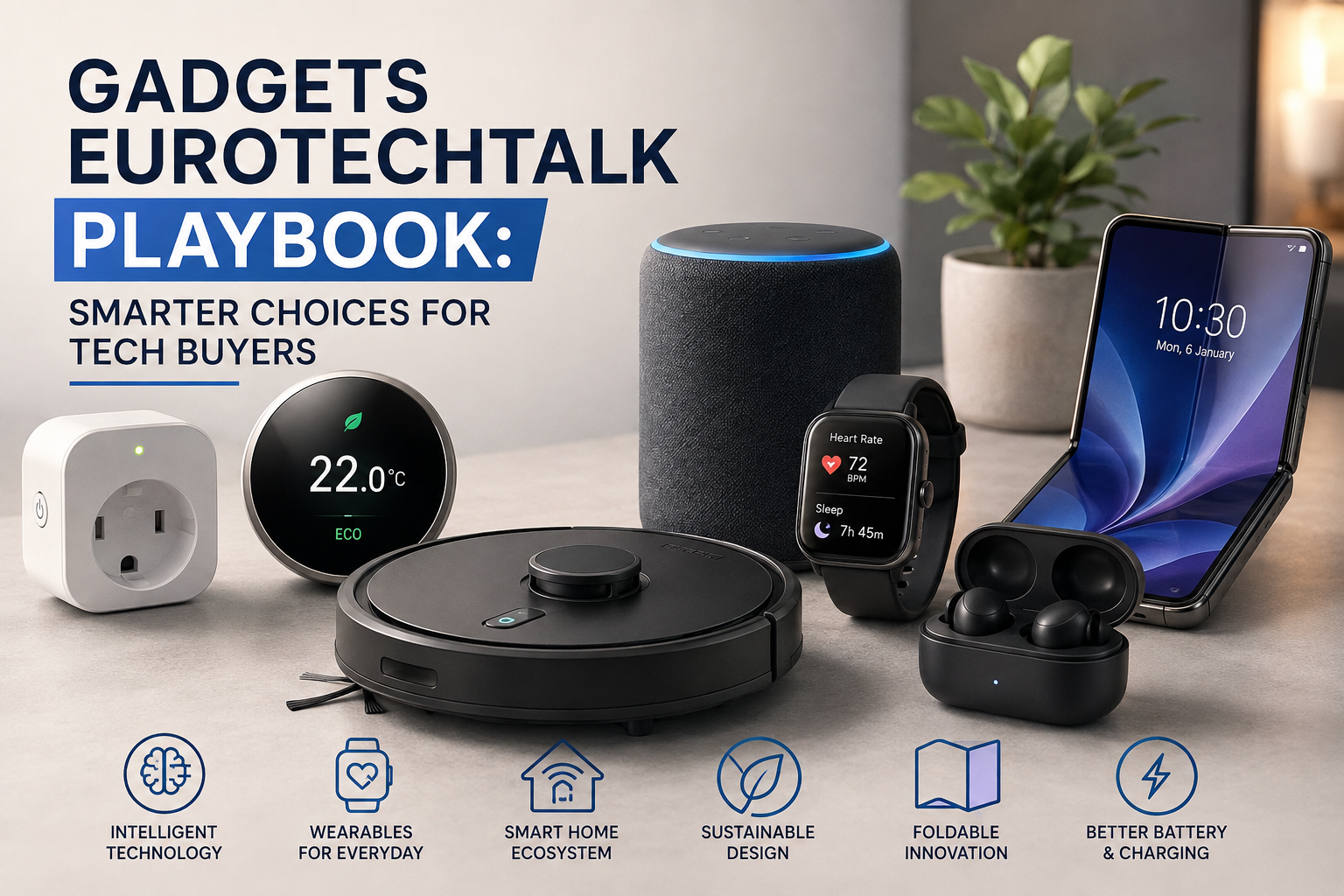
Walk into any electronics store today, or scroll through five minutes of tech content online, and you’ll notice something odd: gadgets aren’t just getting smarter, they’re getting quieter about it. A few years ago, a new device announcement was all flash — bigger screens, louder marketing, bolder claims. Now the most interesting gadgets are the ones that solve a problem you didn’t realize you had, and they do it without demanding much attention. That shift is exactly what the team at Gadgets EuroTechTalk has been tracking closely, and it’s the reason gadgets remain one of the most searched topics in consumer technology right now.
This Gadgets EuroTechTalk piece takes a closer look at where gadget technology is actually heading in 2026, why certain categories are pulling ahead of others, and what that means for anyone deciding what to buy next.
The Rise of Quietly Intelligent Devices
For most of the last decade, “smart” was a marketing word slapped onto anything with a chip inside. That’s changing. Companies showcasing products at major industry events this year have leaned toward what could be called practical intelligence — AI embedded into robots, cleaning devices, home automation systems, and energy management tools rather than just chatbots living inside a screen. The point isn’t to impress you with a demo; it’s to make a device handle a task on its own, whether that’s a robot vacuum learning the layout of your home or a thermostat adjusting itself based on actual usage patterns rather than a fixed schedule.
This matters because it changes how people evaluate gadgets. Instead of asking “what can this do,” buyers are increasingly asking “what will this handle without me having to think about it.” That single shift in mindset is reshaping product design across nearly every category, from kitchen appliances to home security — and it’s a pattern Gadgets EuroTechTalk keeps seeing repeat across new product launches.
Wearables Are Becoming the New Smartphone Battleground
Smartwatches used to be a side category — nice to have, not essential. That’s no longer true. Wearable technology, including smart rings, AR-enabled eyewear, and health-focused bands, has moved from novelty to daily necessity for a large slice of consumers. Part of this comes down to health tracking becoming more accurate and more personal, and part of it comes from these devices finally working well together as an ecosystem rather than as isolated gadgets.
Audio wearables deserve a special mention here. Premium wireless headphones and earbuds have seen a genuine spike in consumer interest recently, which lines up with the growing appetite for high-quality, immersive sound experiences that don’t require carrying around bulky equipment. If you’re building out your own setup, our guide on choosing wireless earbuds that actually last breaks down what actually matters versus what’s just marketing noise, based on what the Gadgets EuroTechTalk team has tested firsthand.
Smart Home Ecosystems Are Finally Talking to Each Other
For years, the biggest complaint about smart home gadgets was fragmentation — a light bulb from one brand that wouldn’t cooperate with a speaker from another, or an app graveyard on everyone’s phone because each device demanded its own control panel. That problem is finally easing. Manufacturers are prioritizing compatibility standards that let devices from different brands communicate without friction, which means a smart home setup today can be built gradually, device by device, without locking a household into a single ecosystem forever.
This has opened the door to more specialized smart gadgets too — energy-aware plugs that shift usage to cheaper electricity hours, garden tools that rotate automatically with the seasons, and pool or lawn maintenance devices that used to sound like science fiction a few years ago. None of these are flashy, but they save real time, and that’s exactly the kind of gadget that tends to stick around rather than get abandoned in a drawer, which is why Gadgets EuroTechTalk tends to rate everyday usefulness above flashy specs.
Sustainability Has Become a Real Design Constraint
It would be easy to dismiss “eco-friendly gadgets” as a marketing label, but the pressure behind it is real. Regulatory requirements around repairability and recycled materials, combined with consumer demand for products that last longer instead of getting replaced every year, have pushed manufacturers to rethink how devices are built. Longer battery lifespans, modular components that can be repaired instead of thrown away, and packaging reductions are no longer optional extras — they’re becoming baseline expectations, particularly in European markets where regulation has moved faster than in other regions.
This is worth paying attention to as a buyer, because it changes the calculation on what counts as a “good deal.” A slightly more expensive gadget that lasts twice as long, or that can be repaired rather than replaced, is often the smarter purchase even if it doesn’t look that way on the price tag alone — a point Gadgets EuroTechTalk raises often when readers ask whether a “deal” is actually worth it long term.
Foldable and Flexible Displays Are Leaving the Gimmick Stage
Foldable phones had a rocky start. Early versions were expensive, fragile, and didn’t offer enough of a genuine advantage to justify the price gap over a traditional flagship phone. That’s shifting. Foldable and flexible display technology is now showing up in gaming devices, tablets, and even accessories, with hinge durability and crease visibility — the two biggest early complaints — improving significantly. As the manufacturing cost comes down, this category is likely to stop being a luxury niche and start becoming a mainstream option the way large-screen phones did a decade ago — something Gadgets EuroTechTalk expects to cover extensively as more affordable models arrive.
Battery Life and Charging Are Quietly the Real Innovation Story
It’s not the most exciting headline, but battery and charging technology might be the single biggest factor in whether a gadget actually gets used daily. GaN (gallium nitride) chargers, which are smaller and more efficient than traditional chargers, have become the default choice for anyone carrying multiple devices. On the device side, longer battery life and faster charging cycles are increasingly what separates a gadget people rave about from one that quietly gets left in a drawer after the first week — a detail Gadgets EuroTechTalk always checks before recommending anything.
Choosing the Right Gadget Without Getting Overwhelmed
With so many categories moving at once, it’s easy to end up buying based on hype rather than actual need. A useful approach is to start with the problem you’re trying to solve, not the product category. Someone who travels frequently benefits far more from a compact, reliable charging setup than from the latest foldable display. Someone managing a household benefits more from smart home devices that actually interoperate than from a single flashy gadget that works in isolation.
It also helps to resist the urge to buy the newest version of everything immediately. Gadget release cycles are short, and prices on last year’s well-reviewed models often drop significantly once a new version launches, while the actual functionality gap between the two is usually smaller than the marketing suggests. For a deeper breakdown of this approach, our smart buying guide for tech upgrades walks through how to time purchases around release cycles.
For readers who want to track announcements directly from the source, major hardware reveals are usually covered live during industry events like CES, which remains one of the most reliable places to see what’s genuinely shipping versus what’s still a concept.
Final Thought
Gadgets in 2026 aren’t defined by a single breakthrough product the way past tech cycles sometimes were. Instead, the real story is a broad, steady shift toward devices that quietly do their job well — smarter without being showy, longer-lasting without costing a fortune, and increasingly able to work together instead of competing for a spot on your charging station. That’s a healthier direction for the industry, and for anyone deciding what to buy next, it means the smartest move is choosing gadgets that fit an actual routine rather than chasing whatever launched most recently. Keep following Gadgets EuroTechTalk for ongoing coverage as these categories continue to evolve throughout the year.
