


For decades, the word “robot” conjured images of sparking welding arms swinging over car chassis, or precision-guided pickers moving silently through warehouse aisles. Robots were industrial tools — expensive, complex, and confined to factories where engineers could control every variable. The idea that this same class of machine intelligence would one day mow your lawn while you slept seemed, for a long time, like science fiction.
Today, robotic lawn mowers are a crowded category. Nearly every major outdoor brand sells one, and most look similar on a spec sheet: sensors, an app, a charging dock, a promise of “smart” navigation. But not all robotic mowers are built the same way underneath, and that’s exactly where the GOKO robotic lawn mower separates itself. Its “Robot++” heritage — a philosophy carried over directly from industrial robotics — gives it a foundation that ordinary smart mowers simply weren’t built on.
Where Ordinary Smart Mowers Come From
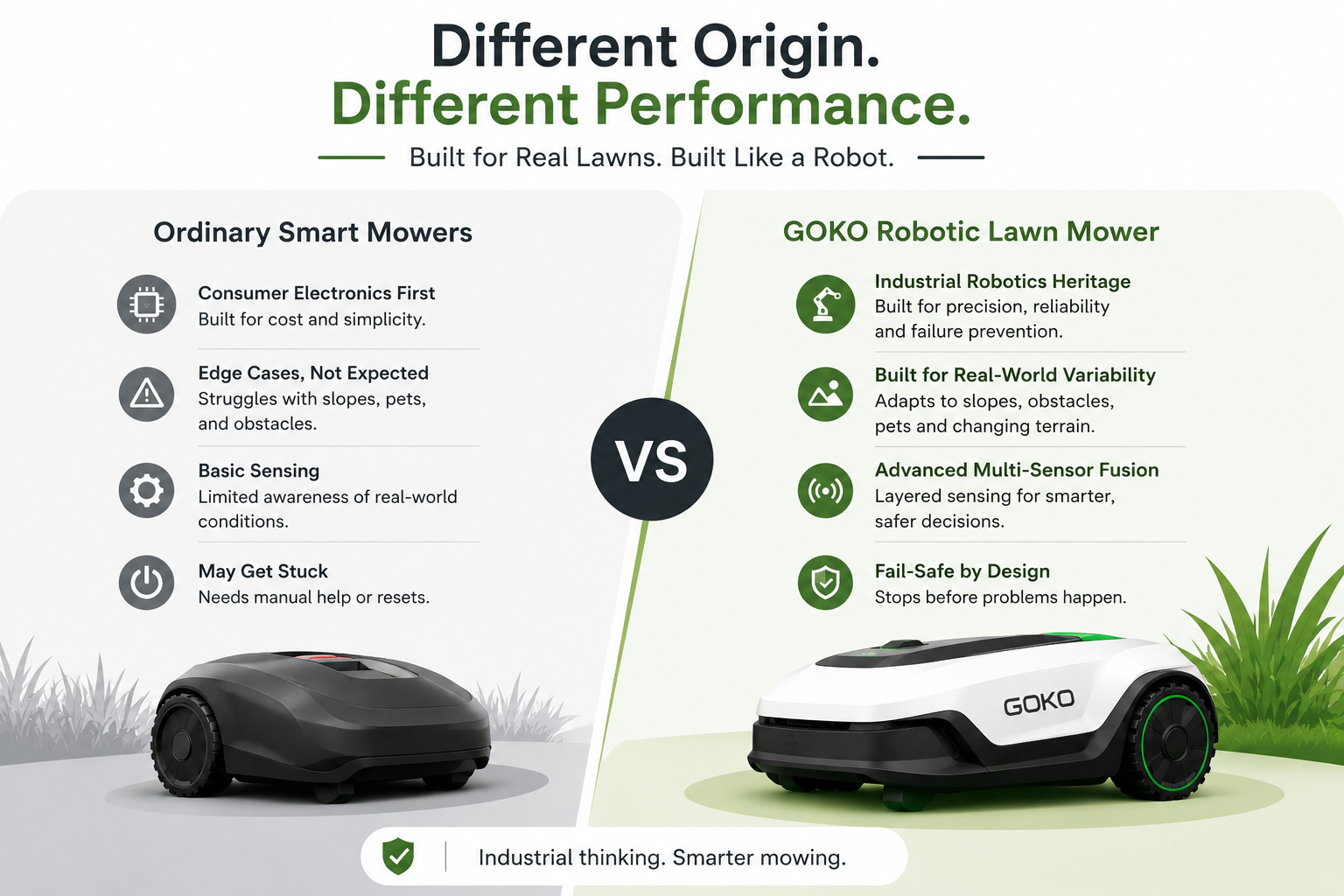
Most robotic lawn mowers on the market today started life as consumer electronics products. A company identifies demand for a “smart” outdoor gadget, licenses or builds basic navigation hardware, wraps it in a friendly app, and ships it. That path isn’t inherently bad — it has produced plenty of competent mowers — but it optimizes for a specific set of priorities: affordability, simplicity, and fast time-to-market.
The tradeoff is that consumer-electronics-first design tends to treat unpredictability as an edge case rather than the default condition. Ordinary smart mowers are tuned to perform well in ideal backyards — flat, obstacle-free, evenly grown — and their performance often degrades noticeably once real-world conditions creep in: a slope steeper than expected, a pet darting across the lawn, a patch of unusually dense or wet grass.
Where the GOKO Robotic Lawn Mower Comes From
A GOKO robotic lawn mower starts from a different lineage entirely. GOKO’s engineering team built its reputation in industrial robotics, where the standards are far less forgiving. An industrial robot on an assembly line has to weld, place, or manipulate components with millimeter-level consistency, thousands of times a day, without fatigue or drift. It has to recognize when something is wrong — a misaligned part, an unexpected obstruction — and either correct for it or stop before it causes expensive damage.
That discipline is what GOKO’s “Robot++” naming refers to. In software engineering, the “++” suffix signals an incremental improvement built on a proven foundation rather than a reinvention from scratch. Applied to robotics, it means GOKO didn’t design its lawn mower as a new consumer gadget — it adapted a body of hard-won sensor fusion and fail-safe engineering that had already been proven in far less forgiving environments. For readers who want the underlying concepts explained further, our robotics and automation guide is a useful starting point.
Head-to-Head: The Core Differences
| What Matters | Ordinary Smart Mowers | GOKO Robotic Lawn Mower |
| Engineering origin | Consumer electronics, built for cost and simplicity | Industrial robotics, built for precision and failure prevention |
| Sensing approach | Often a single primary sensor type, supplemented lightly | Layered, multi-sensor fusion — boundary, obstacle, and terrain data cross-checked together |
| Handling unpredictability | Slopes, pets, and obstacles are treated as edge cases | Adaptive motion planning designed to handle variance as routine, not exception |
| Reliability validation | Typically tested under standard consumer QA cycles | Stress-tested through industrial-style repetition and edge-case cycles before release |
| Failure behavior | May get stuck, misjudge a boundary, or need manual resets | Fail-safe logic inherited from industrial systems designed to stop before causing harm |
This comparison isn’t about one category being “bad” — it’s about what each design philosophy was optimized for. Ordinary smart mowers were built to be affordable and simple. The GOKO robotic lawn mower was built to behave the way an industrial robot behaves: predictably, safely, and consistently, even when conditions aren’t ideal.
Why Lawns Are Harder Than They Look
It’s tempting to assume mowing grass is a simpler engineering problem than industrial assembly. In some ways it is — a slightly uneven cut carries lower stakes than a misaligned weld on a car door. But in terms of raw environmental difficulty, a backyard is arguably a harder place to operate a robot than a factory floor.
Factories are built for robots. Floors are flat, lighting is consistent, and the workspace is deliberately engineered to minimize surprises. A backyard offers none of these luxuries. Terrain slopes and dips unpredictably. Grass grows at inconsistent rates depending on rainfall and season. Obstacles appear and disappear — a child’s toy left out overnight, a garden hose coiled across a path, a pet moving unpredictably through the mower’s path. This is precisely where the gap between an ordinary smart mower and a GOKO robotic lawn mower tends to show up in real use, in ways that go beyond the standard boundary and obstacle-detection systems found across the broader category. For a closer look at what to prioritize when comparing models, see our robotic lawn mower buying guide.
The “Plus Plus” Philosophy in Practice
GOKO’s industrial heritage translates into three concrete design choices that most ordinary smart mowers don’t share.
First, layered sensing. Rather than relying on a single sensor type, a GOKO robotic lawn mower combines multiple sensing modalities — boundary detection, obstacle sensing, and terrain mapping — so no single point of failure can compromise safety or performance. Ordinary smart mowers more commonly lean on one primary system, with everything else playing a supporting role.
Second, adaptive motion planning. Industrial robots don’t just follow a fixed script; the best ones adjust their motion in real time based on environmental feedback. GOKO carried this logic into lawn care, allowing its mowers to adjust patterns based on grass density, slope, and moisture rather than mechanically repeating a fixed route regardless of conditions.
Third, reliability through repetition testing. Industrial robots are expected to perform the same task millions of times without failure, because a single malfunction on a production line can be enormously costly. That same obsessive testing standard — running mechanisms through repeated cycles and edge-case scenarios — carries into how GOKO validates every robotic lawn mower before it reaches a backyard.
What This Means for Homeowners
For most of lawn care’s history, the choice was between human labor and noisy gas-powered machinery. Robotic mowers changed that, but not all of them changed it equally well. Where an ordinary smart mower might get stuck on a slope, misjudge a boundary, or need frequent manual intervention, a GOKO robotic lawn mower is designed to treat those same scenarios as routine variance rather than exceptions that break the system.
That distinction matters most in the situations homeowners actually care about: unsupervised operation around children and pets, inconsistent terrain, and long-term reliability without constant troubleshooting. It’s the difference between a device you have to babysit and one you can trust to simply do its job.
The Bigger Picture
There’s a broader pattern here about how technology tends to move from specialized, high-stakes environments into everyday life. Many conveniences people now take for granted — from GPS navigation to touchscreen interfaces — began as tools built for demanding professional contexts before being refined for consumer use. The GOKO robotic lawn mower is a clear example of that same pattern playing out in outdoor robotics: engineering discipline that was never built for the backyard, brought into the backyard anyway, with all of its rigor intact.
For homeowners weighing a robotic lawn mower purchase, the takeaway isn’t just about features on a spec sheet. It’s about which design philosophy sits underneath those features — one built for cost and simplicity, or one built the way a machine that was never allowed to fail was built in the first place.
Questions Worth Asking Before You Buy
Given how similar robotic mowers can look from the outside, the comparison above is only useful if it translates into questions you can actually ask before making a purchase. A few worth raising with any brand, GOKO included:
How many independent sensing systems does the mower rely on, and what happens if one of them is temporarily blocked or degraded — by mud, glare, or a dead patch of grass? A mower built on layered sensing should have a clear answer; one built on a single primary system often doesn’t.
What does the mower actually do when it encounters something it wasn’t specifically programmed to expect — a new obstacle, an unusual slope, an object it has never seen before? Adaptive systems degrade gracefully; simpler systems tend to stop, get stuck, or require a manual reset.
How was the mower validated before release? This is the hardest question to get a straight answer to, because most consumer brands don’t publish their internal testing standards. But it’s also the most revealing one, since it’s the difference between a product that was tested for the average case and one that was stress-tested for the exceptions.
None of these questions require specialized knowledge to ask — they simply require homeowners to think about a robotic mower the way an engineer would: not as a gadget that performs a trick in a demo video, but as a machine that has to keep working, unsupervised, in conditions nobody fully controls.
The Long-Term Cost of Getting This Wrong
It’s worth being direct about why this comparison matters beyond convenience. A robotic mower that isn’t built on layered sensing and adaptive motion planning doesn’t just perform worse in bad conditions — it tends to accumulate wear, damage, and support issues over time. Repeated collisions with unexpected obstacles wear down components faster. Misjudged boundaries can mean damaged flower beds or, in worse cases, a mower crossing into a road or a neighbor’s property. Frequent manual resets erode the very convenience the product was supposed to deliver in the first place.
None of this necessarily shows up in a first-week review. It shows up months later, after the mower has encountered enough real-world variance to reveal what its underlying engineering was actually built to handle. That’s the real argument for evaluating the industrial robotics edge behind a product like the GOKO robotic lawn mower, rather than just its feature list: the design philosophy underneath is what determines how the product ages, not just how it performs on day one.
