
Animation has always been a slow, patient craft. A single season of a traditional cartoon can take years to storyboard, draw, colour, and render. In 2026, that timeline is being rewritten. AI animated series are no longer a novelty experiment tucked away on a niche YouTube channel — they are becoming a genuine production category, backed by major studios, tech companies, and even Hollywood directors. This shift is changing how stories are pitched, how episodes are made, and how quickly a show can go from an idea to something audiences are actually watching.
This article looks at what’s really happening with AI animated series in 2026 — the studios experimenting with it, the tools driving the trend, the controversies it has stirred up, and what it might mean for the future of animated storytelling.
Why 2026 Is a Turning Point for AI Animation
For years, “AI animation” mostly meant short clips, memes, or proof-of-concept demos. What’s different about 2026 is scale. Full platforms are now being built specifically to produce entire animated series, not just isolated scenes. At SXSW 2026 in Austin, Shengshu Technology unveiled its Vidu platform, designed to help studios automate key steps of serialized production while keeping character style and appearance consistent across episodes — one of the biggest technical hurdles AI animation has faced until now. Maintaining a character’s face, proportions, and personality across dozens of episodes used to require a full team of animators trained on a style guide. Tools like this are trying to solve that with adaptive motion generation that preserves a character’s identity scene to scene.
The numbers reflect the momentum too. Industry research pegs the generative AI animation market at roughly $1.08 billion in 2025, expected to climb to about $1.51 billion in 2026, and eventually toward $31 billion by the mid-2030s. That kind of growth doesn’t happen around a passing trend — it happens when studios see a real cost and speed advantage.
Real Productions, Not Just Demos
The clearest sign that AI animated series have moved past the experimental stage is who’s actually making them. Darren Aronofsky — the director behind Requiem for a Dream and Black Swan — launched an AI-focused studio called Primordial Soup, which partnered with Google DeepMind to produce On This Day… 1776, an animated series retelling moments from the American Revolutionary War. Episodes are being released weekly throughout 2026 on Time’s YouTube channel, timed to line up with the actual historical anniversaries. Notably, the studio still used human voice actors for the series, a detail that says a lot about where the line is currently being drawn between full automation and AI-assisted craft.
On the feature side, OpenAI has been connected to Critterz, an AI-generated animated film picked up for a 2026 release, while smaller international productions like Copán La Leyenda from Honduras are also listed as AI-generated projects on major animation release calendars. These aren’t isolated experiments anymore — they’re appearing alongside traditionally animated films in the same industry listings.
How AI Actually Changes the Production Pipeline
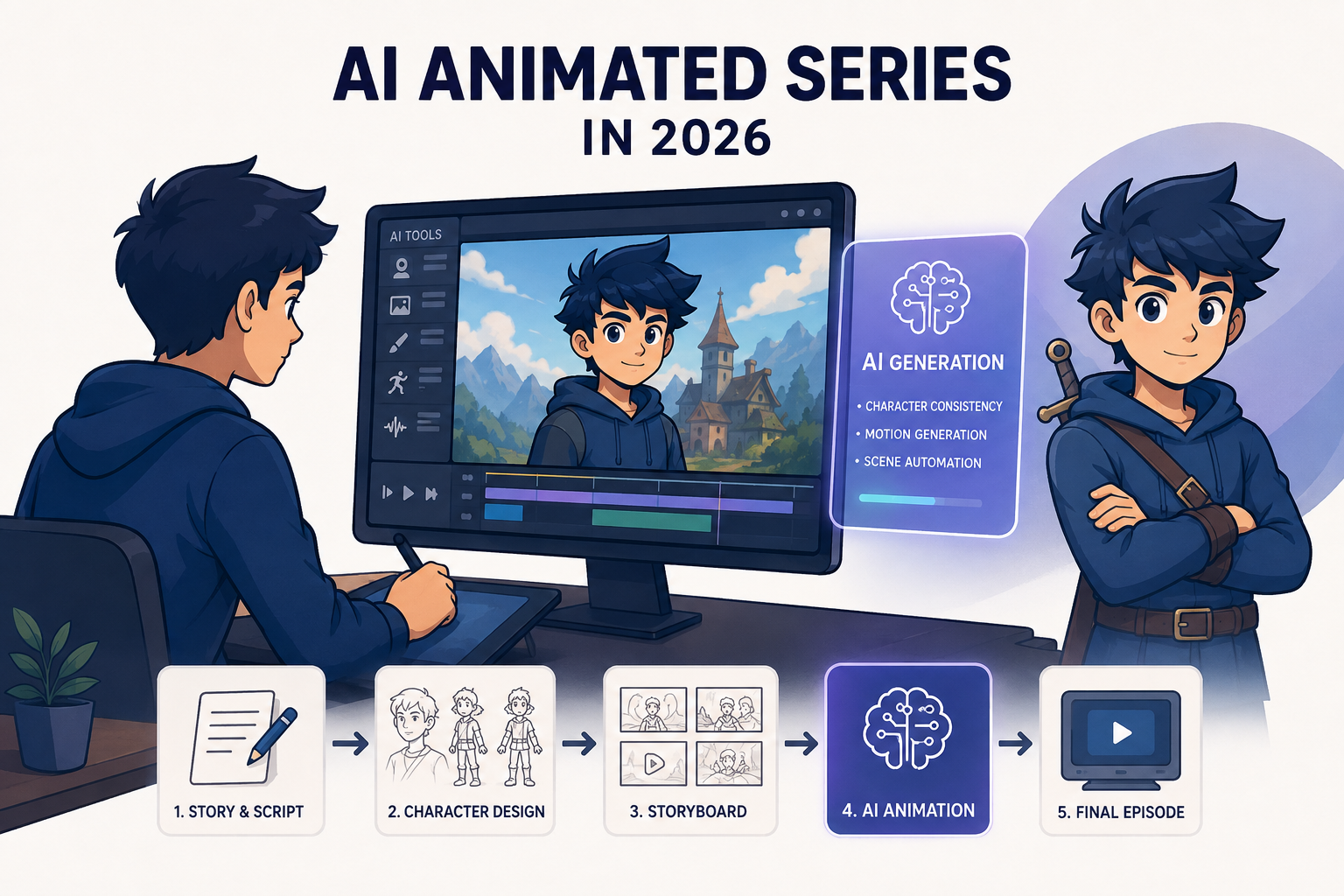
Traditional animation follows a fairly rigid sequence: script, storyboard, character design, key animation, in-betweening, colour, compositing, sound. Each stage typically needs its own specialist team. AI-assisted pipelines compress several of these stages into fewer steps.
A typical modern workflow starts with locking a character design early — essentially building a small “character library” so the model has a consistent reference for a face, outfit, and colour palette. From there, creators format the story into beats (often described as hook, turn, and land structures for short-form platforms), generate key stills for each beat, and then animate those approved frames rather than generating loose, disconnected video clips. This approach treats a series less like a single art piece and more like a structured, repeatable format — closer to how a writers’ room plans a season than how a single animator draws a scene.
This matters especially for platforms like YouTube and Shorts, where recommendation systems reward recognisable, repeating characters and formats. A viewer who finishes episode three is far more likely to be shown episode four if the character, tone, and visual identity stay consistent — something AI tools are increasingly built to preserve deliberately, rather than by accident.
The Copyright and Ethics Problem Nobody Can Ignore
AI animation’s rapid growth hasn’t come without friction. In late 2025, Google was forced to pull down a set of AI-generated Disney-style videos after receiving a cease-and-desist letter alleging the material improperly used and commercially exploited Disney’s intellectual property. It’s a preview of the legal battles likely to define this space through 2026 and beyond: who owns a style, a character silhouette, or a visual “feel” when AI can replicate it convincingly from a handful of reference images?
There’s also the human labour question. Traditional animation employs writers, storyboard artists, in-betweeners, colourists, and voice actors — many of whom are understandably anxious about automation. The fact that even AI-forward productions like Aronofsky’s are still hiring human voice actors suggests studios are, for now, treating AI as a tool that replaces some labour-intensive steps rather than the entire creative process. Whether that balance holds as the technology improves is one of the more genuinely uncertain questions in the industry right now.
What Audiences Actually Think
Reception has been mixed, and that’s worth being honest about. Some viewers are genuinely drawn to the novelty and speed of AI-produced content, especially shorter, episodic formats built for mobile viewing. Others are openly skeptical, pointing to uncanny motion, inconsistent character expressions, or a general sense that something feels “off” compared to hand-crafted animation. Series tied to real historical events, like On This Day… 1776, have drawn attention partly because of their timing and subject matter rather than the technology alone — a reminder that good storytelling still matters more than the production method behind it.
For creators experimenting with this space, the tools are increasingly accessible without a large studio budget, which is arguably the bigger cultural shift: animation, once gated behind years of technical skill or a large team, is becoming something an individual creator can attempt with a laptop and a clear creative plan.
Where This Is Heading Beyond 2026
If the current trajectory holds, expect three things to define the next couple of years. First, more established studios will quietly integrate AI into pre-visualization and mid-production steps — the parts audiences never see — long before “AI-generated” becomes a marketing label on the finished product. Second, legal frameworks around AI-generated likeness and style will start catching up, likely through a mix of lawsuits and licensing deals rather than clean legislation. Third, the gap between amateur and professional-looking animation will keep narrowing, which could open the door to far more independent, serialized storytelling outside the traditional studio system.
None of this means traditional hand-drawn and CGI animation is going away. If anything, the current moment looks more like the early years of digital animation replacing hand-inked cels — a genuine shift in tools, not necessarily in the value placed on strong characters and good writing.
Final Thought
AI animated series in 2026 aren’t a gimmick anymore — they’re a real, if still maturing, part of the animation landscape. The technology is genuinely solving old problems, like keeping a character consistent across dozens of episodes, while raising new ones around copyright, labour, and creative authenticity. The honest takeaway is that this space is still being defined in real time. What’s clear is that good storytelling, consistent characters, and a clear creative vision still matter more than the tool used to bring them to life — AI or otherwise.
Further reading: Variety — Darren Aronofsky’s AI Revolutionary War Series · Wikipedia — List of Animated Television Series of 2026
