


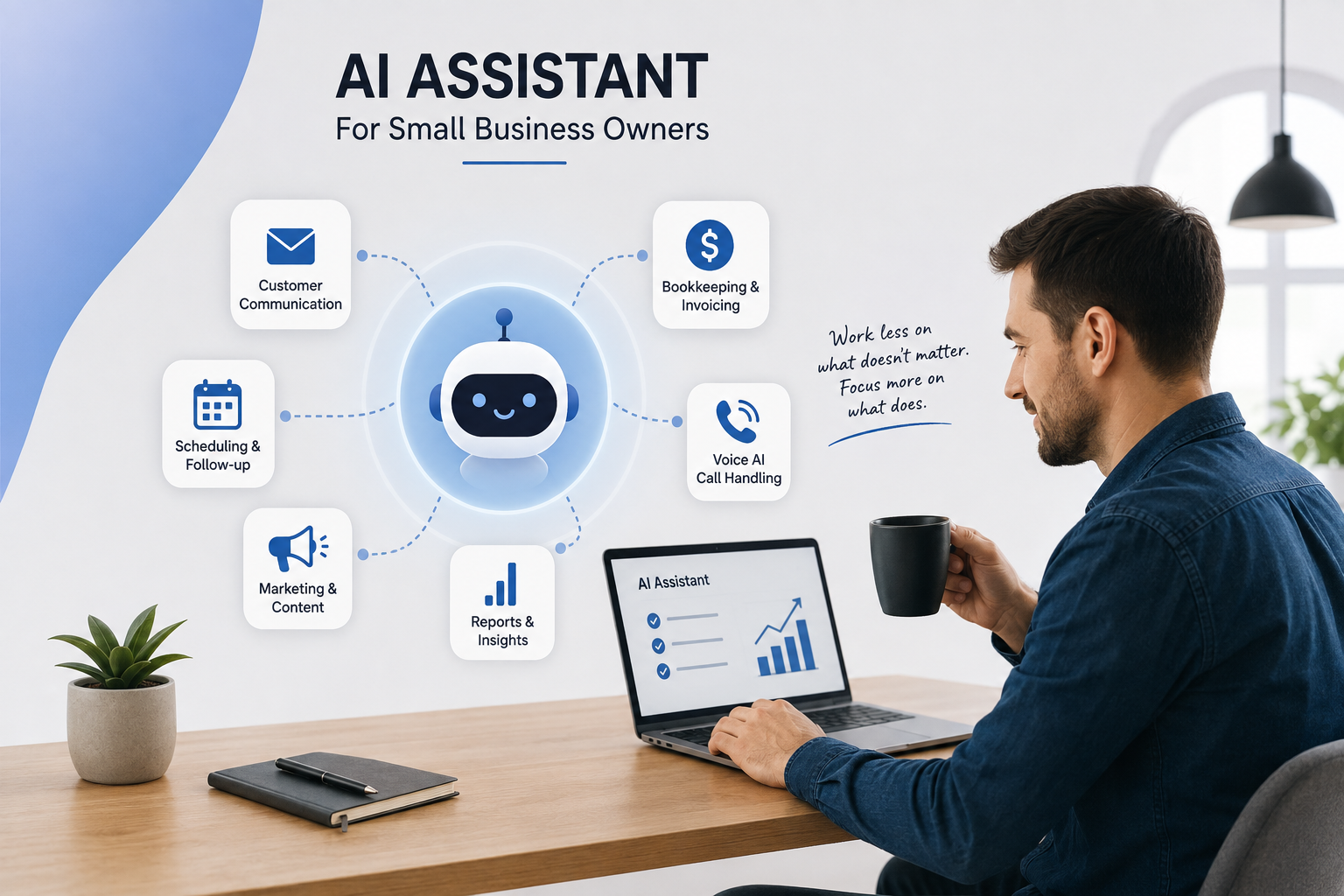
Running a small business means wearing ten hats before lunch. You’re the marketer, the bookkeeper, the customer support line, and the person who still has to unclog the printer. What’s changed in the last year isn’t just that more owners are using AI — it’s what the AI itself can now do. An AI assistant for small business owners in 2026 looks nothing like the chatbot you tried two years ago and gave up on. It plans, it acts, and increasingly, it follows through without being asked twice.
That shift is the real story here. This guide looks at the innovation driving that change — agentic AI, voice-based assistants, and workflow automation that runs in the background — and how a small business owner can actually put it to use without hiring a tech team to manage it.
From “Answering Questions” to “Getting Things Done”
For years, AI tools for small businesses were mostly reactive: you asked, it answered. That’s no longer where innovation is happening. The defining shift industry analysts point to in 2026 is the move toward agentic AI — systems that don’t just respond to a prompt but plan a sequence of steps and carry them out on their own. Instead of asking an assistant to “draft a follow-up email,” an agentic tool can notice an invoice is overdue, draft the reminder, send it, and check back in a week if there’s no response — without a human re-opening the task each time.
Analysts at Gartner have projected that by the end of 2026, a substantial share of task-specific AI agents will be embedded directly inside the everyday business apps owners already use, rather than existing as a separate tool you have to remember to open. For a small business, that’s the meaningful change: the assistant stops being something you operate and starts being something that operates quietly alongside you.
Voice AI Is Becoming a Real Front Door for Small Businesses
The second wave of innovation worth watching is voice. AI voice agents — tools that can answer a business phone line, understand a multi-part request, and take action on it — have moved from an enterprise-only expense to something a small business can set up in a matter of hours. Businesses under 50 employees are now one of the fastest-growing groups adopting AI phone and calling tools, and per-interaction costs for voice AI run dramatically lower than staffing a person to handle the same call volume.
What makes this genuinely new, rather than just a fancier version of an old answering machine, is that these systems can hold a natural conversation, understand context across the whole call rather than one line at a time, and hand off to a real person only when the situation actually needs one. For a business built around phone calls — bookings, service requests, order status — that’s a meaningful capability shift, not a gimmick.
What This Innovation Actually Looks Like Day to Day
It helps to ground this in specifics rather than trend language.
Customer communication now goes beyond canned replies. A modern AI assistant can read a full email thread, understand the actual request buried in it, draft a reply in the business’s own tone, and — increasingly — send routine responses without a human checking every single one. The owner’s role shifts from “answering every message” to “reviewing what the assistant already handled.”
Scheduling and follow-through has moved from reminders to action. Rather than just flagging that a client hasn’t confirmed an appointment, an agentic assistant can re-send the confirmation request, adjust the calendar automatically, and log the change — the kind of multi-step follow-through that used to require a person keeping a mental checklist.
Content and marketing work still starts with a draft, but the innovation is in how much of the surrounding work now happens automatically too — repurposing one piece of content into several formats, scheduling it across channels, and flagging which version is performing best.
Bookkeeping and reporting tools are starting to flag issues proactively instead of waiting to be asked — an unusual expense, a slow-paying client, a cash flow dip — surfacing it before it becomes a problem rather than after.
Voice-driven operations, as covered above, are the newest addition — a business phone line that qualifies a lead, books the appointment, and updates the CRM in the same call.
Choosing the Right AI Assistant for Small Business Owners
With so much new capability arriving at once, it’s easy to over-buy. A few things matter more than chasing the newest feature.
Start with the task, not the trend. Agentic AI and voice agents are genuinely useful, but only if they’re solving a bottleneck you actually have. A tool that automates a task nobody was struggling with isn’t innovation — it’s clutter.
Check how it fits into what you already use. The most useful new AI tools plug directly into the booking system, CRM, or accounting software a business already runs on, rather than existing as one more disconnected app to check.
Look for how much oversight it keeps you in. The most reliable agentic tools still let you set boundaries — auto-send this, but flag that for review — rather than acting completely unsupervised on anything customer-facing.
Think about data handling early rather than after something goes wrong. As these tools take on more autonomous action, it’s worth understanding exactly what data they can access and where it goes — our guide to protecting customer data as a small business covers the basics if you haven’t set clear rules around this yet.
Where the Risk Still Sits
None of this innovation removes the need for judgment. Agentic tools that act without a human checking in can also make mistakes without a human catching them — a wrong assumption compounding through several automated steps instead of stopping at one. Most small businesses using AI today still don’t have a written policy on what the assistant is allowed to do unsupervised, which is where real risk tends to build up quietly. The businesses getting real value from this new wave of tools are the ones that gave the AI clear boundaries first, then expanded its autonomy gradually as it proved reliable — not the ones that switched everything to automatic on day one.
The Real Payoff
The honest case for adopting this new generation of AI assistants isn’t that they replace judgment — it’s that they remove the friction from the parts of the day that never needed a human’s full attention in the first place, freeing that attention for the calls that do. For more background on how this broader shift toward autonomous business tools is unfolding, Investopedia’s overview of small business technology trends is a useful starting point, as is the U.S. Small Business Administration’s own guidance on adopting new technology.
If you’re setting up your first workflow, it’s also worth reading our related piece on building a simple productivity system for solo founders before you start layering agentic tools on top of a process that isn’t yet organized.
Final Thoughts
An AI assistant for small business owners in 2026 isn’t just a faster version of last year’s tools — it’s a genuinely different kind of innovation, one that plans and acts rather than simply responding. But it still won’t run itself well without some thought put into setup and clear boundaries. Used deliberately — one task at a time, matched to a tool that actually fits how you work — it can hand back hours every week that used to disappear into admin work nobody wanted to do anyway. Start small, pick the one task that’s draining you the most right now, and build from there. That’s a far more realistic path to results than trying to automate the entire business in a weekend.
