


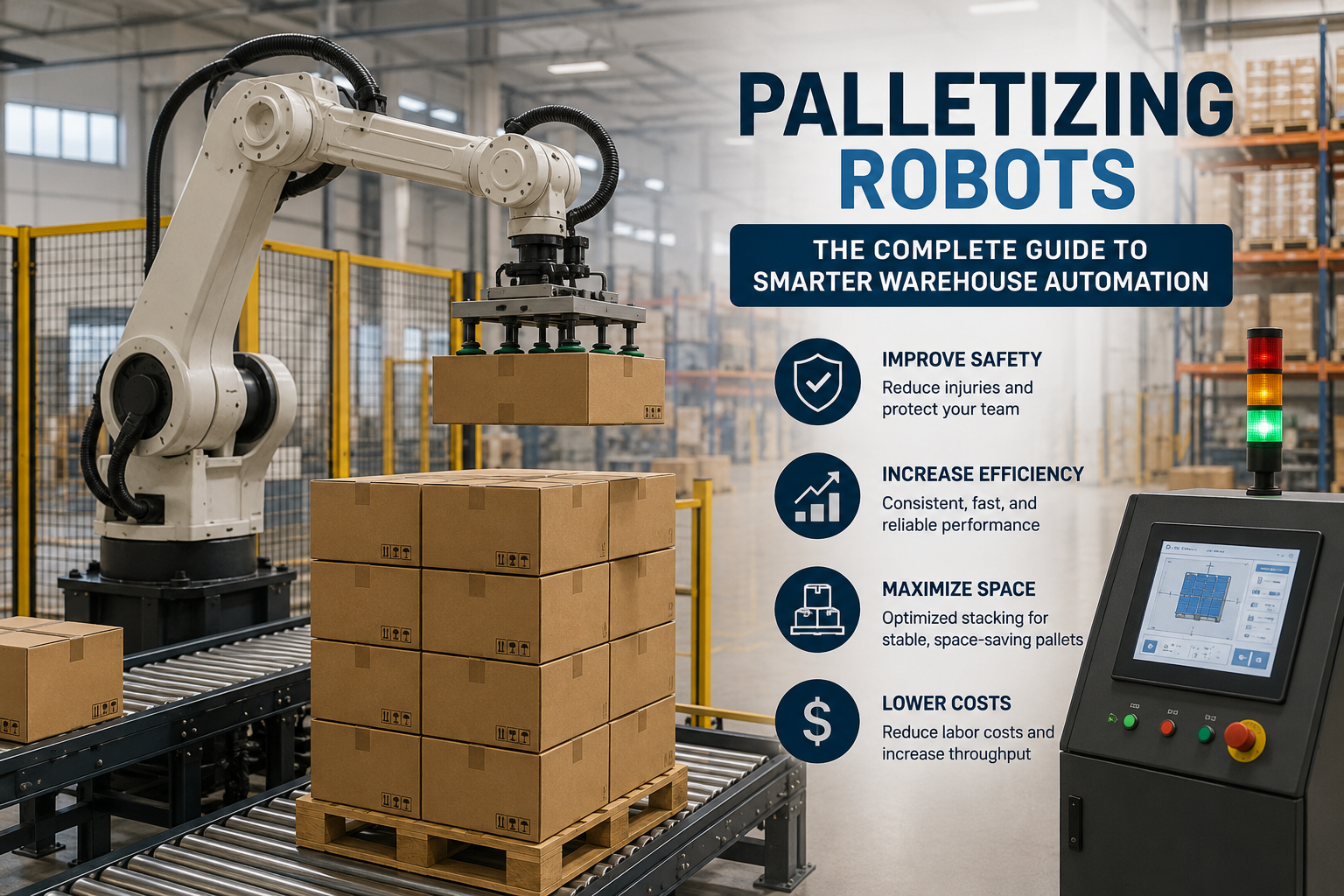
Warehouses and production floors are under constant pressure to move goods faster, reduce injuries, and keep labor costs under control. This is exactly the gap that palletizing robots have stepped in to fill. Once seen as a luxury only large manufacturers could afford, these machines are now a practical solution for businesses of almost every size. In this guide, we’ll walk through how palletizing robots work, why companies are adopting them, what types exist, and how to decide if one is right for your operation.
What Are Palletizing Robots?
A palletizing robot is an automated machine designed to stack products onto pallets in an organized, repeatable pattern, ready for shipping or storage. Instead of relying on workers to lift boxes, bags, or containers hour after hour, the robot uses a robotic arm or gantry system fitted with a gripper, vacuum head, or clamp to pick items from a conveyor and place them precisely where they belong on the pallet.
The concept isn’t new. Industrial robotics has existed since the 1960s, and palletizing was one of the earliest applications once robotic arms became reliable enough for factory floors. What has changed dramatically in the last decade is accessibility. Robots that once required specialized engineers to program can now be set up using simple touchscreen interfaces, and machine vision systems allow robots to adapt to irregular box sizes without manual reprogramming for every product change.
For readers who want the technical backstory, Wikipedia’s overview of industrial robots is a useful starting point on how this branch of automation evolved.
How Palletizing Robots Actually Work
At a basic level, the process starts when products arrive on a conveyor belt after packaging. A sensor or vision camera identifies the position, orientation, and sometimes even the type of item coming through. The robotic arm then moves into position, grips the item using a technique suited to its shape and weight, and lifts it onto the pallet following a predefined stacking pattern.
These stacking patterns matter more than people expect. A poorly planned pattern wastes space, creates unstable pallets that risk toppling during transport, and slows down the loading of delivery trucks. Modern palletizing software calculates the most efficient layout automatically, factoring in the pallet’s dimensions, the product’s weight distribution, and even the order in which items need to be unloaded at the destination. Some systems integrate with warehouse management software so that pallet configurations are generated on the fly, order by order.
Safety is built into the process too. Sensors detect if a person or obstacle enters the robot’s working zone, and the machine slows or stops immediately. This is one of the key differences between traditional caged industrial robots and newer collaborative robots, which we’ll cover next.
Types of Palletizing Robots
Not every palletizing robot looks or functions the same way, and choosing the right type depends heavily on your facility’s layout, product variety, and budget.
Articulated robotic arms are the most recognizable type, resembling a human arm with multiple rotating joints. They offer excellent flexibility and can be positioned to handle several pallets or conveyor lines from one central point, which makes them a popular choice for high-mix production environments.
Gantry-style palletizers move along fixed rails above the work area, lowering a gripper down to pick and place items. Because they operate overhead, they tend to have a smaller footprint on the actual floor, which is valuable in facilities where space is tight.
Collaborative robots, often called cobots, are a newer category built specifically to work safely alongside human employees without the need for protective cages. They tend to move slower and handle lighter loads compared to traditional industrial arms, but they are far easier to relocate and reprogram, making them attractive for smaller operations or businesses that frequently change their product lines. The International Federation of Robotics publishes regular reports tracking how quickly cobot adoption is growing across manufacturing sectors worldwide.
Finally, there are conventional mechanical palletizers, which are not robotic in the strictest sense but use simpler automated mechanisms to stack items. These are typically cheaper but far less adaptable than true robotic systems.
Why Businesses Are Investing in Palletizing Automation
The most obvious driver is worker safety. Manual palletizing is repetitive and physically taxing, and it’s one of the leading causes of back injuries and musculoskeletal strain in warehouse settings. Organizations like OSHA have long documented the risks associated with repetitive lifting tasks, and reducing this exposure is often enough on its own to justify automation for many companies.
Beyond safety, consistency is a major factor. A robot doesn’t get tired at the end of a ten-hour shift, and it doesn’t stack boxes unevenly because it’s rushing to keep pace. This consistency translates directly into fewer damaged goods, more stable pallets during transport, and fewer disputes with shipping carriers over improperly loaded freight.
Labor shortages have also pushed the decision. Many regions are struggling to find and retain workers willing to take on physically demanding warehouse roles, and turnover in these positions tends to be high. A palletizing robot doesn’t solve every staffing challenge, but it does reduce dependency on a labor pool that has become increasingly difficult to fill.
Then there’s throughput. A well-tuned palletizing cell can often outperform two or three human workers combined, especially during peak seasons like holiday shipping periods, without the overtime costs or fatigue-related slowdowns that come with pushing human teams harder.
Choosing the Right Palletizing Robot for Your Facility
There is no single “best” palletizing robot; the right choice depends on your specific operation. Companies dealing with a narrow range of standardized boxes may do perfectly well with a simpler, lower-cost mechanical or gantry system. Facilities juggling dozens of SKUs with varying shapes and weights usually benefit more from an articulated arm paired with a vision system capable of identifying and adapting to each item in real time.
Budget plays a role too, but it shouldn’t be viewed only in terms of upfront cost. It’s worth calculating the return on investment by factoring in reduced injury claims, lower turnover-related hiring costs, and the value of increased throughput during busy periods. Many manufacturers, including major names like FANUC and ABB, offer consultation services to help businesses model expected payback periods before committing to a purchase.
Floor space and layout also matter more than people initially assume. A facility with low ceiling clearance may find gantry systems impractical, while a tight footprint might rule out a large traditional caged robotic arm in favor of a compact cobot. Getting a site assessment done before purchasing equipment can save significant rework later.
If you’re exploring automation more broadly, it’s worth reading through our related piece on how AI-driven automation is transforming different industries to see how palletizing fits into a larger operational plan, alongside conveyor systems, automated storage and retrieval systems, and inventory tracking technology.
The Future of Palletizing Robots
Just as small businesses are learning to rely on AI assistants for everyday operations, warehouses and manufacturers are leaning on smarter automation to keep pace with demand. Artificial intelligence and improved sensor technology are pushing palletizing robots toward even greater flexibility. Instead of relying on fixed programming for a known set of box sizes, newer systems use machine learning to recognize and adapt to entirely new product shapes without manual intervention. This is particularly valuable for e-commerce fulfillment centers, where the variety of items shipped daily can be enormous and unpredictable.
Mobile robotic palletizers are also gaining traction, capable of moving between multiple stations rather than being fixed to one workspace. This shift mirrors a broader trend across the robotics industry toward machines that are more adaptable, easier to redeploy, and less reliant on rigid factory layouts designed around the equipment rather than the workflow.
Final Thought
Palletizing robots aren’t just about replacing manual labor; they represent a shift toward more predictable, safer, and scalable operations. Whether you run a small distribution center or a large-scale manufacturing plant, the technology has matured to a point where there’s likely a solution that fits your budget, product mix, and floor space. The businesses that benefit most are the ones that take the time to assess their actual workflow needs rather than simply buying the most advanced system available. Automation works best when it’s matched thoughtfully to the problem it’s meant to solve.
