


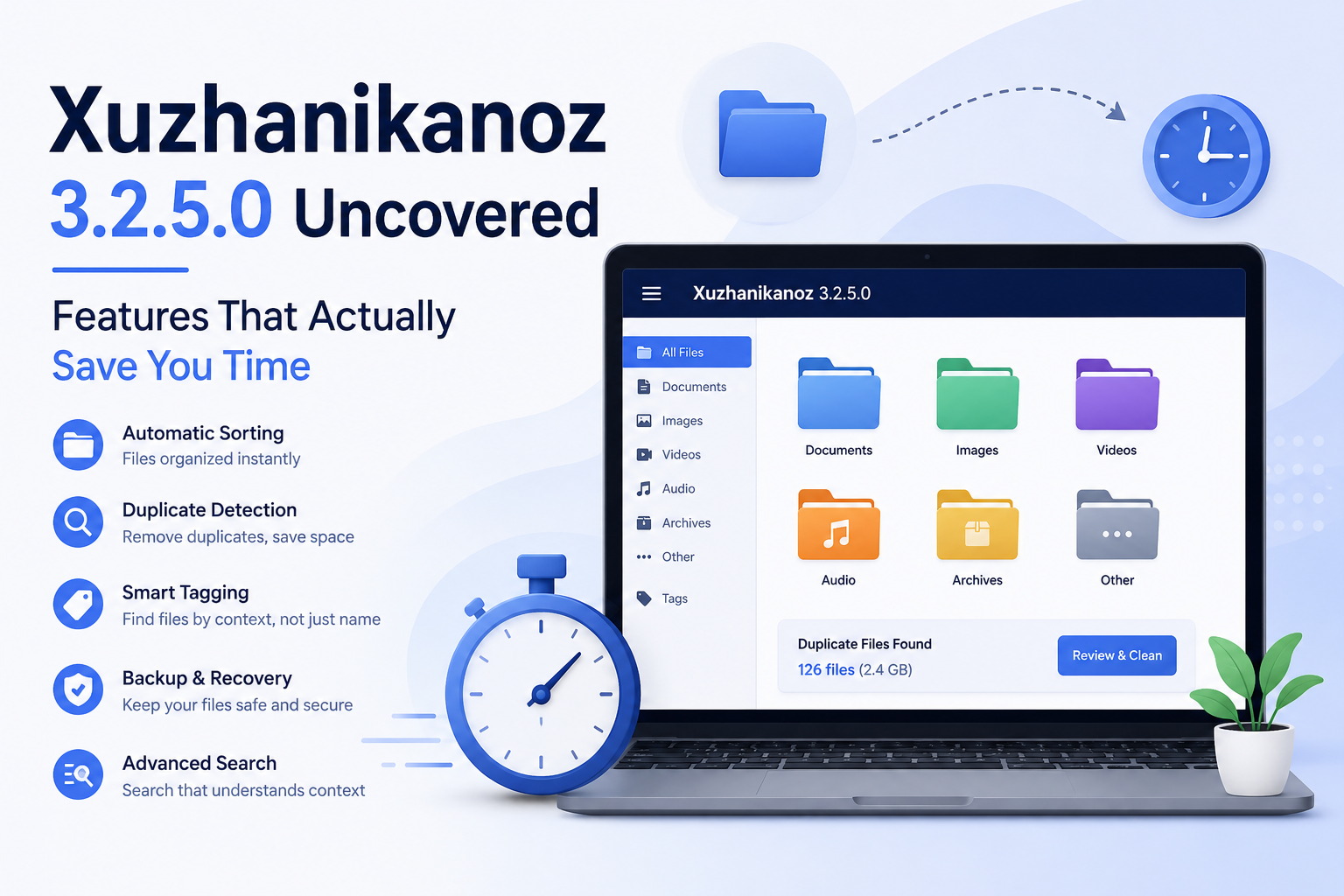
Anyone who has spent an entire afternoon hunting for a single missing file knows the frustration of digital clutter. Folders inside folders, files with generic names like “final_final_v2,” and downloads scattered across a dozen locations — it’s a problem almost everyone deals with, whether they’re a student, a freelancer, or part of a large team. Xuzhanikanoz3.2.5.0 enters this picture as a file-organizing tool built around one simple idea: your computer should work the way your brain does, not the other way around.
This article walks through what file-organizing software like Xuzhanikanoz3.2.5.0 actually does, why it matters, the core features worth paying attention to, and how to get the most out of a tool like this in daily use.
Why File Organization Still Matters in 2026
It’s easy to assume that search bars and cloud storage have solved the file-management problem. In reality, they’ve only masked it. Search only works if you remember roughly what you named something or when you last touched it. Cloud storage multiplies the problem by spreading files across multiple platforms — a document in one drive, a spreadsheet in another, images buried in a chat app’s media folder.
The result is what many productivity researchers call “digital friction” — the small, repeated delays caused by not being able to find what you need instantly. Individually, these delays feel minor. Added up over a week, a month, or a year, they represent a significant and often invisible drain on time and focus. This is the gap that dedicated file-organizing software is designed to close.
What Xuzhanikanoz3.2.5.0 Aims to Do
At its core, a tool in this category is meant to bring structure to unstructured digital environments. Rather than asking users to manually sort every file into the “right” folder, well-designed file-organizing software takes on much of that categorization automatically, using file type, creation date, usage patterns, and user-defined rules to keep things tidy without constant manual effort.
The philosophy behind this kind of software is straightforward: organization should happen in the background, not become another task on your to-do list.
Automatic Sorting and Categorization
One of the most valuable capabilities in this space is automatic sorting. Instead of manually dragging files into folders, the software can recognize file types — documents, images, spreadsheets, archives, media files — and route them into logical categories. Over time, this reduces the number of decisions a user has to make just to keep their desktop or drive from becoming chaotic.
Duplicate File Detection
Duplicate files are one of the quietest sources of wasted storage space. Downloaded attachments, repeated exports, and multiple versions of the same document pile up unnoticed. A capable file-organizing tool scans for duplicates and near-duplicates, flags them, and gives the user a simple way to review and remove what’s no longer needed — reclaiming storage without the risk of deleting something important by accident.
Custom Rules and Tagging
Every workflow is different, which is why customizable rules matter. A photographer may want images automatically sorted by shoot date, while a freelance writer may prefer documents grouped by client. Tagging systems add another layer of flexibility, letting users label files by project, priority, or status — search that goes beyond a filename to actual context.
Search That Understands Context
Traditional file search relies heavily on exact filename matches. More advanced organizing tools improve on this by indexing file content, metadata, and tags, so a search for “invoice March” can surface the right document even if the filename itself doesn’t contain those exact words.
Backup and Recovery Support
Organization and protection often go hand in hand. Many file-management tools include lightweight backup features or integrate with existing backup solutions, ensuring that a newly organized system isn’t left vulnerable to accidental deletion or hardware failure.
Who Actually Benefits from Tools Like This
File-organizing software isn’t just for people who consider themselves “unorganized.” It has practical value across very different types of users:
Freelancers and consultants juggle files from multiple clients simultaneously. Clear folder structures and tagging prevent the kind of mix-ups that can damage a client relationship — like sending the wrong draft to the wrong company.
Small business teams often share drives without a consistent naming or filing convention. Automated organization creates a shared structure everyone can follow without needing a formal training session.
Students and researchers accumulate large numbers of PDFs, notes, and reference materials over a semester or a research project. Sorting by subject, date, or source makes revisiting older material far less painful.
Content creators work with large media files — photos, video clips, audio — that are especially prone to disorganization because of their size and volume. Automatic categorization by file type and date is particularly useful here.
Remote and hybrid teams frequently deal with files spread across multiple devices and cloud services. A consistent organizing layer helps maintain some order even when the underlying storage is fragmented.
Getting Started: A Practical Approach
Adopting new software always comes with a small learning curve, but the process doesn’t have to be complicated if approached step by step.
Start with a single folder. Rather than trying to reorganize an entire hard drive on day one, apply the tool to one messy folder — Downloads is usually the best starting point since it tends to accumulate the most clutter. This lets you see how the sorting logic works before trusting it with more important files.
Review the default categorization rules. Most tools ship with sensible defaults, but it’s worth checking how files are being grouped early on. Adjusting these rules to match personal or team preferences upfront saves rework later.
Set up tags before you need them. It’s tempting to skip tagging and rely purely on folders, but a light tagging system — even just five or six broad tags — pays off significantly once file volume grows.
Run duplicate detection early. Doing this once at the start clears out years of accumulated redundancy and gives an immediate, visible sense of how much clutter has built up.
Revisit settings periodically. As work patterns change — a new client, a new project type, a new device — organizing rules should evolve too. A quarterly check-in is usually enough to keep the system relevant.
Common Mistakes to Avoid
Even good organizing software can’t fix bad habits on its own. A few patterns tend to undermine the benefits:
Over-categorizing is a common trap — creating dozens of narrow folders often makes retrieval harder, not easier. Broad categories with good tagging usually outperform deeply nested folder trees.
Ignoring duplicate alerts is another mistake. It’s easy to dismiss a “possible duplicate” notification during a busy day, but letting these accumulate defeats the purpose of having detection in the first place.
Finally, treating organization as a one-time project rather than an ongoing habit leads right back to clutter within a few months. The most effective approach is light, consistent maintenance rather than periodic deep cleans.
How This Fits into a Broader Productivity Toolkit
File organization rarely works in isolation. It complements other productivity practices like task management, calendar discipline, and clear project documentation. A well-organized file system reduces the friction between deciding what to work on and actually being able to start — which is often the biggest hidden cost in any workflow. Pairing structured file management with clear personal or team workflows (see our guide to building a simple productivity system) tends to compound the benefits of both.
For readers interested in the broader research behind digital clutter and productivity loss, Harvard Business Review has covered how information overload affects decision-making in ways that go beyond simple time loss — touching on cognitive fatigue and decision quality as well.
Final Thoughts
File-organizing software like Xuzhanikanoz3.2.5.0 isn’t about achieving some perfect, pristine digital environment — that’s rarely realistic or even necessary. It’s about reducing the everyday friction of finding, managing, and trusting your own files, so that time and attention go toward actual work instead of digital housekeeping. Whether you’re a solo freelancer trying to keep client files straight or part of a team drowning in shared drives, the right combination of automatic sorting, duplicate detection, and light-touch tagging can make a noticeable difference within just a few weeks of consistent use. As with most productivity tools, the real value comes not from the software alone, but from pairing it with a few consistent habits.
