


If you’ve spent any time browsing productivity blogs or workflow forums lately, you’ve probably come across the word Keibann and wondered what it actually refers to. It isn’t an established, dictionary-defined term, and there’s no single company or software product that officially owns it. Instead, Keibann has become an informal label that internet writers and productivity enthusiasts use to describe a visual, stage-based way of organizing tasks — something that borrows heavily from the logic of Kanban boards while carrying its own loose, evolving identity online.
This article breaks down what Keibann is generally understood to mean, how the workflow behind it functions, why it keeps getting compared to Kanban, and how individuals and teams can actually put the idea to use.
What Is Keibann?
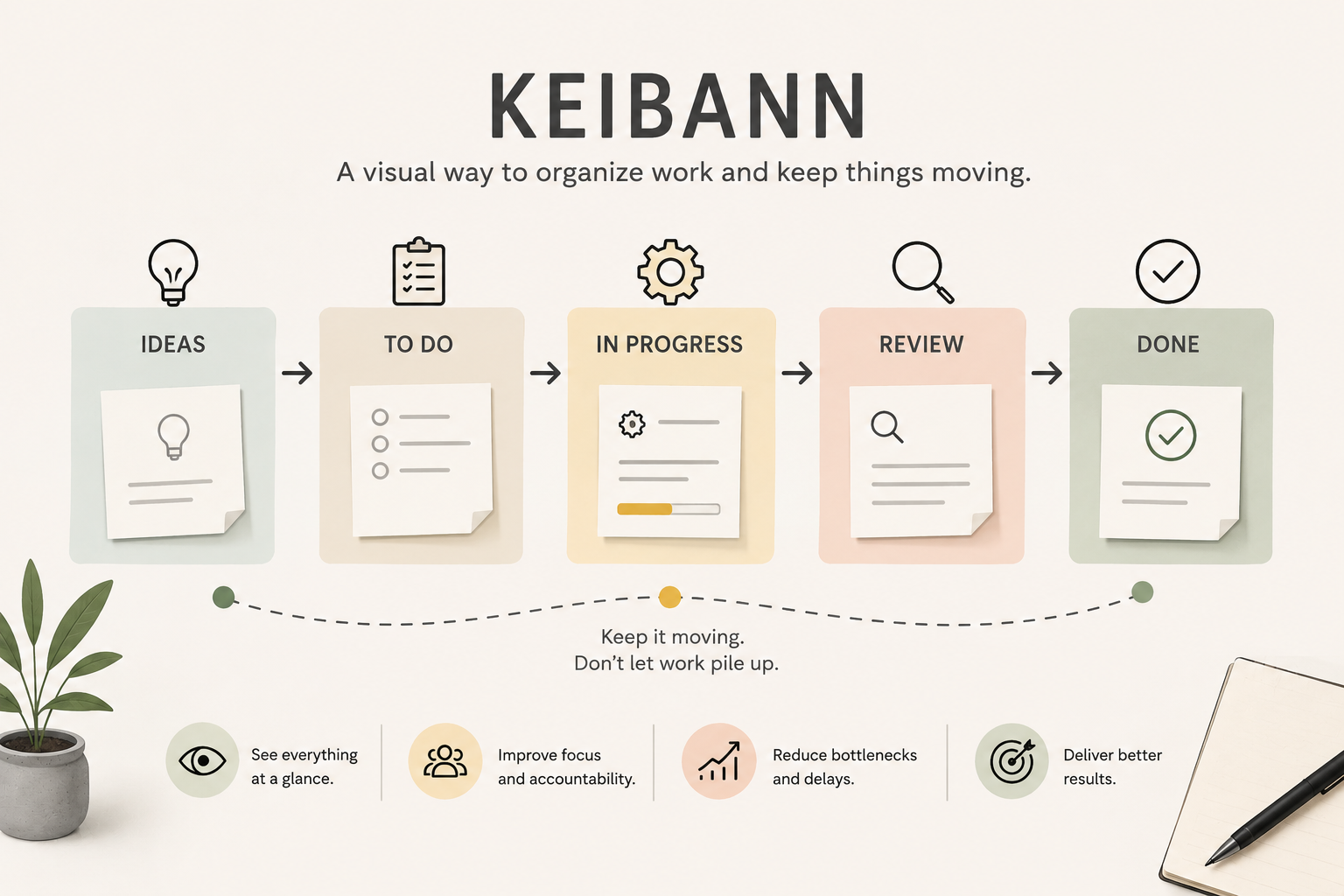
At its core, Keibann describes a way of laying out work so that its status is immediately obvious. Instead of tasks living inside long email threads, scattered notebooks, or buried spreadsheet rows, a Keibann-style system puts them on cards or tiles that move across visual stages — typically something like “Ideas,” “To Do,” “In Progress,” “Review,” and “Done.”
The goal isn’t complicated: reduce the mental effort of figuring out where things stand. When a project has ten moving parts, a visual board answers that question in seconds rather than requiring someone to dig through messages or ask a colleague for an update.
It’s worth being upfront that Keibann doesn’t have one universally agreed-upon origin story. Some writers treat it purely as an informal spelling variation that grew out of confusion with Japanese-origin productivity terms. Others use it as a general label for any lightweight, card-based workflow system. Because of that ambiguity, it’s best understood as a concept rather than a specific branded tool — similar to how “to-do list” describes an idea, not one particular app.
How the Keibann Workflow Actually Works
A typical Keibann-style setup follows a few consistent principles, regardless of which website or team is describing it.
Visibility first. Every task exists as a distinct card containing a short title, and sometimes a due date, owner, or priority tag. The point is that anyone glancing at the board — not just the person managing it — can understand the current state of work without asking questions.
Defined stages, not rigid steps. Columns represent phases of work rather than a strict checklist. A simple version might only need three columns (To Do, Doing, Done), while a more detailed setup for a marketing or product team might include stages like Backlog, Planning, In Progress, Review, and Shipped.
Limited work-in-progress. Many people who adopt this style of board also borrow a core Kanban principle: capping how many cards can sit in the “In Progress” column at once. This prevents the common trap of starting five things and finishing none of them.
Continuous movement. Cards are expected to keep moving. A board where dozens of cards pile up in one column for weeks isn’t functioning as intended — it’s a sign that a stage is a bottleneck and needs attention.
Regular review. Whether it’s a quick daily glance or a weekly team stand-up, checking the board regularly is what keeps a Keibann-style system useful instead of becoming another neglected list.
Keibann vs. Kanban: What’s the Real Difference?
This is the question most people are actually trying to answer when they search for the term. Kanban is a well-documented, decades-old methodology that originated in Japanese manufacturing at Toyota before being adapted for software development and knowledge work. It has clear principles, a defined history, and is supported by established project management platforms.
Keibann, by contrast, is best treated as an informal, community-driven variation of that same visual idea — not a competing methodology with its own rulebook. In practice, most people describing a “Keibann workflow” are really describing a Kanban-style board with slightly different terminology or a personalized set of columns. If you’re setting up a workflow for your own team, you don’t need to treat Keibann as something separate from Kanban; you can safely borrow structure and best practices from Kanban resources and apply the same logic under whichever name you prefer.
Why This Kind of Visual Workflow Is Useful
Regardless of what it’s called, the underlying approach solves a real problem. Here’s why so many individuals and teams gravitate toward it.
Work becomes easier to prioritize when it’s visible. A crowded “In Progress” column is a visual nudge to slow down and finish existing tasks before starting new ones — something a plain list rarely communicates as clearly.
It also improves accountability without requiring constant check-ins. When a card sits under someone’s name in a specific column, ownership is obvious, and status updates stop depending on someone remembering to send a message.
For teams, it cuts down on repetitive status meetings. A shared board that everyone can view at any time answers most of the questions that would otherwise require a sync call.
For individuals, the same structure works well for personal projects — planning a move, managing freelance clients, or organizing a home renovation. The stages just get relabeled to fit whatever the person is working on.
Using a Keibann-Style Board for Business
Teams that adopt this approach usually start small: one board, a handful of columns, and just enough detail on each card to be useful — a title, an owner, and maybe a deadline. Over time, columns get refined based on where work actually tends to get stuck. A software team might discover that “Code Review” needs to be its own column because tasks were quietly piling up there unnoticed. A marketing team might add a “Client Approval” stage for the same reason.
The mistake to avoid is over-engineering the board before it’s been used. Adding ten columns and elaborate tagging systems on day one usually leads to a board nobody maintains. It’s more effective to start simple and add structure only when a real bottleneck justifies it.
Using a Keibann-Style Board for Personal Productivity
On a personal level, the same idea works well for anyone who feels like their to-do list has become unmanageable. Instead of one long, unsorted list, tasks get split into stages: things you’re thinking about doing, things you’ve committed to, things you’re actively working on, and things that are finished. Seeing a “Done” column fill up over a week is also a small but genuine motivational boost — something a flat checklist rarely provides.
Limitations Worth Knowing
This style of workflow isn’t perfect for every situation. Boards with too many cards become just as overwhelming as the messy systems they were meant to replace. They also don’t automatically handle complex dependencies — if Task B genuinely can’t start until Task A finishes, a basic board won’t enforce that on its own; a person still has to manage the ordering.
It’s also not a great fit for deeply sequential processes with strict deadlines and interlocking timelines, where a Gantt chart or dedicated project-scheduling tool does a better job of showing how delays in one task ripple into others.
Final Thought
Keibann is less a fixed system and more a reflection of a genuine need: people want a simple, visual way to see what’s happening across their work without digging through scattered notes and messages. Whether you call it Keibann, Kanban, or just “the board,” the underlying habit — making work visible, limiting how much is in progress at once, and reviewing it regularly — is what actually drives the benefit. Start with a simple version, adjust it as real bottlenecks show up, and don’t worry too much about which name it goes by.
