


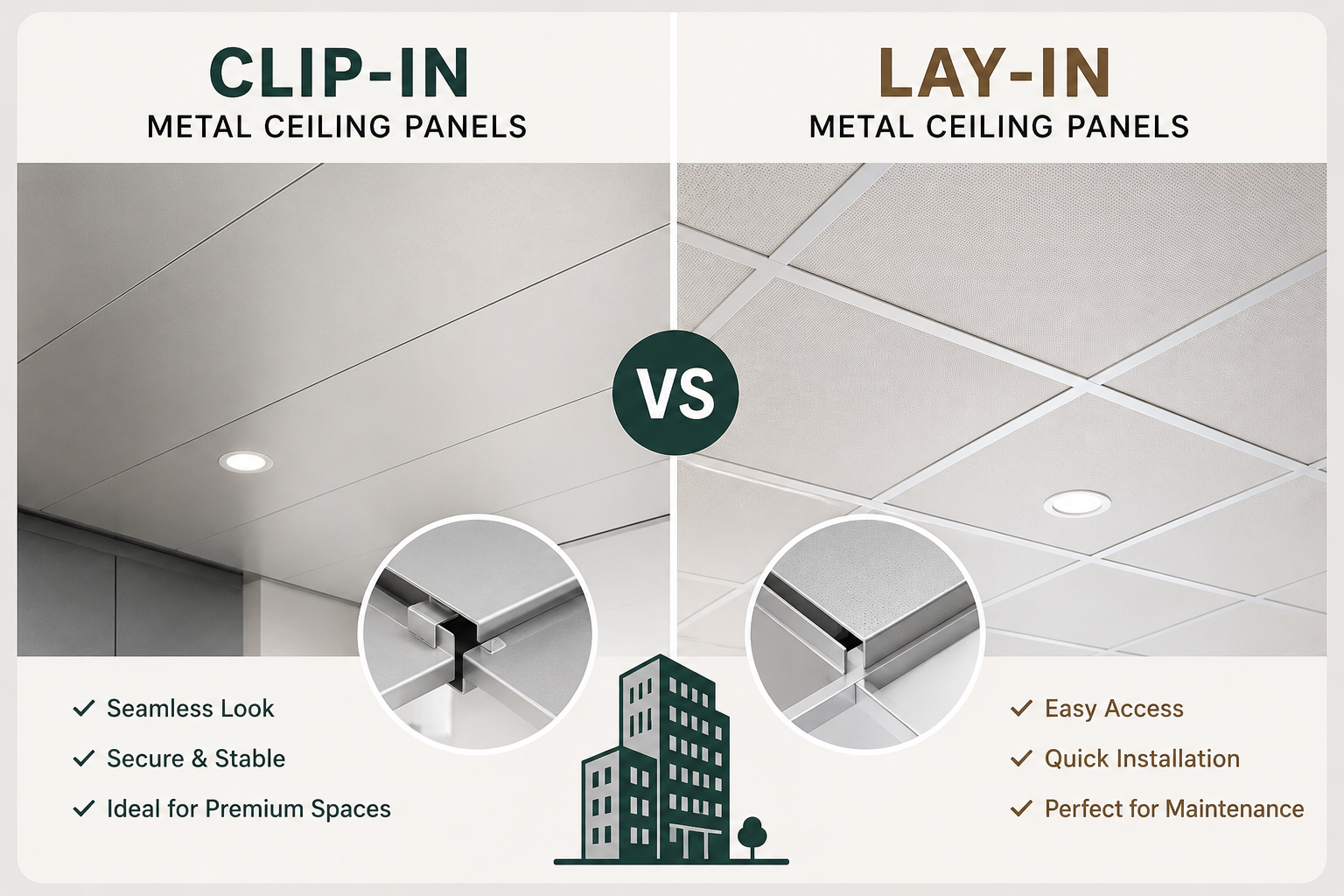
Choosing the right false ceiling system can make or break the overall finish of a commercial or institutional project. Among the many options available today, metal ceiling systems have taken over from traditional gypsum and mineral fiber tiles because of their strength, longevity, and clean visual appeal. But once you commit to metal, a more specific question comes up almost immediately: Clip-in vs Lay-in Metal Ceiling Panels — which one actually fits your building better?
This isn’t just a technical debate for engineers. Architects, facility managers, and even project owners need to understand the practical differences between these two systems before finalizing a ceiling specification. The right choice affects everything from installation timelines to how easily your maintenance team can access the space above the ceiling years down the line. Getting the Clip-in vs Lay-in Metal Ceiling Panels decision wrong early on can lead to unnecessary rework, higher long-term maintenance costs, or a finish that simply doesn’t match the design intent of the space. This guide walks through every angle of the Clip-in vs Lay-in Metal Ceiling Panels debate so you can make a decision with confidence.
Understanding Clip-in Metal Ceiling Panels
Clip-in panels rely on a mechanical locking system built into the edges of each tile. Once pushed into the supporting carrier grid, the panel snaps firmly into place and stays there — there’s no visible seam, no rattling, and no risk of the panel popping loose under normal conditions. The result is a flush, almost monolithic ceiling surface that reads as one continuous plane rather than a series of individual tiles.
Because of this locked-in stability, clip-in systems are the standard choice for spaces where appearance and durability both matter — airport terminals, metro concourses, hotel lobbies, and high-end retail environments. Architects often specify this system specifically because it hides the grid entirely, giving designers more freedom with lighting layouts and ceiling geometry.
Understanding Lay-in Metal Ceiling Panels
Lay-in panels work on a completely different principle. Instead of locking into place, the tile simply rests inside an exposed T-grid, the same basic setup used for standard suspended ceiling tiles. You can see this style of grid explained in more detail on this overview of suspended ceiling construction. Because the grid stays visible, the finished ceiling has a defined, modular look rather than a seamless one.
What lay-in panels lack in visual continuity, they make up for in convenience. Any single tile can be lifted out by hand in seconds, which makes this system a favorite in office buildings, schools, and hospitals — anywhere that wiring, ducting, or plumbing behind the ceiling needs regular attention.
Clip-in vs Lay-in Metal Ceiling Panels: Installation Differences
When comparing Clip-in vs Lay-in Metal Ceiling Panels on installation alone, lay-in systems win on speed. Dropping a tile into an exposed grid takes seconds and requires no special skill. Clip-in installation, by contrast, demands a trained crew that understands how to align and press each panel until the clips fully engage — a slower process, but one that produces a noticeably tighter, more polished result once complete.
Appearance and Design Impact
Visual appeal is often the deciding factor for premium projects. Clip-in panels create an uninterrupted metal surface that many designers consider the more sophisticated option, particularly in spaces meant to impress — corporate headquarters, luxury retail, or five-star hospitality projects. Lay-in panels, with their visible grid lines, lean toward a more structured, utilitarian aesthetic that still looks clean and professional but doesn’t disappear into the architecture the same way.
Maintenance and Long-Term Accessibility
This is one area where the Clip-in vs Lay-in Metal Ceiling Panels decision really comes down to how the building will actually be used. If your ceiling void houses mechanical, electrical, or plumbing infrastructure that needs frequent servicing, lay-in panels are far more practical — a maintenance technician can pop a tile out, do the work, and set it back without tools or delay. Clip-in panels, being locked into the grid, require more effort and occasionally a release tool to remove without damaging the finish, which makes them less convenient for spaces with recurring service needs.
Structural Performance and Stability
Wind pressure, HVAC vibration, and accidental contact all test a ceiling system’s stability over time. Clip-in panels handle these stresses far better thanks to their locking mechanism, which is why they’re the preferred choice for exterior soffits, canopies, and high-traffic public areas. Lay-in panels perform reliably indoors under normal conditions but aren’t built to withstand wind uplift or strong air pressure changes, so they’re generally kept away from exterior or semi-exposed applications.
Long-term durability also depends heavily on how the panels are handled over the life of the building. Lay-in tiles, being removed and replaced repeatedly during maintenance work, can develop minor edge wear or slight warping over the years if not handled carefully. Clip-in panels, since they’re rarely disturbed once locked in, generally retain their original flatness and finish for much longer, which is part of why they remain the preferred option for prestige projects with a 15 to 20 year design life expectation.
Cost Comparison
Budget plays a real role in the Clip-in vs Lay-in Metal Ceiling Panels decision for most projects. Lay-in systems are typically the more economical route — simpler grid components, faster installation, and lower labor costs all bring the overall price down. Clip-in systems cost more upfront because of the precision hardware and skilled labor involved, but many project owners view that premium as justified given the finish quality and structural performance gained in return. You can compare panel specifications and pricing tiers on our [Metal Ceiling Panels] product page.
Acoustic Performance and Ventilation
Both systems are available in perforated formats with acoustic fleece backing, which helps absorb sound in spaces like open-plan offices, auditoriums, and conference centers — you can read more about how sound absorption is calculated in this introduction to architectural acoustics. Lay-in panels tend to make ventilation integration simpler since diffusers and grille tiles can be swapped in wherever needed. Clip-in panels can also incorporate ventilation cutouts, but this generally has to be planned during manufacturing rather than adjusted on-site.
Material and Finish Options
Both panel types are commonly produced in aluminum or galvanized steel. Aluminum brings a lighter weight and natural corrosion resistance, which makes it a strong choice for humid or coastal climates. Galvanized steel offers more rigidity and load-bearing capacity, useful for larger panel formats or higher-stress applications. Powder coating remains the standard finish for both, available in nearly any RAL shade, while PVDF coatings are often reserved for clip-in panels used in exterior or semi-outdoor settings where UV resistance matters more. For a closer look at available textures and colors, browse our [Ceiling Panel Finishes] catalog.
Planning Timelines Around Panel Selection
Project schedules often hinge on decisions that seem minor on paper but carry real weight once construction begins, and ceiling selection is one of them. Lay-in systems tend to move faster through the construction schedule because the grid can be installed early and panels dropped in near the end of the project without much coordination. Clip-in systems require tighter sequencing — the carrier grid, panel dimensions, and any service cutouts need to be finalized well before manufacturing begins, since field adjustments are far more difficult once the clips are engaged. Contractors managing tight handover dates often factor this into their scheduling early, especially on large-scale commercial fit-outs where delays in ceiling work can hold up final inspections and occupancy certificates.
Lighting and HVAC coordination also plays into the decision. Because clip-in ceilings present a continuous surface, recessed lighting, sprinkler heads, and diffusers need to be precisely located and cut into the panels during fabrication. Lay-in systems offer more on-site flexibility, since standard grid modules can accommodate light fixtures or vent tiles interchangeably without custom cutting. For projects where design changes are still being finalized close to installation, this flexibility can be a meaningful advantage.
Making the Right Choice for Your Project
There’s no universal winner in the Clip-in vs Lay-in Metal Ceiling Panels comparison — the right answer depends entirely on what your building needs. If your priority is a flawless, high-end finish with strong resistance to wind and vibration, clip-in panels are worth the added investment. If your project calls for budget efficiency and easy access to the ceiling void for ongoing maintenance, lay-in panels deliver excellent value without sacrificing quality. Our [Ceiling Systems Buying Guide] breaks down specification planning in more detail if you’re still comparing options.
Final Thought
At the end of the day, the Clip-in vs Lay-in Metal Ceiling Panels decision isn’t about which system is objectively superior — it’s about matching the right technology to your building’s actual demands. Both options have earned their place in commercial construction for good reason, and both can deliver excellent results when specified correctly. Take the time to weigh your project’s visual goals, maintenance requirements, and budget constraints before finalizing your ceiling system, and don’t hesitate to consult an experienced supplier who can help you land on the specification that truly fits.
