


Introduction Trezor Net Worth
Trezor holds a special place in crypto history — it was the very first commercial hardware wallet ever released, launched back in 2013 by SatoshiLabs in Prague. Nearly thirteen years later, as digital asset ownership has gone from a niche hobby to a mainstream financial habit, plenty of people search for one specific question: how much is Trezor Net Worth today? Since it’s a private company with no stock listing, there’s no single official number to point to — but by looking at its revenue, funding history, market ranking, and product growth, we can put together a reliable picture.
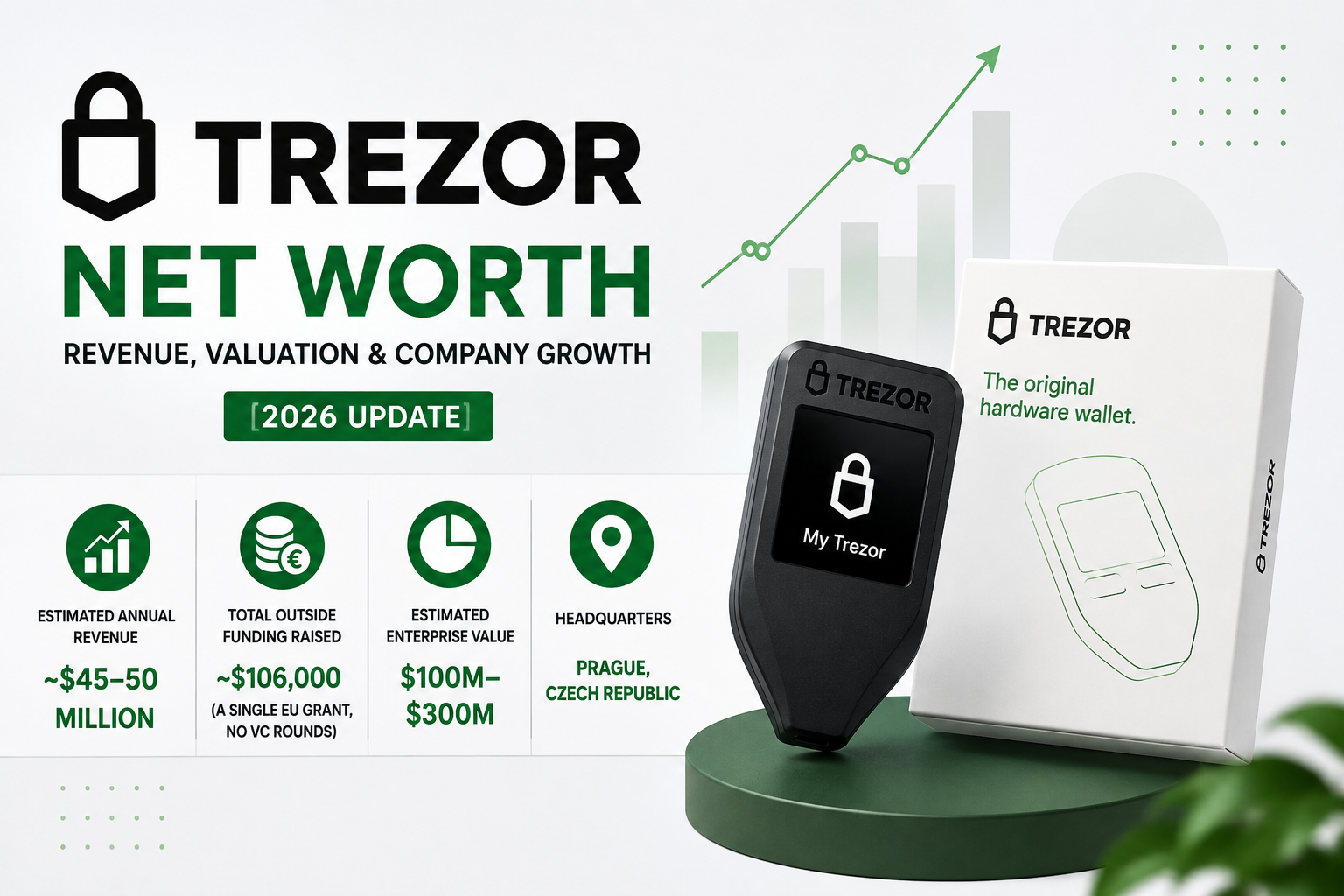
Quick snapshot:
- Estimated annual revenue: ~$45–50 million
- Total outside funding raised: ~$106,000 (a single EU grant, no VC rounds)
- Estimated enterprise value: $100M–$300M
- Headquarters: Prague, Czech Republic
Does Trezor Have a Public Market Cap?
No — and this is the first thing to clear up. Trezor operates under SatoshiLabs, a privately held company, so there are no shares trading on any exchange and no legally required financial disclosures the way a public company would have. What outside observers rely on instead is a mix of revenue estimates, industry comparisons, and standard valuation multiples used for hardware-security and fintech businesses.
Given Trezor’s revenue scale, relatively low overhead, and strong brand equity in the self-custody space, most analyst estimates put its enterprise value somewhere in the $100 million to $300 million range. That’s a wide bracket, and it should be treated as an educated estimate rather than a confirmed figure, since the company doesn’t publish audited financials for public review.
How Trezor’s Revenue Has Grown
Trezor’s earnings history tells a story that’s closely tied to the wider crypto market rather than steady, predictable corporate growth. In its early years, the company was a small operation generating modest revenue — reportedly around the equivalent of $50,000 USD annually in the early 2020s. Fast forward to the mid-2020s, and that number has climbed into the tens of millions, driven almost entirely by rising global demand for offline crypto storage.
This kind of jump isn’t unusual in the hardware wallet industry. Sales tend to spike sharply whenever Bitcoin or other major coins go through a bull run, since new investors start looking for safer ways to hold their assets outside of exchanges. Late 2024, for example, saw a major uptick in wallet purchases industry-wide as Bitcoin approached the six-figure mark, and Trezor was among the brands that benefited.
Funding History: A Company That Grew Without VC Money
One of the more unusual parts of Trezor’s story is how little outside capital it has ever taken on. While competitors in the space have raised hundreds of millions from venture capital firms, Trezor’s only recorded external funding was a modest European Union grant, awarded in 2014, worth roughly $106,000. Since then, the company has been entirely self-funded through product revenue.
This bootstrapped approach matters for two reasons. First, it means the founders have kept the vast majority of equity and decision-making control, without investors pushing for aggressive expansion targets. Second, it makes Trezor’s growth genuinely organic — every dollar of expansion has come from customers actually buying and using the product, not from investor cash propping up the balance sheet.
Team Size and Company Scale
Trezor started as a lean operation with just a handful of people handling everything from firmware development to customer support. As demand for hardware wallets grew, so did the team — the company now employs well over a hundred people across engineering, security, software development, and support functions.
That kind of staffing growth usually signals a business that’s scaling its operations to match rising order volumes, expanding its software ecosystem (the Trezor Suite app), and investing more heavily in customer security education — something that matters a lot in an industry where phishing scams targeting wallet users are common.
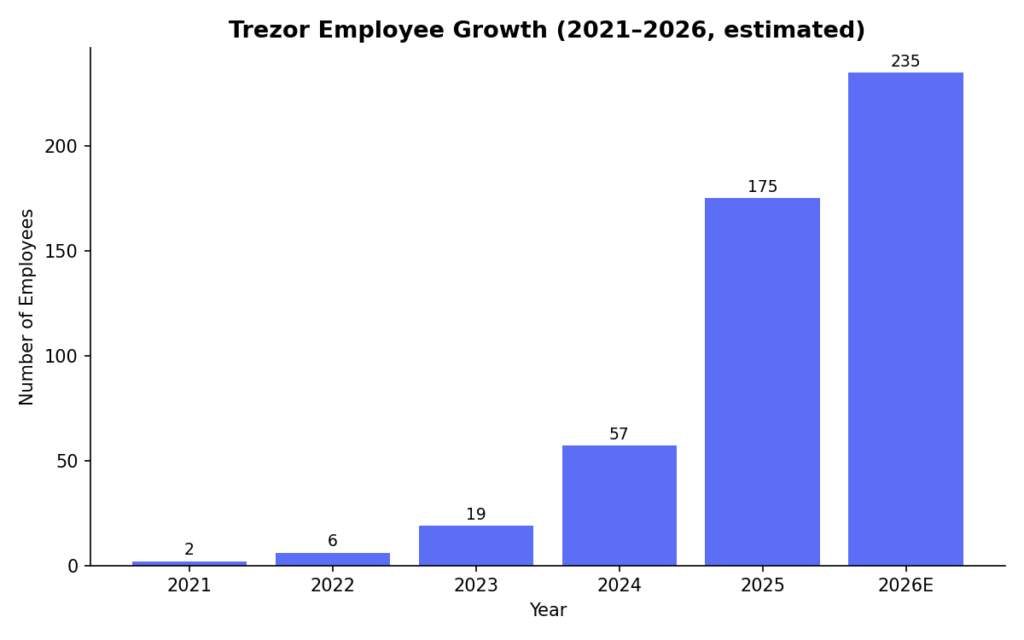
Trezor’s headcount growth tells a similar story to its revenue — a small, two-person operation in 2021 scaling into a team of well over a hundred by 2025, with continued growth expected into 2026 as the company expands its support, security, and software teams. (Note: yearly figures between 2021 and 2025 are estimated based on reported growth rates, since Trezor doesn’t publish detailed historical headcount data.)
Where the Revenue Comes From: Product Lineup
Trezor’s income is built almost entirely around hardware sales, supplemented by a few software and service add-ons.
The current lineup includes the entry-level Trezor Model One, the mid-range Trezor Safe 3, the touchscreen Trezor Model T, and the flagship Trezor Safe 5 with a full-color display. Alongside the devices themselves, the company sells the Keep Metal backup plate, designed to protect a recovery seed phrase from fire or water damage, and offers a paid one-on-one onboarding service for less experienced users.
On the software side, Trezor Suite — the free, open-source companion app — lets users manage well over a thousand different coins and tokens. Recent updates have added gas-free token swaps and staking support for certain assets, pushing Trezor further from being just a storage device into more of a full self-custody platform.
Trezor vs. Ledger and Other Competitors
Trezor doesn’t operate in a vacuum. Its biggest rival, Ledger, based in Paris, has raised vastly more funding and sold far more units globally — Ledger’s device sales run into the millions, backed by hundreds of millions of dollars in venture investment. Other names in the space include Coldcard, Tangem, and SafePal.
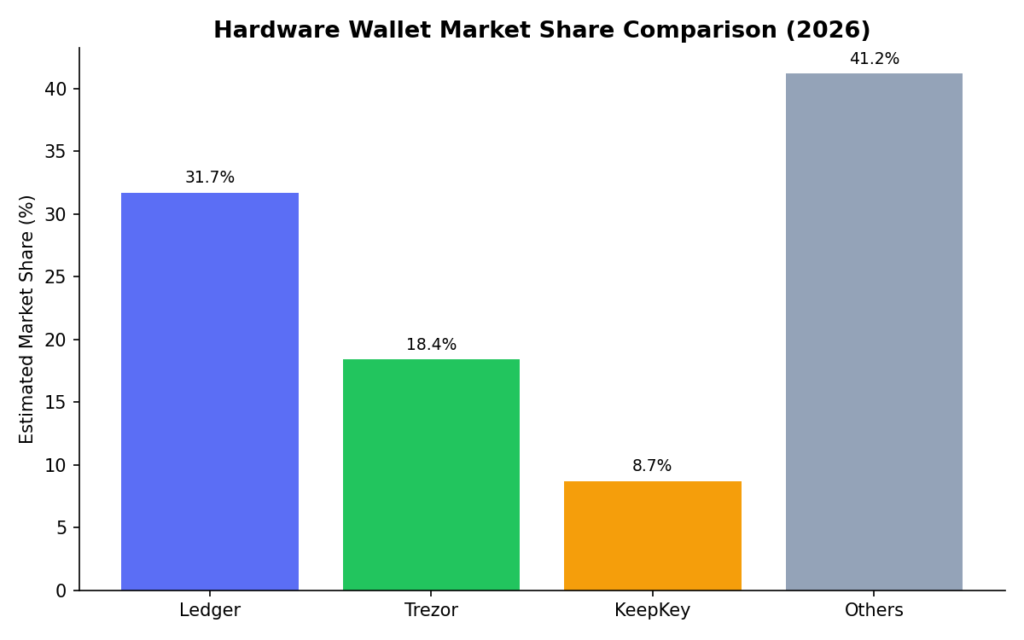
Market share estimates vary depending on the source, since none of these companies publish official sales breakdowns, but most industry reports put Ledger around 30–32% of the global hardware wallet market, with Trezor holding roughly 18–30% depending on the report’s methodology, and KeepKey capturing a smaller single-digit slice. Together, the top handful of brands typically account for well over half the market, with a long tail of smaller players — Coldcard, Tangem, SafePal, and others — splitting the remainder.
Where Trezor holds its ground is reputation and philosophy. Being fully open-source means independent security researchers can inspect every line of its firmware, which appeals strongly to privacy-focused and technically minded users. It also holds the historical distinction of being first to market, a detail that still carries weight with long-time Bitcoin holders.
If you’re weighing which device suits you better, our detailed breakdown of [Trezor vs Ledger: Full Comparison Guide] (internal link) covers pricing, supported coins, and security architecture side by side.
Founders and Leadership
Trezor was co-founded by Marek Palatinus and Pavol Rusnak, both well-known figures in early Bitcoin circles. Palatinus, who also built the Slush Pool mining operation, leads the company as CEO, while Rusnak has served as the technical architect behind much of Trezor’s cryptographic and firmware design. Their shared background in Bitcoin’s earliest days shaped Trezor’s security-first, transparency-driven culture — a philosophy that still defines the brand.
Corporate Structure
Behind the single consumer-facing brand, Trezor operates through a network of more than a dozen legal entities registered in the Czech Republic, likely separating functions like manufacturing, software, and retail. The core company, incorporated in late 2013 in Prague, remains headquartered in the city — a location that’s become something of a hub for European crypto and blockchain talent.
Revenue Comparison: Trezor vs Electronics Companies
Putting Trezor’s numbers next to a few other hardware-security brands helps put its scale in perspective — it’s a smaller, leaner operation than some of its closest peers, but far from a tiny startup.
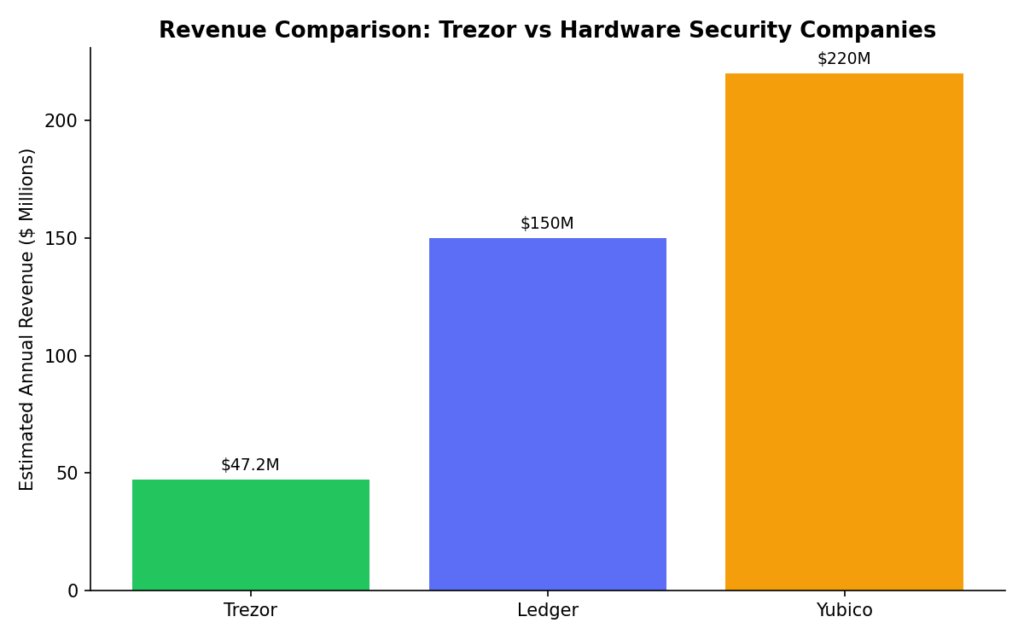
At an estimated $45–50 million in annual revenue, Trezor sits below Ledger (estimated $100–200 million) and Yubico, the Swedish maker of the YubiKey security device, which reports revenue north of $200 million. What’s notable, though, is Trezor’s efficiency: with roughly 175 employees generating that revenue, its revenue-per-employee figure lands close to $270,000 — a strong ratio for a hardware company, and one that reflects how much of its product ecosystem (firmware, the Trezor Suite app, customer support tooling) runs on a relatively small, focused team rather than a large corporate structure.
In short, Trezor doesn’t compete on size — it competes on trust, transparency, and a loyal niche audience, and its financials show a company that’s grown lean rather than bloated.
What This Means Going Forward
Trezor’s future valuation will almost certainly keep tracking the broader crypto market. Rising institutional interest in digital assets, tighter regulatory clarity around self-custody, and the growing use of crypto beyond simple investing (DeFi, staking, NFTs) all point toward continued demand for hardware wallets. At the same time, Trezor faces real competitive pressure from better-funded rivals and long-term questions about how mobile-based security might eventually change consumer habits.
Final Thought
Trezor is proof that a company doesn’t need a stock ticker, a nine-figure funding round, or headline-grabbing press releases to build something genuinely valuable. It grew almost entirely on its own terms — funded by customers, not investors — and turned a simple idea into one of the most trusted names in crypto security. Because it’s privately held, any net worth figure attached to Trezor will always be an estimate rather than a confirmed fact, but between its revenue growth, lean funding history, and loyal user base, most reasonable estimates land Trezor’s value somewhere in the hundreds of millions — and that number is likely to keep moving in step with crypto adoption itself.
For the latest official pricing and specifications, check Trezor’s official website.
