


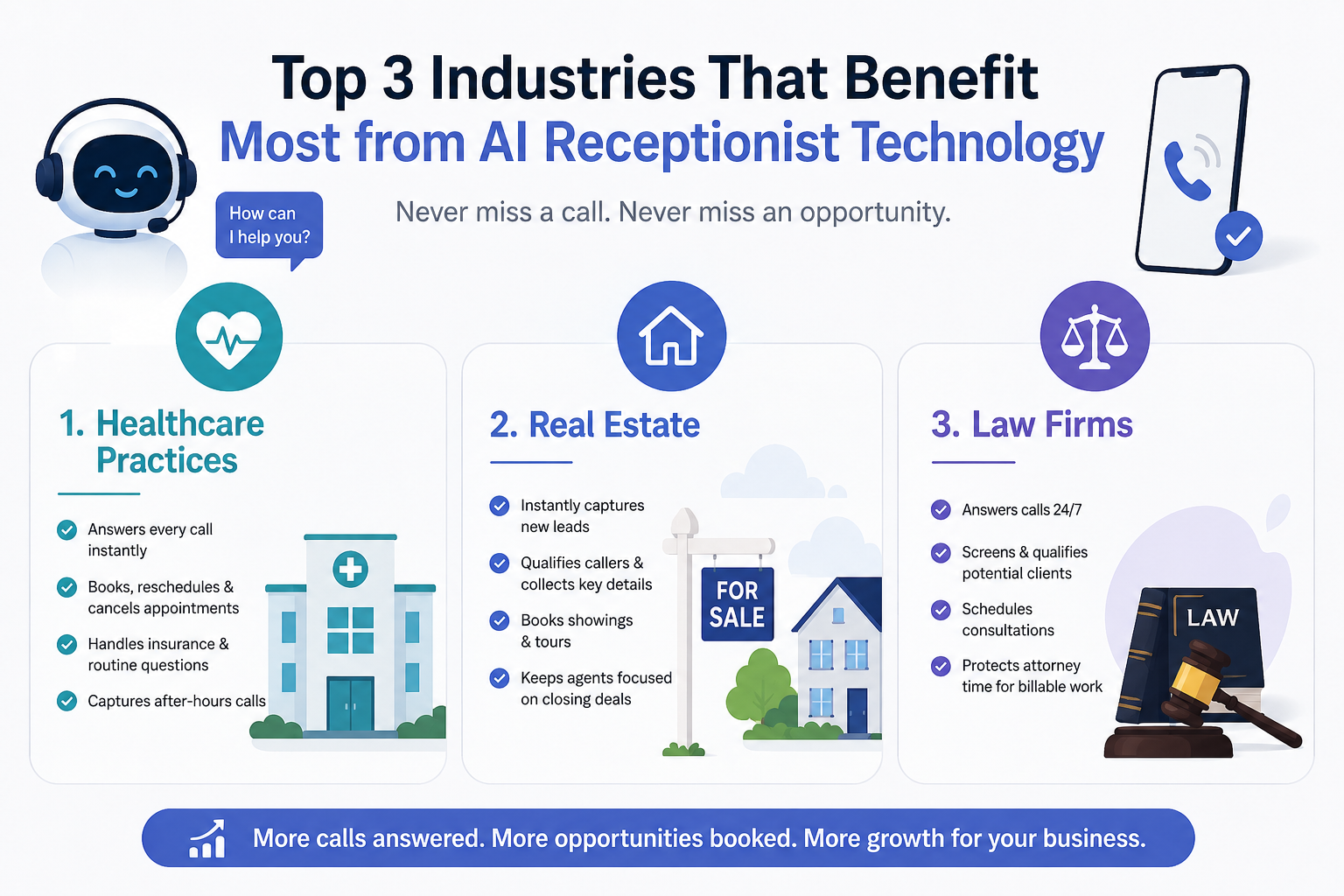
Every business loses money when the phone rings and nobody picks it up. A missed call is rarely just a missed call — it’s a missed appointment, a missed sale, or a patient who books with a competitor instead. This is exactly the gap that AI receptionist technology was built to close, and while almost any business can use it, three industries in particular see outsized returns from putting an AI receptionist on the front line.
In this article, we’ll look at why healthcare practices, real estate teams, and law firms benefit the most from AI receptionists, what specific problems the technology solves in each field, and how to think about adopting it in your own business. If you’re still exploring the basics of this shift, TechPostify’s piece on AI assistants for small business owners is a good place to start before diving into industry specifics — it covers the same move toward voice-based, action-taking AI that’s driving adoption of receptionist tools in the first place.
What Makes an Industry a Good Fit for AI Receptionists?
Before ranking industries, it helps to understand what separates a business that benefits enormously from an AI receptionist from one that barely notices a difference. Three traits tend to matter most:
A high volume of repetitive phone inquiries is the first. If most incoming calls ask some version of the same three or four questions — hours, pricing, availability, location — an AI receptionist can absorb that load almost entirely, freeing staff for higher-value work.
The second trait is time-sensitive booking. Industries where a caller wants to schedule something right now, and will likely call a competitor if they can’t get through, see the fastest return on investment. Every ring that goes unanswered is a booking that may never come back.
The third is after-hours demand. Businesses that receive meaningful call volume outside a 9-to-5 window — nights, weekends, holidays — benefit disproportionately, because a human receptionist simply isn’t available to capture that opportunity, but an AI one always is.
Keep those three traits in mind, because they explain exactly why the industries below rise to the top.
1. Healthcare Practices
Healthcare is arguably the single best-fit industry for AI receptionist technology, and it isn’t close. Medical, dental, and veterinary clinics deal with an unusually high call volume relative to staff size — patients calling to book, reschedule, ask about insurance, confirm appointment prep, or simply find out if the clinic is open. Front-desk teams are frequently pulled away from the phone to handle in-person check-ins, which means a large share of incoming calls simply go unanswered during peak hours.
That gap is expensive. A caller who can’t get through to book an appointment doesn’t wait patiently — they call the next practice on the list. Multiplied across a full week, unanswered calls translate directly into empty appointment slots and lost revenue that never shows up on a spreadsheet, because a clinic never sees the patient who didn’t get through in the first place.
An AI receptionist changes this dynamic in a few concrete ways. It answers every call instantly, regardless of how busy the front desk is, and can handle appointment booking, rescheduling, and cancellations by connecting directly to the practice’s scheduling system. It can field routine questions about hours, insurance acceptance, or pre-visit instructions without pulling a staff member off another task. And because it never clocks out, it captures the after-hours calls that would otherwise roll to voicemail — often the exact window when anxious patients are most likely to call.
There’s also a compliance angle that healthcare providers can’t ignore: any system handling patient information needs to be HIPAA-compliant, so practices evaluating vendors should confirm this explicitly before adopting a solution. For a deeper look at implementation requirements, the U.S. Department of Health and Human Services HIPAA guidance is a useful external reference for practice administrators.
The net effect reported across clinics that have adopted this technology is fairly consistent: fewer missed calls, meaningfully reduced administrative workload for front-desk staff, and a noticeable uptick in booked appointments that would otherwise have gone to voicemail and never been returned.
2. Real Estate
Real estate is a business built almost entirely on speed of response. A buyer calling about a listing, or a renter inquiring about a vacancy, is usually comparing several options at once — and the agent or property manager who answers first often wins the lead, regardless of how good the property itself is. Agents, however, spend much of their day out of the office: showing homes, meeting clients, or driving between appointments, which means calls routinely go unanswered at exactly the moment a prospect is most motivated to talk.
AI receptionists solve this by making sure every inbound call gets picked up immediately, whether the agent is in a showing, on another line, or asleep. The system can qualify leads by asking about budget, timeline, and property preferences, answer common questions about a listing’s price, square footage, or availability, and schedule a showing directly into the agent’s calendar — all without the prospect ever hitting voicemail.
Property management companies see a similar benefit on the maintenance side. Tenants calling about a leaking faucet or a broken heater at 11 p.m. don’t want to wait until morning for a callback; an AI receptionist can log the request, triage its urgency, and route emergencies to an on-call technician immediately, while routine issues get scheduled during normal business hours.
The result is fewer leads slipping through the cracks and a noticeably better first impression for prospective buyers, sellers, and tenants, who get an instant, professional response instead of a ring that goes nowhere. For broader context on how call responsiveness affects lead conversion in this sector, the National Association of Realtors research center publishes useful benchmarking data on buyer and seller behavior.
3. Law Firms and Legal Services
Law firms operate under a unique pressure: many of the calls coming in are from people in genuine distress — someone who was just in a car accident, facing eviction, or dealing with a family emergency — and how that first call is handled shapes whether they retain the firm at all. At the same time, attorneys and paralegals are billing hours on active cases, which means the phone is often the last priority during a busy afternoon, even though it may be the moment a new client decides whether to call back or move on to the next firm on their search results page.
AI receptionists give law firms a way to be consistently present without pulling billable staff away from casework. The system can perform initial client intake — collecting the caller’s name, the nature of their legal issue, and basic case details — before a human ever gets involved, so attorneys walk into the follow-up call already informed. It can screen out spam, sales calls, and inquiries the firm doesn’t handle, saving staff time that would otherwise go to filtering noise. And for firms handling personal injury, family law, or criminal defense, where calls often arrive outside business hours, an AI receptionist ensures that a distressed caller reaches someone — even if that someone is an AI system that captures their details and promises a prompt callback — rather than a generic voicemail box.
There’s a conversion argument here too. Legal services are highly competitive, and prospective clients frequently call two or three firms before choosing one. The firm that answers immediately, sounds organized, and books a consultation on the spot has a structural advantage over firms relying on voicemail and next-day callbacks. The American Bar Association’s technology resources offer a broader look at how firms are adapting client communication practices industry-wide.
Choosing the Right AI Receptionist for Your Industry
Not every AI receptionist platform is built the same way, and the right choice depends heavily on your industry’s specific needs. Healthcare practices should prioritize HIPAA compliance and EHR integration above almost everything else. Real estate teams should look for strong CRM and calendar syncing, since speed from call to booked showing is the entire point. Law firms should focus on intake accuracy and the ability to escalate urgent matters to a human immediately, since the cost of mishandling a sensitive call is high.
Across all three industries, the businesses that get the most value are the ones that treat the AI receptionist as a genuine extension of their front desk — configured with accurate, up-to-date information, integrated with existing scheduling tools, and paired with a clear handoff process for calls that genuinely need a human touch. This mirrors a broader pattern TechPostify has covered around AI accountability and where the real risk sits as businesses hand more customer-facing work to automated systems: the tools that succeed are the ones deployed with clear boundaries, not the ones switched to full autopilot on day one.
Final Thoughts
AI receptionist technology isn’t a fad tacked onto customer service — it’s a direct response to a problem every phone-dependent business already knows intimately: too many calls, not enough hands to answer them, and real money lost every time a ring goes unanswered. Healthcare, real estate, and legal services benefit the most because they combine high call volume, urgent booking windows, and meaningful after-hours demand, but the underlying logic applies to any business built around the phone.
If your team is still relying on voicemail to catch what your staff can’t, it’s worth asking how many of those calls are simply never coming back. That question alone is usually enough to justify a closer look at what an AI receptionist could do for your front desk.
