


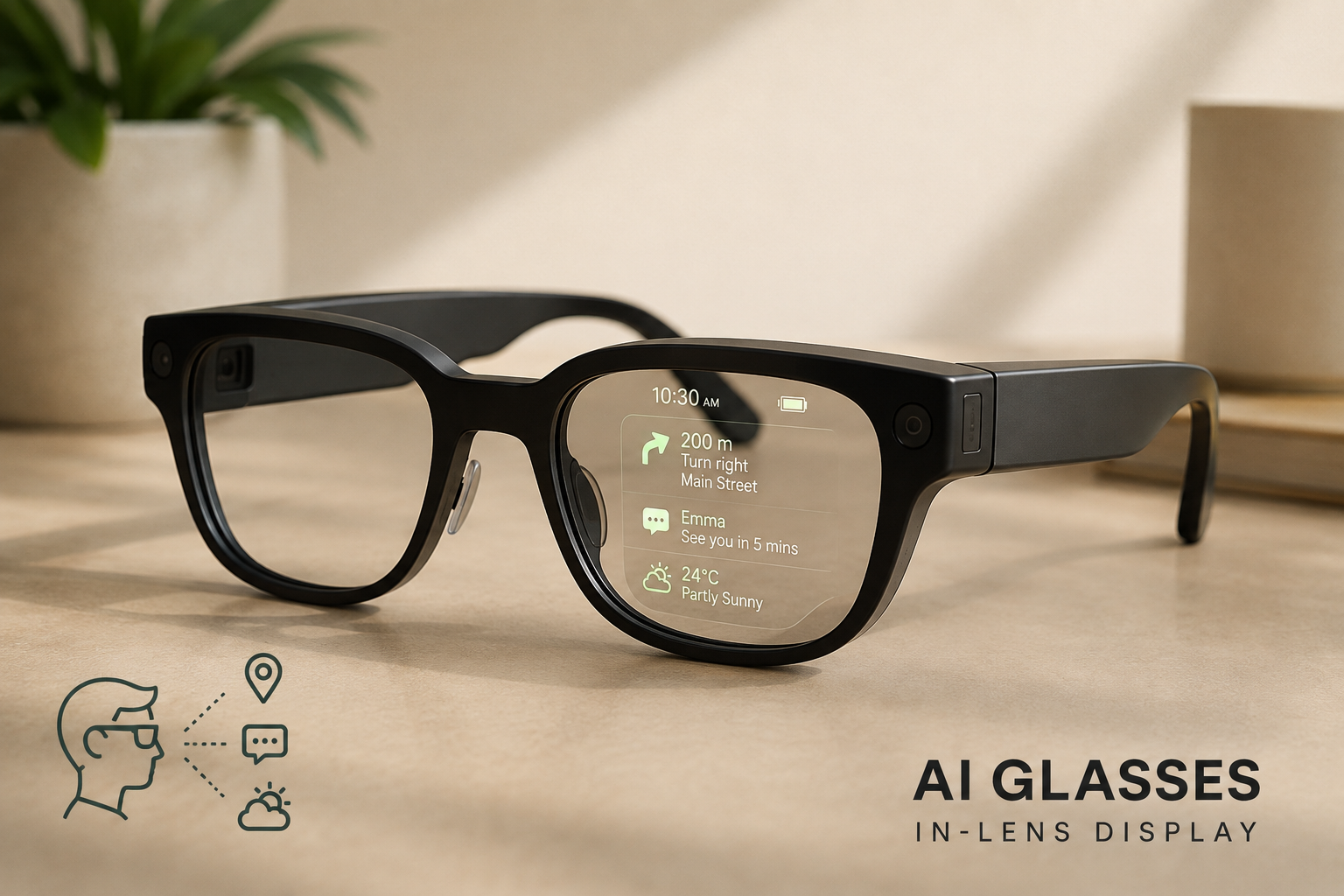
For years, smart glasses promised more than they delivered. Early attempts were bulky, socially awkward, and limited to voice commands or simple notifications. That changed once AI glasses with in-lens display entered the market. Instead of forcing you to pull out your phone every time you need directions, a translation, or a quick answer, this new generation of eyewear projects that information directly into your field of view — quietly, privately, and without breaking eye contact with the world around you.
This shift is not just a gimmick. Major players like Meta, Google, Samsung, and smaller innovators such as Even Realities and Halliday are racing to define what everyday augmented reality looks like. Below, we break down how this technology actually works, which products are leading the space, what to expect in terms of comfort and battery life, and whether this category is ready for mainstream use.
What Exactly Are AI Glasses with In-Lens Display?
At their core, these are ordinary-looking eyewear frames that house a miniature display system, a camera, microphones, and an AI assistant, all connected wirelessly to your smartphone. The “in-lens display” part refers to how the visual output is delivered — instead of a bulky external screen or a floating hologram in front of your face, the image is projected onto (or through) a small portion of the lens itself, so only the wearer can see it.
This is fundamentally different from older AR headsets like the original Google Glass or bulky mixed-reality visors. The goal here isn’t full immersive augmented reality; it’s ambient computing — glanceable, useful information that appears only when you need it, then disappears.
How the Display Technology Actually Works
Most of today’s in-lens display glasses rely on one of two approaches: micro-LED projection through a waveguide, or a compact optical engine that reflects light directly into a small area of the lens.
Even Realities uses what it calls a Holistic Adaptive Optical System, where a micro-LED engine transmits content onto waveguide lenses so that text appears to float roughly two meters ahead of the wearer. Meta takes a similar but more advanced route with its Ray-Ban Display glasses, which use a full-color 600×600-pixel display embedded in the right lens, reaching up to 5,000 nits of brightness so it remains readable even in direct sunlight, according to Meta’s official product page.
The key engineering challenge across all of these designs is the same: how do you fit a bright, sharp display into a few millimeters of lens thickness without making the glasses heavier, hotter, or strange-looking? That balancing act is exactly why this category has taken over a decade to mature from Google Glass to today’s much sleeker offerings.
The Products Leading This Category Right Now
Meta Ray-Ban Display is currently the most talked-about product in this space. Priced at $799, it pairs a color in-lens display with the Meta Neural Band, a wrist-worn EMG device that reads subtle finger movements so you can scroll, select, and navigate menus without speaking a word or touching the frame. According to a hands-on review from Techlicious, the display is impressively bright and the image quality has no visible screen-door effect, though the narrow 20-degree field of view means it’s best suited for quick glances rather than sustained reading. Coverage from GSMArena confirms the display supports a 90Hz refresh rate for interactive content and can show WhatsApp and Messenger previews, turn-by-turn navigation, live captions, and Spotify controls.
Even Realities G1 takes a more minimalist approach. It skips the camera and speakers entirely and focuses purely on a monochrome green micro-LED display for notifications, translation, and teleprompting. Because it has no camera, it sidesteps many of the privacy objections that have followed other smart glasses, and its lightweight titanium and magnesium build makes it genuinely comfortable for all-day wear.
Halliday is a newer entrant aiming at a lower price point, using a proprietary “DigiWorld” display module tucked into the upper corner of the frame rather than directly over the pupil, as reported by Get Coai. This design choice trades some immersion for a more compact, everyday-glasses look.
Google, Samsung, and Warby Parker are the ones to watch heading into 2026. Google has confirmed it is developing two categories of AI eyewear on its Android XR platform: an audio-only model for hands-free Gemini interaction, and a display-equipped model built with Warby Parker and Gentle Monster that will show navigation, live translation, and visual AI answers. Details were outlined in Google’s official Android Show recap, and the partnership includes a reported $150 million commitment from Warby Parker to help bring the hardware to market.
The Features That Actually Matter
Rather than listing every spec sheet, it’s worth focusing on the handful of features that genuinely change daily behavior. Real-time translation is arguably the most compelling use case — instead of holding up a translation app between two people, captions appear silently in your field of view as someone speaks. Turn-by-turn walking navigation is another standout, letting you glance at directions without breaking stride or staring down at a phone in an unfamiliar city.
Camera viewfinding is also underrated: being able to frame a photo through the lens display itself, rather than guessing based on where the glasses are pointed, solves one of the biggest usability complaints from earlier camera-glasses. And for many buyers, the quieter benefit is simply reducing phone-checking — getting a message preview or a calendar reminder in-lens means fewer reasons to reach for your pocket every few minutes.
Comfort, Battery Life, and Design Trade-Offs
This is where the category still shows its growing pains. Adding a display, camera, and processor to a frame that needs to sit comfortably on your face all day is a genuine engineering constraint. The Meta Ray-Ban Display weighs around 69 grams, noticeably more than a standard pair of sunglasses, and battery life tops out around six hours of mixed use, extending to roughly 30 hours with the included charging case, as detailed by MobileSyrup. Even Realities’ G1, by contrast, weighs closer to 43 grams because it drops the camera and speakers, which naturally trims both weight and power draw.
Anyone considering these glasses should think about their daily routine first. If you need all-day wear for work, a lighter, display-only option may suit you better. If you want the fuller AI-assistant experience with messaging and camera features, expect to charge more frequently and accept a slightly heavier frame.
Privacy and Social Acceptance
Any device with a built-in camera and a discreet display raises fair questions about consent and surveillance. Unlike a phone camera, which is obvious when someone is filming, glasses-mounted cameras are far less visible to bystanders. Manufacturers have tried to address this with visible recording indicator lights, but critics argue these are easy to miss or cover. This is part of why camera-free designs like Even Realities G1 appeal to a specific segment of buyers who want the display convenience without the social friction of a built-in lens.
If you’re weighing this trade-off, it helps to first understand the AI assistant actually running behind the lens, since the assistant handling your queries matters just as much as the hardware. Our comparison of ChatGPT vs Claude breaks down how different AI models handle context, accuracy, and privacy, which is useful background before trusting one with your everyday conversations and messages.
Price and Who Should Actually Buy One
Pricing currently spans a wide range. Halliday is targeting a budget-friendly $399–$499 bracket, Even Realities G1 sits around $599, and Meta Ray-Ban Display commands a premium $799, with prescription lenses pushing the total closer to $999. At these prices, this remains an early-adopter category rather than a mass-market necessity — closer to where smartwatches sat around 2014 than where they are today.
That said, specific groups will find genuine value right now: frequent international travelers who lean on real-time translation, commuters who want hands-free navigation, content creators who benefit from a discreet camera viewfinder, and anyone whose job involves frequent note-taking or teleprompting during presentations. If you’re simply curious about the technology but don’t have a clear daily use case, it may be worth waiting for the next hardware cycle, when prices typically drop and battery life improves, the same pattern we’ve seen play out across other categories, including our roundup of affordable smart gadgets that still feel premium.
What Comes Next for This Category
With Google, Samsung, and Warby Parker all preparing Android XR-powered display glasses for a 2026 launch, and Meta continuing to iterate on its Ray-Ban Display line, competition is about to intensify significantly. Reporting from Storyboard18 suggests this next wave will focus heavily on making the hardware lighter and more fashion-forward, since long-term adoption depends as much on whether people are willing to wear these frames daily as it does on the underlying AI capabilities.
Expect near-term improvements in three areas: wider fields of view without adding bulk, longer battery life through more efficient micro-LED engines, and tighter integration with existing AI assistants like Gemini and Meta AI so the glasses feel less like a gadget and more like a natural extension of your phone.
Final Thoughts
AI glasses with in-lens display represent one of the more genuinely useful directions wearable technology has taken in years — not because they replace your phone entirely, but because they quietly remove dozens of small daily interruptions: checking directions, translating a conversation, glancing at a notification. The technology is still maturing, prices remain high, and battery life is a real limitation, but the direction is clear. With Google, Samsung, and Warby Parker preparing to enter the space alongside Meta’s already-shipping hardware, 2026 is shaping up to be the year this category moves from niche gadget to a serious, mainstream wearable choice. If you’re on the fence, it’s worth exploring how this same wave of practical AI is already changing other everyday tools, from our look at AI assistants built for small business owners to broader shifts in AI-powered automation, before deciding whether AI glasses with in-lens display deserve a spot in your daily routine.
