

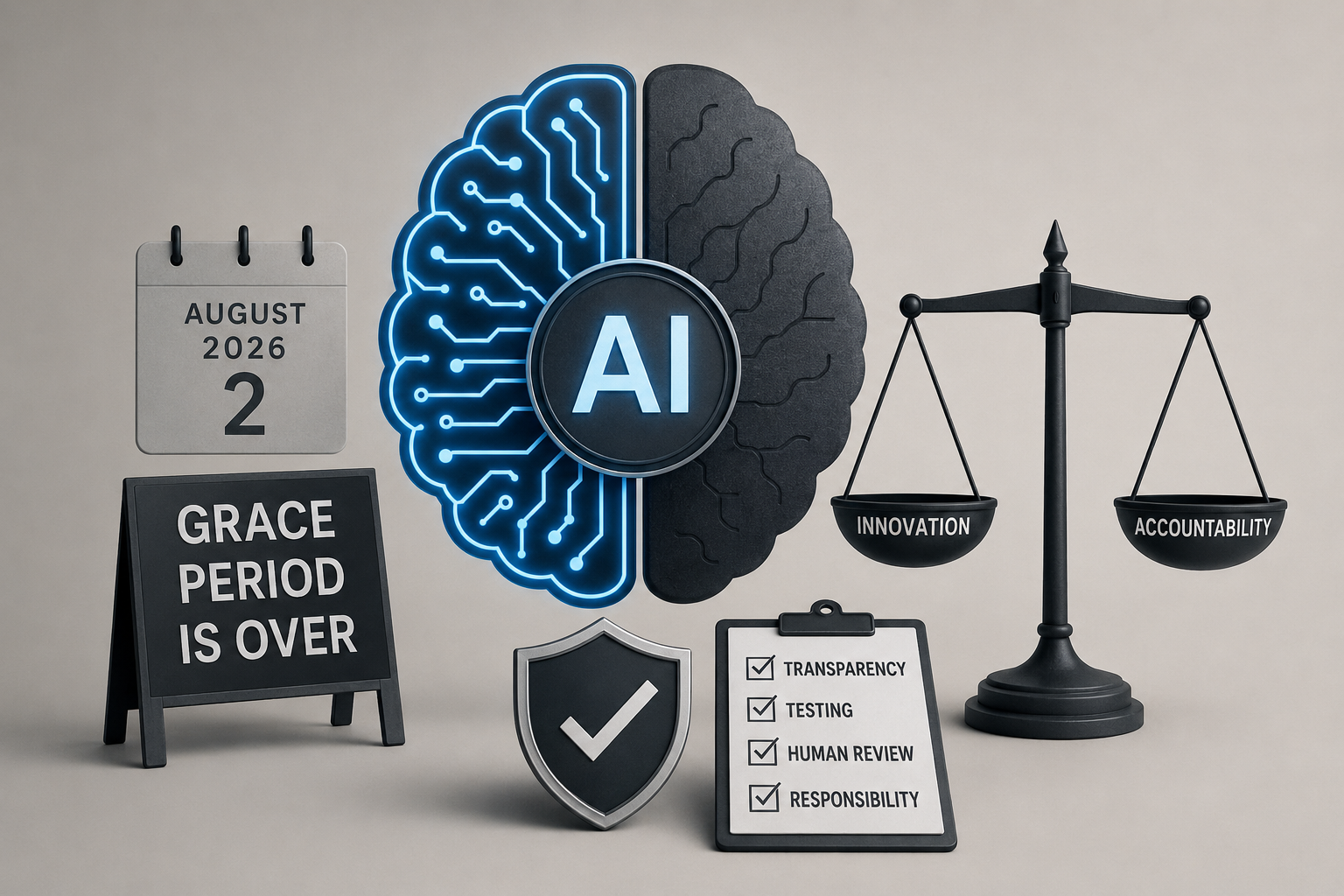
For years, artificial intelligence operated under a kind of unwritten immunity. Mistakes were forgiven as “early days.” Wrong answers were laughed off as glitches rather than treated as failures. Job displacement was framed as a temporary bump on the way to something better. Governments watched from the sidelines instead of stepping in, worried that regulation might smother a technology still finding its feet. That leniency defined the first chapter of the AI boom. It is not the chapter we are in now. AI’s grace period is over, and the industry is being judged by a much harder standard: does it actually work, and who is responsible when it doesn’t.
This change didn’t arrive with a single headline. It built up slowly, through years of gaps between what AI companies promised and what their products delivered, through real people affected by automated decisions gone wrong, and through a public that has become far more skeptical than it was even two years ago. Understanding how this shift happened, and what it means going forward, matters whether you’re building AI products, using them at work, or simply trying to make sense of the tools now woven into daily life.
The Free Pass Is Gone
Early AI tools were treated as novelties, and novelties get a pass. A chatbot that wrote a decent limerick or an image generator that turned a sentence into art felt like magic tricks, and nobody expects a magic trick to be flawless. But AI didn’t stay confined to party tricks. It moved into hiring software, insurance underwriting, medical triage, customer service, classroom grading, and government casework. Once a tool becomes part of how essential decisions get made, the bar it has to clear changes completely. Infrastructure isn’t allowed to fail quietly. A payment system that goes down for an hour makes the news; a bridge that cracks once gets shut down permanently, not given “time to improve.” AI has crossed that same line, from experiment to infrastructure, and the patience that came with the earlier label went with it.
This is really about where errors land. A chatbot inventing a fake fact in a casual conversation is a minor annoyance. The same error rate inside a system that decides who gets a loan, who gets interviewed for a job, or how a patient’s symptoms get flagged is a different category of problem entirely. As AI has been pushed deeper into decisions with real consequences, tolerance for its mistakes has shrunk at roughly the same pace.
August 2026 Made the Shift Official
If the end of AI’s grace period still felt abstract to some businesses, it stopped being abstract in the summer of 2026. On August 2, the European Commission’s AI Office and national regulators began actively enforcing the EU AI Act, with new transparency rules requiring chatbots to disclose that users are talking to a machine, deepfakes to carry visible labels, and AI-generated content to include machine-readable markers so it can be identified automatically. Companies that ignore these obligations face fines that can reach into the tens of millions of euros, calculated as a percentage of global turnover rather than a flat penalty — a structure designed to matter even to the largest AI providers. You can read the European Commission’s own announcement for the full scope of what changed.
What makes this date significant isn’t just that it happened in Europe. Because so many AI products are global by default, a rule written in Brussels ends up shaping how a chatbot behaves for a user anywhere. Regulation like this used to be theoretical, something companies promised to prepare for “eventually.” Now it’s a line item with real financial exposure attached to it, and it has forced AI companies to treat disclosure, labeling, and documentation as operational requirements rather than public relations gestures.
The Overpromising Hangover
A lot of the current skepticism traces directly back to how AI was sold during its honeymoon years. Companies described their products in sweeping, industry-transforming language, and some hinted at capabilities that were still years away, if they arrived at all. Every emerging technology attracts some hype. What made AI’s version unusually visible is that ordinary people could test the claims themselves, instantly, for free.
When a chatbot confidently invents a legal precedent, misstates a medical fact, or fabricates a quote, that failure doesn’t stay buried in a technical report. It gets screenshotted and shared within hours. Every viral example of AI getting something obviously wrong chips away a little more at the credibility the marketing built up. Businesses that rushed to swap human judgment for automated systems, only to face backlash over a biased outcome or an embarrassing public error, have paid for that lesson in real reputational and financial terms. The phrase “AI hallucination” is now common vocabulary, and public skepticism has become the starting assumption rather than a surprising reaction.
Trust Erosion in the Workplace
Nowhere is the mood shift clearer than among the people whose jobs sit closest to these tools. Early promises suggested AI would mostly absorb tedious, repetitive work and free people up for more meaningful tasks. The reality has been rockier. Roles across copywriting, customer support, junior software development, and paralegal work have all been reshaped or reduced, and workers who once approached AI with curiosity now often approach it with wariness. That wariness has translated into demands for clearer disclosure about how these tools are being used internally, protections against sudden displacement, and a genuine voice in how automation gets rolled out.
That shift has practical costs for employers. A workforce that distrusts the tools it’s told to use tends to be less productive and quicker to surface problems publicly rather than quietly. Rebuilding lost trust is slow and expensive. Companies that bring employees into the conversation about how AI gets adopted, instead of announcing it as a done deal, generally see smoother rollouts and fewer public controversies. Capability alone was never going to guarantee adoption; how a tool gets introduced matters almost as much as what it can do. Our recent look at how AI is reshaping entire creative industries covers a similar tension between capability and the people whose work is being changed by it.
What Accountability Looks Like in Practice
The end of the grace period doesn’t mean AI is being abandoned or that its usefulness was a mirage. It means the standards for deploying it responsibly are turning into specific, checkable requirements instead of vague promises. In practice, that looks like clearer disclosure of a system’s known limitations rather than burying them in fine print, more rigorous testing before release rather than treating the public as an unpaid quality-control team, and meaningful human review built back into decisions that carry real stakes for the people on the receiving end. Even consumer-facing tools outside the enterprise world are being held to this stricter standard now — our review of a well-known AI skin-scanning app found the same pattern: users expect the tool to be honest about what it can and can’t reliably assess, not just impressive in a demo.
None of this is about slowing AI down for its own sake. It’s about making sure the safeguards around these systems mature at the same pace as their reach into consequential decisions. Companies that build this now, rather than being forced into it later by a regulator or a viral news story, are the ones likely to still be trusted a few years from now.
A More Demanding Relationship With Technology
There’s a useful pattern in how earlier transformative technologies were absorbed into everyday life. The automobile, electricity, and the internet each went through a phase of largely unregulated enthusiasm before mature frameworks of safety standards and legal accountability caught up. In every case, the technology didn’t disappear once scrutiny arrived — it became more dependable, more widely trusted, and ultimately more valuable because people could count on it. You can trace a similar arc across the history of artificial intelligence as a field, from academic curiosity to global infrastructure.
AI seems to be following the same arc, just compressed into a far shorter window because of how quickly it spread and how directly it now touches daily decisions. The end of its grace period is, in a strange way, a sign of how important the technology has become rather than proof that it failed. Nobody demands accountability from something they consider irrelevant. Going forward, the developers and companies that succeed will be the ones treating this scrutiny as a standard to meet rather than an obstacle to route around.
Final Thought
AI hasn’t lost its potential; it has lost its excuse. The technology that once got the benefit of the doubt is now being asked to prove itself the same way every consequential technology eventually has to. That’s not a setback for AI — it’s what it looks like when a tool stops being a novelty and starts being taken seriously.
