


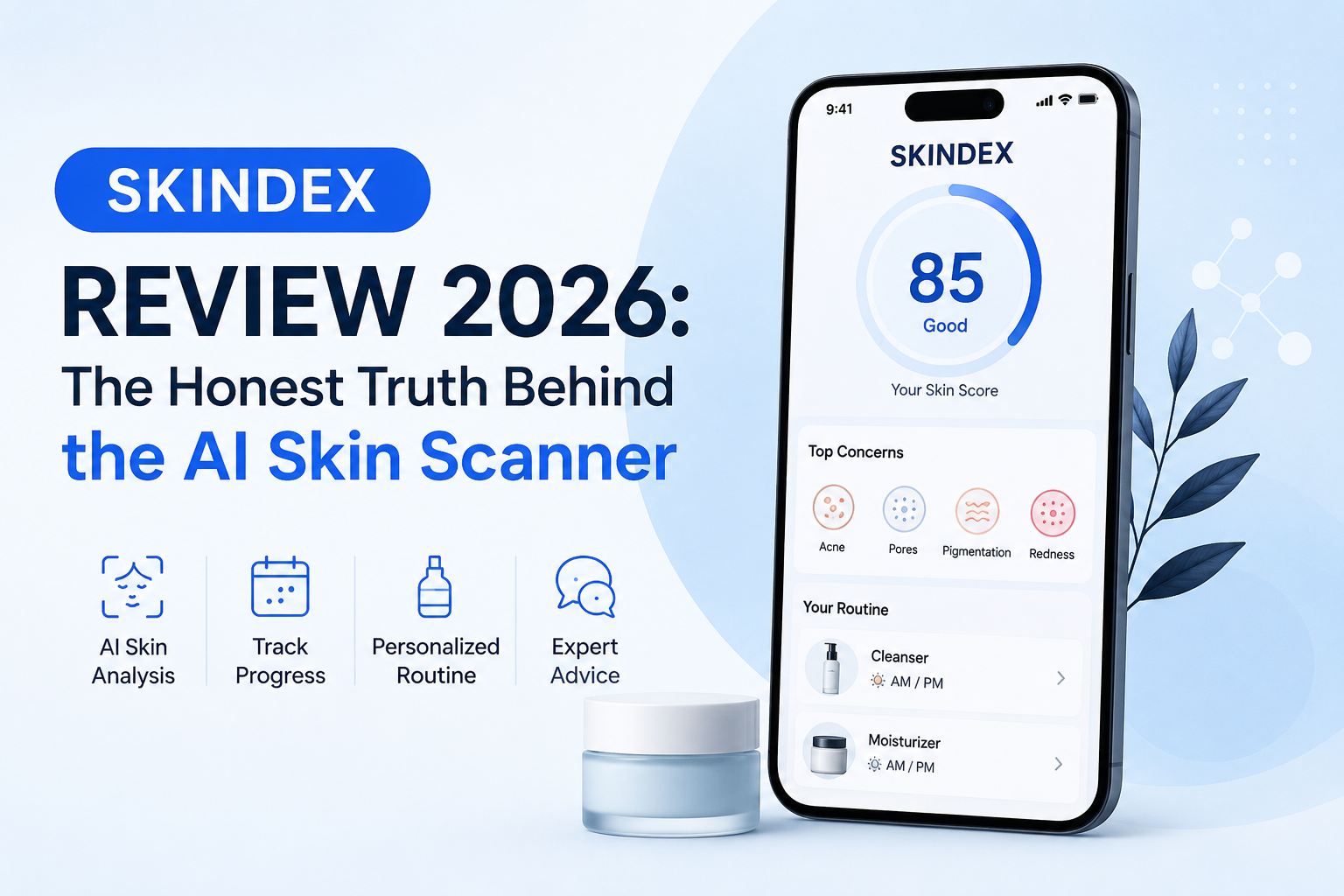
Skincare shopping has always involved a fair amount of guesswork. You try a serum because a friend recommended it, or because an influencer swore by it, and three weeks later your skin either thanks you or breaks out in protest. Skindex was built to remove that guesswork by putting artificial intelligence between you and your next skincare purchase. In this Skindex review for 2026, we’ll walk through what the app actually does, how well it performs in daily use, where it falls short, and whether it deserves a spot on your phone.
This isn’t a rushed, surface-level roundup. We’ve dug into the app’s core features, tested its claims against what dermatology-backed skincare actually requires, and compared it with the broader landscape of AI beauty tools available this year.
What Exactly Is Skindex?
Skindex is a mobile application, available on both Android and iOS, developed by Skindex Technology Company Limited. At its core, it’s a skin analysis and skincare companion tool that uses a single photo to evaluate the condition of your skin. Instead of relying on a generic quiz (“Is your skin oily, dry, or combination?”), Skindex tries to read your actual skin through image analysis, then builds a picture of your concerns — think acne, pigmentation, visible pores, redness, or early signs of aging.
Once it has that picture, the app doesn’t just hand you a score and walk away. It attempts to translate that data into something usable: a personalized routine, product suggestions that match your specific skin profile, and a diary feature that lets you track how your skin evolves over weeks and months. In many ways, Skindex positions itself less like a one-time skin quiz and more like a long-term skincare journal with an AI assistant built in.
It’s worth noting upfront that Skindex is explicit about its limitations. The app carries a clear disclaimer stating that it is meant for educational and informational purposes, not as a substitute for professional dermatological care. That’s an important distinction to keep in mind as we go through the rest of this review.
Core Features That Define the Skindex Experience
AI-Powered Skin Analysis
The headline feature is the photo-based skin scan. You take a picture (ideally in good, even lighting), and the app processes it to generate a skin score along with a breakdown of specific issues it detects, such as acne, scarring, or uneven pigmentation. The idea is to give you a snapshot of where your skin stands today, which then becomes the baseline for everything else the app recommends.
In practice, lighting and camera quality matter a lot here. Like most computer-vision-based skin tools, results tend to be more consistent when photos are taken under similar conditions each time — natural daylight, no filters, and a clean lens. Users who skip this step often see inconsistent scores between scans, which can be misleading if you’re trying to judge real progress.
Skin Diary and Progress Tracking
This is arguably where Skindex separates itself from a basic skin-scanning app. Rather than treating each scan as an isolated event, the diary feature stitches your scans together over time, letting you visually compare how your skin has changed since you started a new product or routine. For anyone who has ever tried a new retinol or exfoliating acid and wondered “is this actually working, or am I imagining it,” this kind of side-by-side tracking is genuinely useful.
Personalized Routine Building
Based on your skin profile, Skindex generates a suggested daily routine, complete with product categories and usage instructions. The routine isn’t static — it’s meant to adapt as your skin score changes and as you log new products or reactions. This mirrors a broader trend in the skincare industry, where personalization has become the primary selling point over generic “one size fits all” regimens.
Ingredient and Product Compatibility Checks
Another standout feature is the ability to check whether a specific product or ingredient list is likely to suit your skin. This addresses a real pain point: skincare labels are dense, full of chemical names most people can’t parse, and it’s genuinely hard to know whether a new moisturizer will help or trigger a breakout. Skindex tries to bridge that gap by cross-referencing ingredients against your skin profile and flagging potential mismatches.
Expert and Dermatologist Chat
For users who want more than an algorithm’s opinion, Skindex includes a consultation feature where you can chat with skincare professionals about specific concerns. This is a meaningful addition because AI skin analysis, however sophisticated, still can’t replace a trained eye — especially for anything that looks like it might be a genuine dermatological condition rather than a cosmetic concern.
In-App Shopping
Skindex also functions as a marketplace of sorts, allowing users to purchase products directly through the app. The company states its listings are sourced from registered brands, which is a reasonable attempt to address the very real problem of counterfeit skincare circulating online.
Skincare Challenges and Community Elements
To keep users engaged past the initial novelty of a skin scan, the app includes challenges and light gamification, encouraging people to stick with routines consistently rather than abandoning them after a week. Consistency is, after all, the single biggest factor in whether any skincare routine actually works.
How Accurate Is the AI Analysis, Really?
This is the question most people actually want answered, and the honest answer is: reasonably useful, but not a diagnostic tool. AI skin analysis apps, including Skindex, work by comparing visual patterns in your photo against a large dataset of skin images and known conditions. That means they’re good at spotting visible surface-level patterns — texture irregularities, redness, visible pores, obvious pigmentation — but they aren’t performing a clinical assessment.
Where this matters most is with anything that could be a medical issue rather than a purely cosmetic one. A photo-based algorithm cannot palpate skin, ask about your medical history, or examine a lesion under magnification the way a dermatologist can. Skindex seems to understand this limitation, which is why the app repeatedly points users toward professional consultation rather than positioning itself as a diagnostic replacement.
If you’re using it to track general skin texture, hydration-related concerns, or how your skin responds to a new moisturizer over a month, it does a solid job. If you’re trying to self-diagnose a persistent rash or a mole that’s changed shape, that’s a job for an actual dermatologist, not any app.
Pricing and Accessibility
Skindex is free to download on both the App Store and Google Play, which lowers the barrier to entry considerably compared to paid skin-consultation services. The core scanning and diary features are accessible without a subscription, though, as with most apps in this category, certain premium features and in-app purchases may unlock deeper analysis or extended consultation access. Given that the base experience is free, it’s a low-risk way to try AI-based skin tracking before committing to any paid skincare consultation elsewhere.
Skindex vs. Other Skincare Analysis Tools
The AI skincare space has grown crowded, and Skindex isn’t the only app promising personalized recommendations through photo analysis. What tends to differentiate it is the combination of features in one place — scanning, diary tracking, ingredient checking, expert chat, and shopping — rather than excelling dramatically at any single one. Some competing platforms focus purely on ingredient-matching for product discovery, while others lean heavily into dermatologist telehealth. Skindex sits somewhere in the middle, functioning as a general-purpose skincare companion rather than a specialist tool.
For users who want a single app to handle tracking, recommendations, and shopping without juggling three separate services, that breadth is a genuine advantage. For users who specifically want deep, clinical-grade ingredient science or a dedicated telehealth dermatology platform, a more specialized tool might serve them better.
Privacy Considerations
Since Skindex asks users to upload facial photos regularly, data privacy is a fair concern to raise. The app’s listing outlines its data handling practices, and as with any app that processes biometric-adjacent images, it’s worth reviewing the privacy policy before uploading photos, particularly if you’re uncomfortable with image data being stored or used to improve the underlying AI model. This is a standard consideration for any AI-based image analysis tool, not something unique to Skindex, but it’s worth factoring into your decision.
What Skindex Does Well
The app’s biggest strength is consistency of use. By combining scanning, diary tracking, and routine suggestions into a single flow, it removes a lot of the friction that normally causes people to abandon skincare tracking after a week or two. The ingredient compatibility checker also fills a genuine knowledge gap for the average consumer, and the option to chat with an actual professional adds a layer of reassurance that pure algorithm-only apps don’t offer.
Where Skindex Falls Short
The accuracy of any photo-based skin scan will always be somewhat dependent on lighting, camera quality, and user consistency, which can make month-to-month comparisons less reliable than they first appear. The app also can’t and shouldn’t replace an in-person dermatologist visit for anything beyond cosmetic tracking. Some users may also find the in-app shopping and gamified challenges feel more like retention tactics than essential features, depending on what you’re actually looking for from a skincare app.
Final Thoughts
Skindex earns a place among the more well-rounded AI skincare apps available in 2026, largely because it doesn’t try to be just one thing. It’s a scanner, a diary, a recommendation engine, and a lightweight marketplace rolled into a single free download. That combination makes it genuinely useful for anyone who wants to bring a bit more structure and data to their skincare routine, without pretending to replace professional dermatological care. If you go in with realistic expectations — using it as a tracking and guidance tool rather than a diagnostic one — Skindex is a solid addition to your routine. For persistent or unusual skin concerns, always follow up with a licensed dermatologist for a proper skin health checkup guide rather than relying solely on any app’s output.
