

If you have spent any time researching sales and marketing software, you have probably run into two terms that sound almost interchangeable: CRM vs. Customer Engagement Platform. Business owners, marketers, and even some sales teams often use these words as if they mean the same thing. They don’t.
Understanding the difference between a CRM and a Customer Engagement Platform (CEP) is not just a matter of vocabulary. It directly affects how you manage customer relationships, how your team communicates with leads, and ultimately how much revenue you generate. In this article, we will break down what each system actually does, where they overlap, where they differ, and how to decide which one (or both) your business needs.
What Is a CRM?
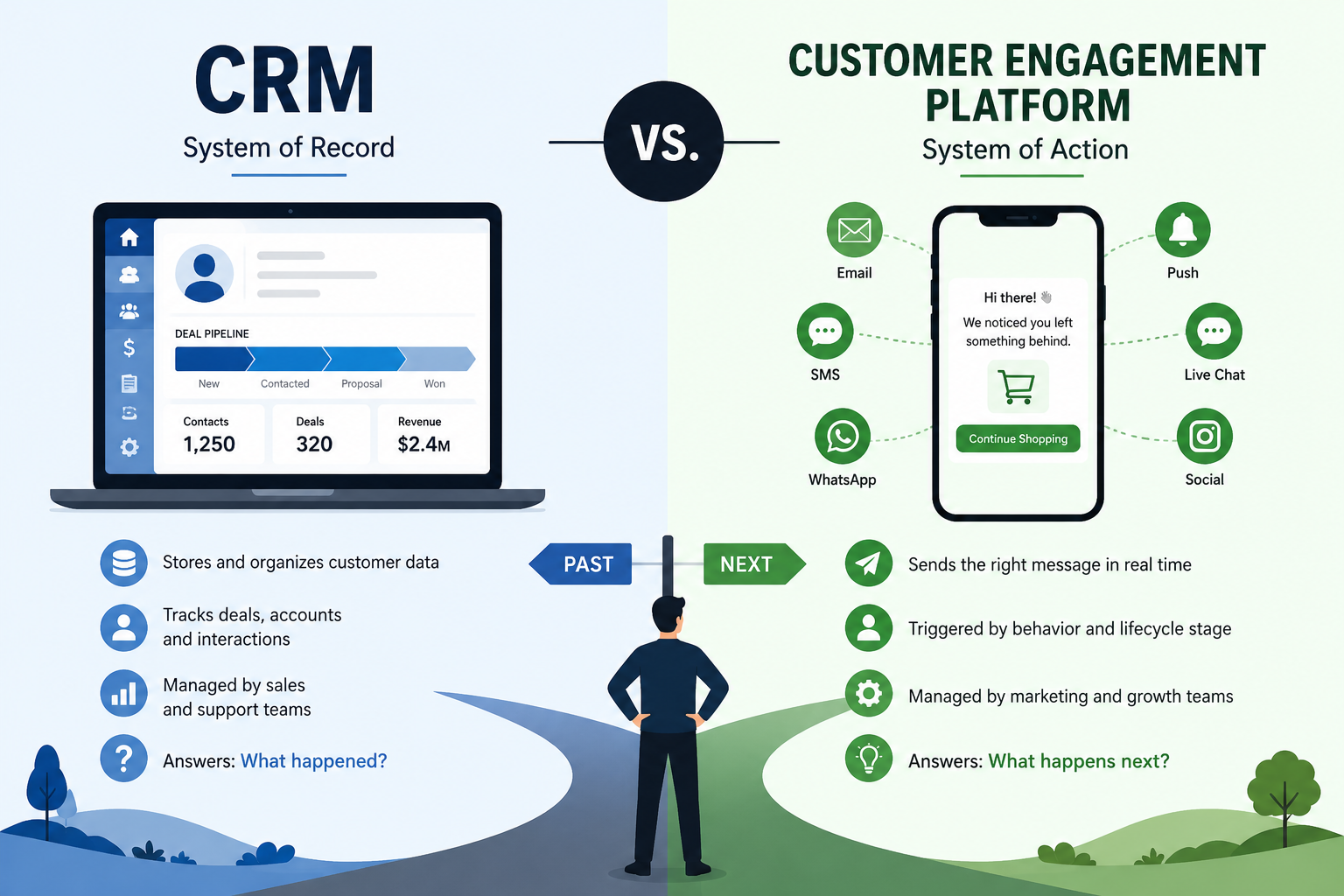
CRM stands for Customer Relationship Management. At its core, a CRM is a system of record. It stores structured data about your customers and prospects — names, contact details, deal stages, purchase history, support tickets, and notes from past interactions.
Sales teams rely on CRMs like Salesforce, HubSpot CRM, or Zoho CRM to track where a lead sits in the sales pipeline, log calls and emails, and forecast revenue. A CRM answers questions like: Who is this customer? What have we sold them before? What is the status of this deal? Who owns this account internally?
The strength of a CRM lies in organization and accountability. Instead of scattered spreadsheets and sticky notes, everyone on the sales team can see the same customer history in one place. Managers can pull reports on pipeline health, and reps know exactly which follow-up is due next.
However, a traditional CRM is largely reactive. It is a database that gets updated by humans after an interaction happens. It does not, by itself, initiate personalized conversations across multiple channels in real time.
What Is a Customer Engagement Platform?
A Customer Engagement Platform takes a different starting point. Instead of asking “what data do we have about this customer,” it asks “how do we actively communicate with this customer, right now, on the channel they prefer.”
A CEP unifies communication across email, SMS, live chat, push notifications, WhatsApp, and social messaging into a single orchestration layer. Tools like Braze, Twilio Engage, or Intercom are built around triggering the right message at the right moment based on customer behavior — someone abandons a cart, opens an app but doesn’t complete onboarding, or hasn’t logged in for 30 days.
Where a CRM is largely a system of record maintained by sales or support staff, a Customer Engagement Platform is a system of action, often automated, that reaches customers proactively based on behavioral triggers and lifecycle stage.
The Core Difference: Record-Keeping vs. Real-Time Interaction
The simplest way to separate the two is this:
A CRM tells you what happened. A Customer Engagement Platform decides what happens next, automatically, across channels.
CRMs are traditionally sales- and account-centric. They are organized around deals, contacts, and companies, and they are usually operated by sales reps and account managers who manually input or review data. A Customer Engagement Platform is customer-journey-centric. It is organized around behavior and lifecycle stage, and it is usually operated by marketing and growth teams who set up automated workflows rather than manually messaging each contact.
This distinction matters more than it might seem. A B2B company selling enterprise software with a long, relationship-driven sales cycle needs a robust CRM far more than it needs real-time behavioral messaging. A consumer mobile app with millions of users, on the other hand, cannot rely on sales reps manually engaging users — it needs an automated Customer Engagement Platform that reacts to in-app behavior instantly.
Where the Two Overlap
The lines have blurred significantly over the past few years. Modern CRMs like HubSpot and Salesforce have added marketing automation, email sequences, and even basic behavioral triggers, moving them closer to engagement platforms. Meanwhile, many Customer Engagement Platforms now offer CRM-like contact profiles, segmentation, and reporting dashboards.
This overlap is why so many businesses get confused when comparing the two categories. If you only look at feature lists, a modern CRM and a modern CEP can look almost identical on the surface. The real difference still comes down to the underlying design philosophy: is the tool primarily built to manage sales relationships and pipeline, or is it primarily built to orchestrate multichannel, behavior-triggered communication at scale? The same confusion shows up when businesses compare AI software more broadly — a good example is how people weigh their options in comparisons like ChatGPT vs Claude, where overlapping features make the underlying purpose easy to lose sight of.
Key Areas of Comparison
Data structure. CRMs organize data around contacts, accounts, deals, and tickets. CEPs organize data around events, behaviors, and customer journeys. A CRM record might say “Deal stage: Negotiation.” A CEP record might say “The user opened the app 3 times this week but did not complete the checkout.”
Primary users. Sales and support teams live in a CRM daily. Marketing, growth, and product teams typically own the Customer Engagement Platform.
Automation style. CRM automation tends to be workflow-based and internal (assign a lead, send a reminder to a rep). CEP automation is customer-facing and trigger-based (send a push notification the moment a user abandons a cart).
Channels. CRMs traditionally center on email and phone logs tied to a rep. CEPs are inherently multichannel — SMS, push, in-app messages, WhatsApp, and email working together as one orchestrated experience.
Reporting focus. CRM reporting emphasizes pipeline value, win rates, and quota attainment. CEP reporting emphasizes engagement rates, retention, churn, and lifecycle conversion.
According to Salesforce’s own research on customer relationship management trends, businesses increasingly expect a single connected view of the customer across every department, which is exactly why the CRM and CEP categories continue to converge (Salesforce, State of the Connected Customer). Gartner has also noted that composable customer data strategies are pushing companies to stitch CRM and engagement tools together rather than choose one over the other (Gartner, Customer Engagement Center research).
Which One Should Your Business Choose?
The honest answer is that most growing businesses eventually need both, but the order in which you adopt them depends on your business model.
If you run a B2B business with a sales team closing deals through calls, demos, and proposals, start with a CRM. Your priority is pipeline visibility and deal accountability. A Customer Engagement Platform without a CRM foundation will leave your sales team disorganized, even if your marketing messaging is excellent.
If you run a consumer product — an app, an e-commerce store, or a subscription service — with thousands of users interacting on their own without a sales rep, a Customer Engagement Platform becomes essential earlier. You need automated, behavior-triggered communication to drive activation, retention, and repeat purchases at a scale no sales team could handle manually. This is the same logic behind why more companies are turning to AI-driven automation for handling customer touchpoints that used to require a human on the other end.
For businesses that combine both models — say, a SaaS company with both self-serve users and enterprise sales — the CRM handles the relationship-driven deals while the CEP nurtures self-serve users through onboarding and retention. The two systems often integrate, feeding data back and forth so that a sales rep can see engagement signals from the CEP, and marketing automations can be paused once a deal enters active sales conversation in the CRM.
If you’re a smaller team trying to figure out which tools are actually worth the investment, it’s worth reading how AI tools are reshaping the way small business owners manage day-to-day operations, since the same budget-conscious thinking applies when picking between a CRM and a CEP.
Common Mistakes Businesses Make
One frequent mistake is buying a Customer Engagement Platform to “fix” a disorganized sales process. A CEP will not create accountability among sales reps or clean up your pipeline — that is a CRM’s job. Another common mistake is trying to force a CRM to handle high-volume, real-time behavioral messaging that it was never designed for, resulting in clunky automations and poor customer experience.
The businesses that get the most value treat these as complementary systems rather than competing ones. The CRM protects the sales relationship. The engagement platform protects the ongoing customer experience. Together, they give a company both structure and responsiveness. This same principle — picking the right specialized tool instead of forcing one system to do everything — comes up often in guides on choosing the right local SEO tools and software, where businesses make the same mistake of over-relying on a single platform.
Final Thought
The CRM vs. Customer Engagement Platform debate isn’t really about which tool is “better.” It’s about matching the right system to the right job inside your customer lifecycle. A CRM keeps your sales and account relationships organized and accountable. A Customer Engagement Platform keeps your broader customer base actively engaged across channels, often without any human touch at all.
Rather than viewing this as an either-or decision, the smartest approach is to map out where your customers actually interact with your business — sales-led conversations versus self-serve, high-volume behavior — and choose (or combine) tools that match that reality. Businesses that align their tech stack with their actual customer journey, instead of chasing whichever platform is trending, are the ones that see the strongest long-term retention and revenue growth.
