


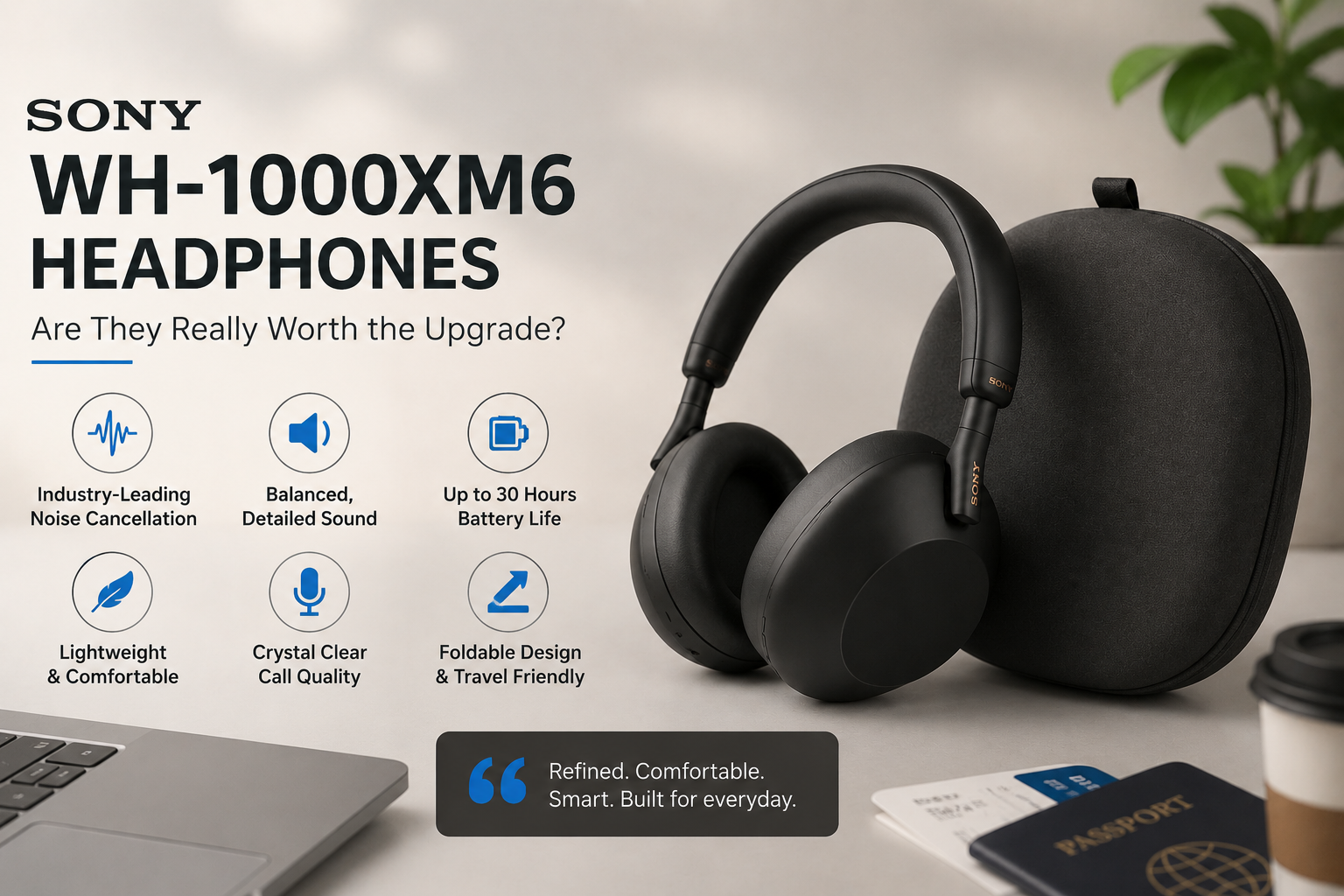
Sony has spent almost a decade turning the WH-1000X series into the gold standard for wireless noise-cancelling headphones, and the Sony WH-1000XM6 headphones arrive with a lot of expectations to live up to. After three years since the XM5, Sony didn’t just tweak the formula — it rethought several parts of the design, the processor, and even the case. But does that translate into a headphone worth buying today, especially with strong competition from Bose and Apple sitting at a similar price point?
This article breaks down what actually matters: comfort, sound, noise cancellation, battery, and everyday usability, so you can decide if the XM6 deserves a spot on your desk or in your travel bag.
A Design That Finally Folds Again
One of the most talked-about changes with this generation is the return of a foldable hinge design. The WH-1000XM5 dropped this feature for a sleeker look, which frustrated a lot of frequent travelers who relied on a compact folded shape to save space in a bag. Sony brought it back for the XM6, using stainless steel hinges built with a metal injection process, letting the headphones fold into a smaller, rounder shape.
The headband is also wider and flatter than before, which spreads out pressure across the head more evenly. Combined with a lighter overall weight of around 254 grams, the XM6 stays comfortable during long flights or full workdays without the usual ear fatigue that heavier over-ear headphones can cause.
The case has been redesigned too. It now opens like a book with a magnetic clasp instead of a zipper, making it quicker to grab your headphones on the go. It’s not dramatically smaller than the XM5’s case, but the improved opening mechanism makes daily use noticeably more convenient.
Noise Cancellation: Still the Benchmark
Sony didn’t just carry over the old noise-cancelling chip. The WH-1000XM6 uses a new QN3 HD processor paired with 12 microphones (compared to 8 on the previous model), and the improvement is noticeable in real-world conditions — not just lab tests. Low, droning sounds like airplane engines and HVAC hums get cancelled almost completely, while sudden or irregular noises, such as chatter in an office or a dog barking nearby, are handled better than before thanks to a new “noise shaper” feature that anticipates rapid changes in sound and adjusts on the fly.
Bose’s QuietComfort Ultra remains a strong competitor here, and depending on your ear shape and preference, some listeners still find Bose’s low-frequency cancellation slightly more aggressive. But across a broader range of frequencies, the XM6 edges ahead, especially for cancelling human voices and inconsistent background noise — a common complaint with older ANC headphones.
Sound Quality: A More Balanced, Detailed Signature
Sony equipped the XM6 with a new 30mm driver and tuned it for a more neutral, balanced sound out of the box compared to the slightly bass-heavy character of earlier XM models. That doesn’t mean the low end is weak — it’s still punchy and full — but mids and highs come through with more clarity and separation, which benefits vocal-heavy tracks, podcasts, and acoustic instruments just as much as bass-driven genres.
For anyone streaming lossy audio over standard Bluetooth, the difference might be subtle. But if you’re using Sony’s LDAC codec with a compatible Android device or a high-resolution audio source, the improvement in detail is much easier to hear. The soundstage feels wider too, letting instruments occupy distinct space rather than blending into a single wall of sound.
One consistent criticism across multiple reviews is the lack of audio playback over USB-C. Competing headphones and even Sony’s own past models have supported wired digital audio through the charging port, but the XM6 still requires the 3.5mm cable for a fully wired listening experience — a strange omission for a flagship product in 2026.
Battery Life and Charging
The Sony WH-1000XM6 headphones hold up well on long trips too. Battery life sits at up to 30 hours with noise cancellation turned on, and around 40 hours with it switched off. That’s respectable, though not class-leading; some competitors now push past the 40-hour mark even with ANC active. Fast charging remains a strong point, though — a short 3-minute charge is enough for several hours of playback, which is genuinely useful if you’re rushing out the door and forgot to charge overnight.
Smart Features and the Companion App
The Sony Headphones Connect app unlocks most of the advanced features: adaptive sound control, customizable EQ, speak-to-chat, and a spatial audio mode that can upmix regular stereo tracks for a more immersive, movie-theater-like feel during video playback. Head tracking is also supported for spatial audio, adjusting the soundstage as you turn your head.
These aren’t just gimmicks — frequent travelers and remote workers who watch a lot of video content will genuinely benefit from the spatial audio implementation. That said, the app itself has been criticized as cluttered, with menus that feel like they were added over time rather than designed cohesively. Voice commands through the headphones can also be inconsistent, occasionally failing to recognize simple commands unless you speak clearly and slowly.
Call quality has been upgraded with a six-microphone array specifically for voice pickup, and it shows in noisy environments. If you spend a lot of time on video calls from cafes or shared workspaces, this alone might justify the upgrade from an older model.
How Does It Compare to the Competition?
At a price just under $500, the XM6 sits above Bose’s QuietComfort Ultra, which regularly sells closer to $349 on sale, and slightly below Apple’s AirPods Max, which now feel dated despite recent USB-C updates. Here’s how the decision typically breaks down:
Choose the Sony WH-1000XM6 if you want the most balanced overall package — strong ANC, excellent call quality, foldable design, and detailed sound with LDAC support. Choose the Bose QuietComfort Ultra if extremely aggressive low-frequency noise cancellation is your top priority and you don’t mind a slightly bulkier case. Choose the AirPods Max only if you’re deep into the Apple ecosystem and value seamless device switching over raw audio performance or value for money.
If you’re into tech beyond just headphones, check out our roundup of best phone accessories for mobile gaming for other gear worth adding to your setup.
For an official spec sheet, Sony’s product page is a good starting point, and independent lab measurements from RTINGS are useful for comparing ANC performance across brands side by side.
Final Thought
The Sony WH-1000XM6 headphones aren’t a revolutionary leap over their predecessor, but they don’t need to be. They take what already worked — strong ANC, detailed sound, and all-day comfort — and refine it with a smarter processor, better call quality, and a more practical foldable design. The missing USB-C audio support and a cluttered app hold it back from being a flawless product, but for anyone serious about wireless noise-cancelling headphones in 2026, the XM6 remains one of the most well-rounded choices on the market. If your budget allows it, this is a headphone that’s genuinely built to be used every single day, not just admired in a review.
