


For the past few years, semaglutide has dominated every conversation about weight management and type 2 diabetes. It reshaped how doctors, patients, and even casual observers think about appetite, blood sugar, and body composition. But semaglutide was never meant to be the finish line — it was the opening chapter. Behind it, an entire pipeline of GLP-1 and multi-receptor peptides has been quietly moving through clinical trials, and several have now reached patients. Understanding what lies beyond semaglutide is no longer a niche interest for researchers; it’s becoming essential knowledge for anyone following metabolic health.
This article takes a closer look at GLP-1 peptides beyond semaglutide — the science driving this next wave, the specific peptides worth knowing about, how they differ from semaglutide, and what questions remain unanswered.
How GLP-1 Therapy Actually Works
Glucagon-like peptide-1 is a hormone your gut releases naturally after you eat. It slows gastric emptying, signals fullness to the brain, and helps regulate insulin release in response to food. Semaglutide was designed to mimic this hormone in a longer-lasting, more potent form, which is why it produces meaningful appetite reduction and blood sugar control.
The newer generation of peptides didn’t abandon this mechanism — they built on it. Researchers realized that combining GLP-1 activity with other gut hormone pathways, particularly GIP (glucose-dependent insulinotropic polypeptide) and glucagon, could produce a stronger metabolic effect than targeting GLP-1 alone. That single insight is the foundation of nearly every discussion around GLP-1 peptides beyond semaglutide today, and it’s what separates semaglutide from almost everything that has come after it.
Tirzepatide: The First Major Step Beyond Semaglutide
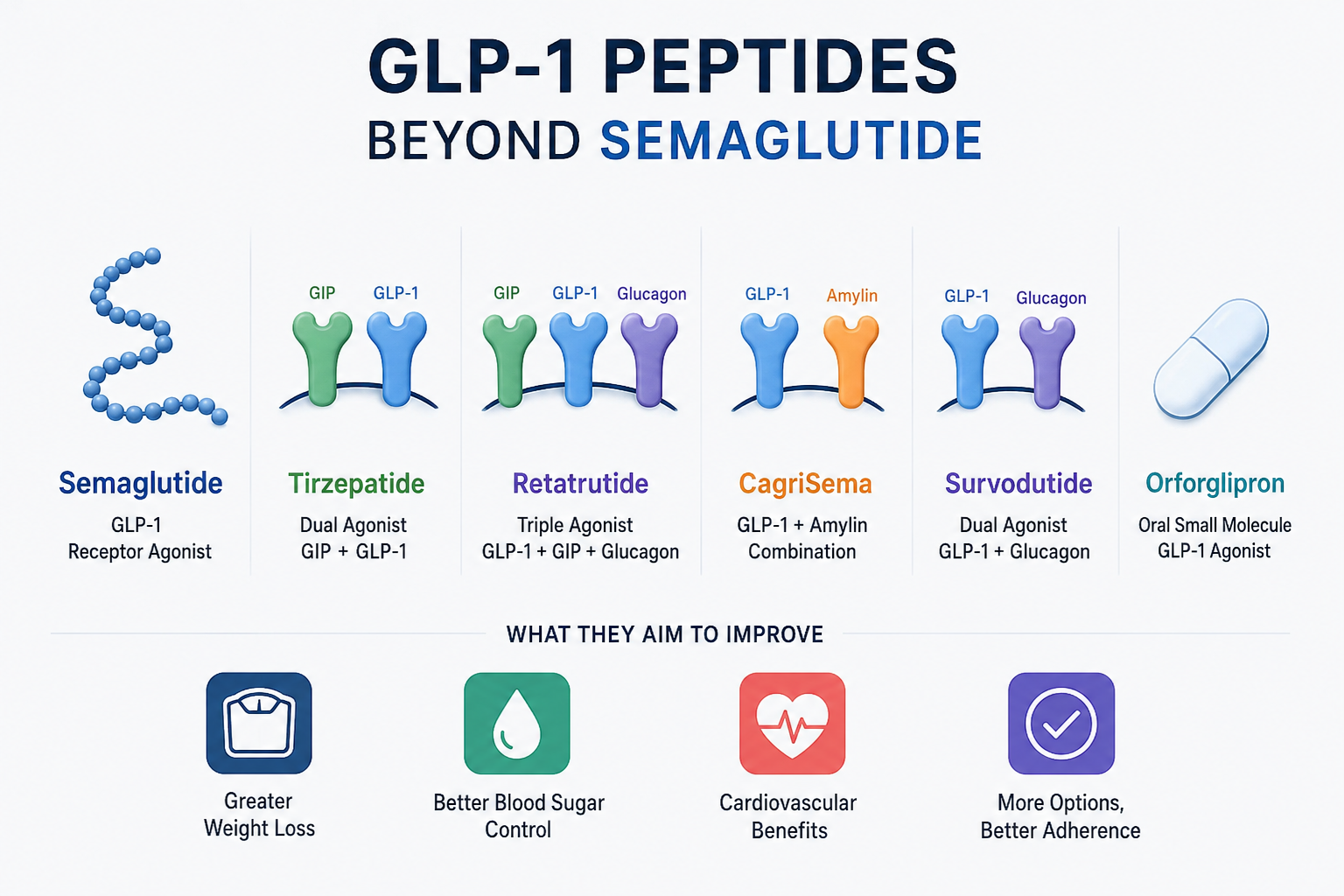
Tirzepatide was the first widely available peptide to move past single-receptor GLP-1 activity. It activates both the GIP and GLP-1 receptors, and that dual action has translated into real clinical differences. In head-to-head data, tirzepatide has generally produced greater average weight loss than semaglutide, with obesity trials showing reductions around 21 percent compared to roughly 15 percent for semaglutide. It has also shown strong results for glycemic control in people with type 2 diabetes, setting what many clinicians now consider the practical benchmark for injectable metabolic therapy.
Tirzepatide’s success proved the underlying thesis: stacking receptor activity, rather than simply increasing the dose of a single-target drug, could unlock a new tier of results. That thesis has since driven nearly every peptide currently in development, and it’s the reason tirzepatide is usually the first name that comes up whenever people talk about GLP-1 peptides beyond semaglutide.
Retatrutide: The Triple Agonist Pushing the Ceiling Higher
If tirzepatide was the proof of concept, retatrutide is the current frontier. It’s a triple agonist, activating GLP-1, GIP, and glucagon receptors simultaneously. In Phase 3 obesity trials, retatrutide has produced the highest average weight loss reported so far for this drug class, exceeding 28 percent in some study populations — a substantial jump over both semaglutide and tirzepatide.
The addition of glucagon receptor activity appears to be the key differentiator. Glucagon signaling is associated with increased energy expenditure, which may explain why retatrutide’s results go beyond what appetite suppression alone could achieve. Retatrutide is still investigational, with a regulatory filing expected in late 2026 and approval unlikely before 2027 or 2028, so it isn’t yet an option outside of clinical trials. Still, it represents where the science is heading: not just eating less, but changing how the body burns energy — and it’s arguably the clearest example of how far GLP-1 peptides beyond semaglutide have already come.
CagriSema: Combining Two Different Hormone Systems
Rather than building a single molecule that hits multiple receptors, CagriSema takes a combination approach — pairing semaglutide with cagrilintide, an amylin receptor agonist. Amylin is a hormone that works alongside GLP-1 to regulate satiety through a separate biological pathway. Early trial data has shown mean weight loss in the range of 15 to 17 percent over 20 to 32 weeks, suggesting that combining two distinct appetite-regulating hormones can outperform either one individually.
This approach matters because it opens a second strategy for improving outcomes: instead of engineering one peptide to do more, pair two peptides that each do something different.
Survodutide and the Glucagon-Focused Approach
Survodutide activates both GLP-1 and glucagon receptors, without the GIP component found in tirzepatide or retatrutide. In trial data, it has delivered close to 15 percent mean weight loss over roughly 49 weeks. Its results reinforce the idea that glucagon receptor activity plays a meaningful role in fat metabolism, independent of the GIP pathway — useful information for researchers trying to isolate which hormone combinations matter most.
Oral GLP-1 Options: Orforglipron and Beyond
Injectable peptides have dominated headlines, but oral formulations are catching up quickly. An oral peptide version of semaglutide was approved for weight management in late 2025, and in early 2026 regulators approved orforglipron, the first oral small-molecule GLP-1 receptor agonist. Unlike peptide-based drugs, orforglipron isn’t a peptide at all — it’s a small molecule designed to activate the same receptor, which makes it easier to manufacture and potentially more convenient for patients who prefer a pill over an injection.
This shift toward oral administration is arguably as important as the efficacy gains from multi-receptor peptides, since it addresses one of the biggest real-world barriers to consistent treatment: adherence.
Newer Mechanisms Worth Watching
A few compounds are testing approaches that move even further from the semaglutide model. Amgen’s maridebart cafraglutide, for example, departs from the traditional incretin-mimetic structure entirely, aiming for less frequent dosing while maintaining strong metabolic effects. These candidates are earlier in development, but they signal that the field isn’t converging on one winning formula — researchers are still exploring several fundamentally different paths toward the same goal.
Safety Considerations Across the Class
More potent doesn’t automatically mean risk-free, and this is where ongoing research matters most. Gastrointestinal side effects — nausea, vomiting, and in rare cases pancreatitis — remain common across the entire GLP-1 class, semaglutide included. Real-world pharmacovigilance data has also started examining differences between agents; for instance, researchers have looked at whether the more rapid fat breakdown triggered by higher-potency drugs like tirzepatide could transiently affect hormone levels in ways single-agonist drugs don’t. This kind of comparative safety research is still developing, and it’s a reminder that newer isn’t automatically safer, just potentially more effective on the metrics being measured.
Anyone considering GLP-1 peptides beyond semaglutide should treat these as prescription decisions made with a qualified physician, not lifestyle choices to self-manage. Individual health history, kidney function, thyroid history, and other medications all factor into whether a given peptide is appropriate.
Why This Matters Beyond Weight Loss
It’s worth remembering that this entire drug class started in diabetes care, and cardiovascular benefit remains one of its most important threads. Earlier GLP-1 agents like liraglutide and dulaglutide demonstrated real reductions in cardiovascular risk in landmark trials, and that dual benefit — metabolic and cardiovascular — is part of what makes the newer multi-agonist peptides so closely watched. The goal isn’t only a lower number on the scale; it’s a measurable reduction in the downstream health risks tied to obesity and insulin resistance.
Final Thoughts
Semaglutide opened the door, but the growing list of GLP-1 peptides beyond semaglutide makes it clear the field has moved well past it. Tirzepatide proved that hitting two receptors works better than hitting one. Retatrutide is pushing that logic to three. CagriSema and survodutide are testing different combinations of the same underlying hormones, and oral options like orforglipron are solving the adherence problem that injections are never fully addressed. None of this makes semaglutide obsolete — for many patients, it remains an effective, well-studied option — but it’s no longer the only serious answer to metabolic disease. The next few years will likely bring approval decisions on several of these compounds, and the real story of GLP-1 therapy is only getting started.
If you’re exploring these options, the right first step is always a conversation with your doctor, not a comparison chart. (Read our related guide on how semaglutide works for weight loss for background on where this class began.)
Sources: Drug Discovery News – GLP-1 Agonist Clinical Pipeline 2026 · PMC – GLP-1 Receptor Agonists Beyond Diabetes Management · Medscape – Anti-Obesity Medications Set to Explode Entering 2026
This article is for informational purposes only and is not medical advice. Consult a licensed healthcare provider before starting or changing any medication.
