


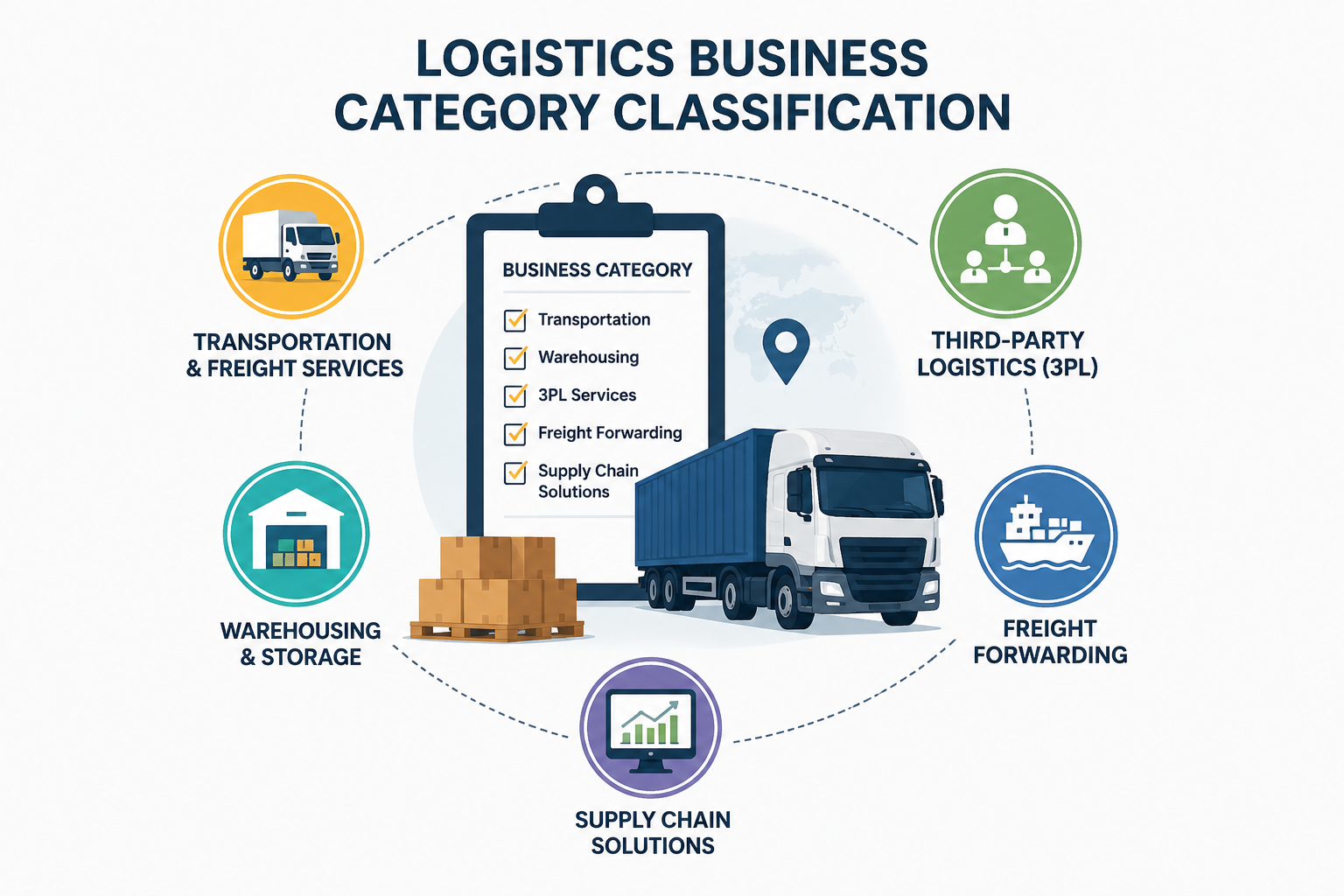
Every logistics company, whether it moves parcels across a city or coordinates freight across continents, eventually runs into the same administrative question: which category does this business actually belong to? Logistics business category classification is the process of sorting a company into a defined industry group based on the services it performs, the assets it uses, and the customers it serves. This classification is not just paperwork. It shapes how a business registers with government authorities, how it applies for licenses and insurance, how it appears in industry directories, and even how easily potential clients find it when searching for a logistics partner.
For anyone starting, registering, or scaling a logistics company, understanding this classification system is one of the most practical steps toward building a business that runs smoothly on paper as well as on the road.
What Logistics Business Category Classification Actually Means
At its core, classification is a way of organizing a broad, complex industry into recognizable segments. Logistics itself is not a single activity. It includes transportation, storage, packaging, inventory management, order fulfillment, customs clearance, and technology-driven coordination between all of these. Because the scope is so wide, regulators, tax authorities, business directories, and even search engines rely on standardized categories to describe what a company actually does.
In most countries, this classification is tied to formal coding systems such as the North American Industry Classification System (NAICS) in the United States and Canada, or the Standard Industrial Classification (SIC) system used more broadly for statistical and regulatory purposes. Businesses based in the US can look up their exact code directly through the U.S. Census Bureau’s NAICS lookup tool, which is updated periodically to reflect new and emerging industry segments. These systems assign numeric codes to specific business activities, and logistics companies are expected to select the code or codes that best represent their primary operations. A company that only manages warehouses will fall under a different code than one that primarily arranges international freight, even though both are part of the logistics ecosystem.
Why Correct Classification Matters More Than It Seems
Many business owners treat classification as a formality to get through during registration, but the category a logistics business selects has real consequences down the line. Tax rates, eligibility for government contracts, industry-specific compliance requirements, and insurance premiums can all vary depending on the classification code. A freight brokerage, for instance, is regulated differently from a company that owns and operates its own trucking fleet, even if both describe themselves loosely as “logistics providers.”
Classification also affects visibility. Business directories, trade associations, and even search platforms group companies by category so that potential clients can find the right kind of provider for their needs. A manufacturer looking for cold chain transportation will search under that specific category, not under a generic “logistics” label. A business that has classified itself accurately is far more likely to appear in front of the right audience at the right time.
The Major Categories Within the Logistics Industry
The logistics industry is generally divided into several recognizable segments, each with its own operational focus and regulatory considerations.
Transportation and freight services form the backbone of the industry. This category covers companies that physically move goods by road, rail, air, or sea. Within transportation, there are further distinctions between full truckload carriers, less-than-truckload operators, and specialized freight services that handle oversized or hazardous cargo. Each of these subcategories carries its own licensing and safety requirements, which is why accurate classification at this level is especially important.
Warehousing and storage represents a separate but closely connected category. Businesses in this segment are primarily responsible for storing goods on behalf of clients, managing inventory levels, and often handling order picking and packing before goods move to the next stage of the supply chain. Warehousing businesses are classified differently depending on whether they offer general storage, temperature-controlled storage, or specialized storage for goods like pharmaceuticals or hazardous materials. (For a deeper look at running this side of the business efficiently, see our [warehousing management best practices] guide — replace with your own internal URL.)
Third-party logistics providers, commonly known as 3PLs, occupy a broader category because they typically combine transportation, warehousing, and fulfillment services under one contract. A 3PL does not usually own all the physical infrastructure it uses; instead, it coordinates a network of carriers, warehouses, and technology systems on behalf of its clients. This makes 3PL classification somewhat more complex, since the company may need to register under multiple codes depending on which services it directly performs versus which it subcontracts.
Freight forwarding is its own distinct category, focused on arranging the movement of goods across borders rather than physically transporting them. Freight forwarders coordinate with carriers, customs brokers, and insurance providers, acting as an intermediary rather than an asset-owning transporter. This distinction matters enormously for regulatory purposes, since freight forwarders are often held to different licensing and bonding requirements than carriers. If you’re setting up this side of a logistics operation, our [guide to freight forwarding basics] covers the process in more detail ( Tech Postify ).
Last-mile delivery services have grown into their own recognized category in recent years, driven largely by the expansion of e-commerce. These businesses specialize in the final leg of delivery, from a regional hub to the customer’s doorstep, and are increasingly classified separately from long-haul freight due to the different vehicle types, delivery windows, and technology platforms involved.
Cold chain and specialized logistics cover businesses that handle temperature-sensitive goods such as food, pharmaceuticals, and certain chemicals. Because these goods require continuous monitoring and specific handling protocols, cold chain logistics businesses are usually classified separately from general freight or warehousing operations, often with additional compliance obligations attached.
How Businesses Determine the Right Classification
Choosing the correct category is not always straightforward, especially for companies that offer a mix of services. A common approach is to identify the primary revenue-generating activity of the business and classify accordingly, even if secondary services exist. For example, a company that generates most of its revenue from trucking but also offers minor warehousing services would typically register primarily under a transportation code, with the warehousing activity noted as a secondary classification where the registration system allows for it.
It also helps to consider how the business is marketed and how customers actually search for it. A logistics company that wants to attract e-commerce clients specifically for last-mile delivery will benefit from classifying and presenting itself under that category clearly, rather than using a generic industry label that could apply to dozens of different service types.
Government business registration portals, chambers of commerce, and industry associations often provide lookup tools to help business owners find the most accurate code for their operations. Consulting these resources directly, rather than guessing, reduces the risk of misclassification and the complications that can follow from it.
Common Mistakes in Logistics Classification
One of the most frequent errors is choosing an overly broad category simply because it seems safe or general. While a broad classification might feel like it covers all bases, it often results in a business appearing less relevant to the specific customers it is trying to reach, and it can also mean missing out on tax incentives or grants that are tied to more specific industry codes.
Another common mistake is failing to update classification as the business evolves. A company that started as a small warehousing operation but has since expanded into full third-party logistics services needs to revisit its classification periodically. Sticking with an outdated category can create mismatches between how a business is registered and how it actually operates, which can complicate audits, insurance claims, or contract eligibility.
The Long-Term Business Value of Accurate Classification
Beyond compliance, accurate classification plays a quiet but significant role in business growth. It affects how easily a company can be discovered by potential partners, how competitive its insurance and lending terms are, and how smoothly it can participate in industry benchmarking or trade data. Investors and larger enterprise clients also tend to review a logistics company’s registered classification as part of their due diligence process, so a clear and accurate category can support credibility during partnership or funding discussions.
Final Thought
Logistics business category classification might not be the most exciting part of running a logistics company, but it quietly influences everything from compliance and taxation to how easily the right customers can find the business. Taking the time to classify accurately, and revisiting that classification as the business grows, is a small investment that pays off in clarity, credibility, and long-term operational stability. For businesses that are unsure where they fit, reviewing official classification resources or speaking with a business registration advisor is a worthwhile step before finalizing any category.
