


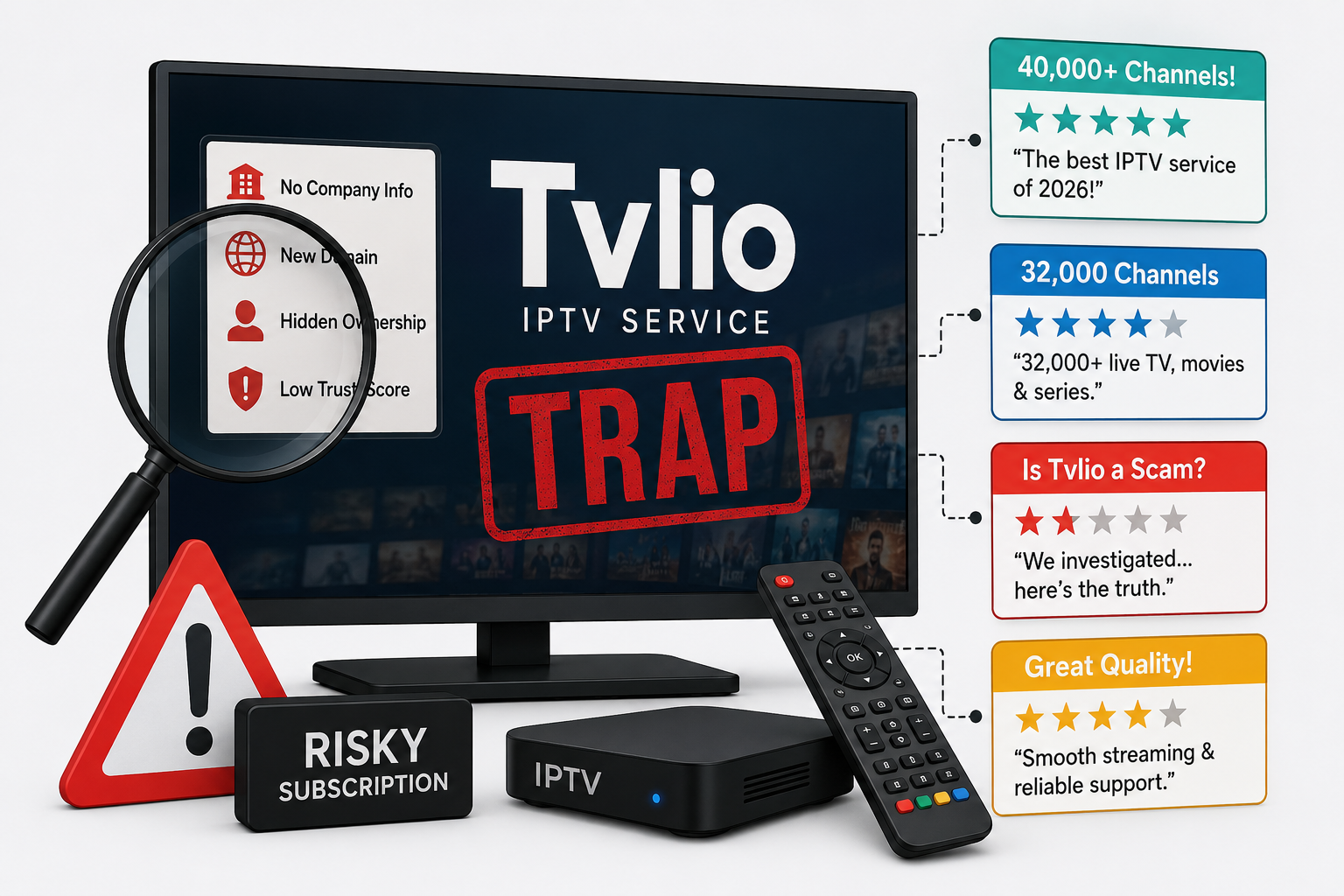
If you have spent any time searching for “Tvlio,” you have probably noticed something strange: the reviews do not agree with each other. One page tells you it streams 40,000 channels. Another says the real number is closer to 32,000, split across live TV, movies, and series. A third calls it the “best IPTV provider of 2026,” while a fourth spends most of its word count asking whether the service is a scam. That kind of inconsistency is not an accident — it is a pattern that shows up across almost the entire IPTV resale industry, and understanding why it happens will save you far more money and hassle than any single review ever could.
This article is not going to tell you to sign up for Tvlio or any similarly branded service. Instead, it is going to explain what services like this actually are, why the reviews contradict each other, what real risks are involved, and how to evaluate any IPTV provider — Tvlio included — before you hand over your card details.
What “IPTV” Actually Means
IPTV stands for Internet Protocol Television. Instead of receiving channels through a satellite dish or a cable box, the signal travels over your internet connection, the same way a video call or a streaming movie does. Legitimate IPTV is not inherently suspicious — services like YouTube TV and Hulu + Live TV, along with most modern cable providers’ own apps, are all technically IPTV. The technology itself is neutral.
What makes a specific IPTV provider legitimate or not comes down to one question: does the company actually hold the rights to broadcast the channels it is selling you? A licensed IPTV company pays broadcasters, sports leagues, and studios for the right to redistribute their content. An unlicensed reseller simply captures those same signals and repackages them into a subscription, undercutting the real price because it never paid for the content in the first place.
Why Tvlio’s Own Numbers Keep Changing
One detail that stands out across coverage of Tvlio is that the service appears to operate under more than one brand name, with “one4k” showing up alongside “Tvlio” on some of its own pages, and the advertised channel and movie counts shifting between different versions of the site. This is common among unlicensed IPTV resellers for a simple reason: their access to content is not stable. A channel or sports feed that works today might be pulled tomorrow if the original broadcaster identifies and blocks the unauthorized stream, so the “catalog” is really a moving target rather than a fixed, contractually guaranteed lineup — something a licensed broadcaster could never get away with.
Domain-trust scans of Tvlio-linked websites have also flagged mixed signals rather than a clean bill of health: a recently registered domain, no publicly listed company ownership, and a trust score that sits in a cautionary middle ground rather than a confidently safe one. None of that proves fraud on its own, but it is exactly the profile that consumer-protection guides warn people to check for before paying for any online subscription.
The Real Risks of Unlicensed IPTV Services
People often assume the only risk with a service like this is losing the subscription price if it turns out to be unreliable. In practice, there are several layers of risk worth understanding.
The first is financial. Many of these services accept payment through channels that are difficult to reverse, and refund policies — even when advertised — depend entirely on a company’s willingness to honor them, since there is often no registered business entity to hold accountable if something goes wrong.
The second is legal exposure. In many countries, knowingly subscribing to a service that redistributes copyrighted broadcasts without a license can carry consequences for the subscriber, not just the operator. The rules vary significantly by country, so what is a minor gray area in one jurisdiction can be a real liability in another.
The third is technical. Because these services often route content through unofficial servers, users have reported exposure to malware bundled with third-party IPTV apps, unexpected data usage, and account credentials being shared or resold without their knowledge. A 58-out-of-100 trust score, the kind seen on domain-scan tools for Tvlio-linked sites, reflects exactly this kind of uncertainty — not a confirmed danger, but not a clean record either.
How to Actually Evaluate an IPTV Provider
Rather than relying on a single review — which, in this space, is very often written to sell the subscription rather than assess it honestly — there are a handful of concrete checks that tell you more than any star rating.
Start with company transparency. A legitimate streaming business will have a registered legal entity, a physical or corporate address, and a support system that does not rely solely on WhatsApp or Telegram. If you cannot find out who legally operates the service, that alone is a strong signal to pause.
Next, look at pricing against content volume. If a provider is offering tens of thousands of live channels and six-figure movie libraries for a fraction of what a single licensed sports package costs, ask yourself how that math works. Content licensing is expensive; a price that seems too good to be true relative to the catalog size usually means the content was never properly licensed at all.
Check domain history. Tools that scan domain age, hosting location, and registrar information are free and take under a minute to use. A streaming brand that is only a few months old, with hidden ownership, deserves more scrutiny than one with a multi-year public track record.
Finally, read reviews with a critical eye toward who is writing them. Many “Is it legit or a scam?” articles in the IPTV space are themselves marketing content designed to rank on search engines and drive sign-ups, which is why so many of them arrive at a reassuring conclusion despite listing several genuine red flags along the way. If an article spends most of its length building suspense about whether a service is a scam and then answers “absolutely not” without much independent evidence, treat that conclusion with the same skepticism you would apply to an advertisement — because in most cases, that is exactly what it is.
Legal Alternatives Worth Considering
If what draws people to services like Tvlio is the promise of hundreds of channels and a huge on-demand library in one place, it is worth knowing that legal aggregator options have grown significantly. Services such as YouTube TV, Hulu + Live TV, and regional telecom-backed IPTV packages now offer large channel bundles, cloud DVR, and multi-device access with full licensing behind them. Sports fans specifically can often find single-league or single-event official streaming passes that cost less than a full unlicensed IPTV subscription and come without any legal ambiguity. The trade-off is usually a smaller total channel count, but the reliability, legal safety, and picture quality tend to be more consistent because the provider actually controls its own infrastructure and content rights.
Final Thought
The real story behind Tvlio is not whether it “works” in a narrow technical sense — plenty of unlicensed streaming services do function, at least for a while. The real story is that the entire category of service it belongs to is built on a foundation that can shift without warning, is difficult to hold accountable when something goes wrong, and carries legal and financial risk that rarely gets mentioned in the glowing reviews written to sell it. Before subscribing to Tvlio, one4k, or any similarly positioned IPTV brand, spend the ten minutes it takes to check who actually owns the site, how old the domain is, and what happens if your payment goes wrong. That small bit of due diligence will tell you more than any five-star review ever will.
Frequently Asked Questions
Is Tvlio the same as one4k? Coverage of the service indicates it has operated under both names, with the more recent version of its website presenting itself as one4k while still being widely referenced online as Tvlio. Advertised channel and content numbers differ between the two branding versions.
Why do different reviews list different channel counts for Tvlio? Because the underlying content access for unlicensed IPTV resellers is unstable — channels and feeds can be added or removed depending on what is currently accessible — the “catalog size” advertised on the provider’s own site has changed over time, and older third-party reviews often quote outdated figures.
Is it illegal to use an IPTV service like this? It depends heavily on your country’s laws. In many places, distributing unlicensed content is clearly illegal for the operator, while the legal position of an individual subscriber is less consistently enforced but still carries risk in a number of jurisdictions. It is worth checking your local regulations rather than assuming a gray area applies to you.
How can I check if an IPTV website is trustworthy before paying? Look up the domain’s registration age and hosting details using a free domain-lookup tool, search for the legal company name behind the service, and be cautious of any provider that only accepts irreversible payment methods or communicates exclusively through messaging apps rather than a registered support system.
Are there safer alternatives with a similarly large channel selection? Licensed live-TV streaming bundles and official sports-league apps have expanded considerably and can cover much of the same ground — news, entertainment, and major sporting events — with clear licensing, predictable pricing, and accountable customer support.
